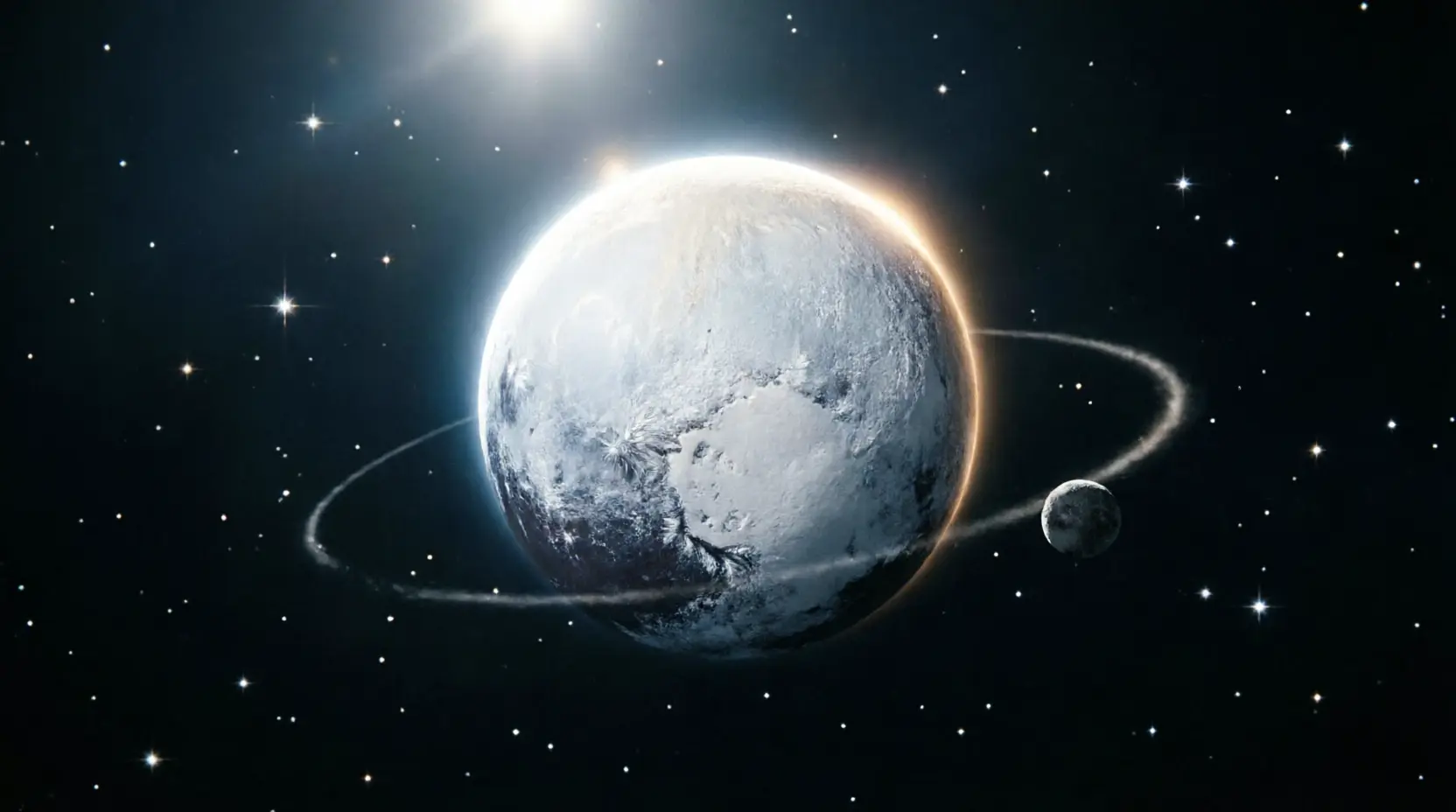
Why Are Planets in a Flat Disk? The Pizza Dough Analogy Explained
Discover why planets orbit in a flat disk instead of a sphere. A simple, jargon-free explanation using the pizza dough analogy for beginners.
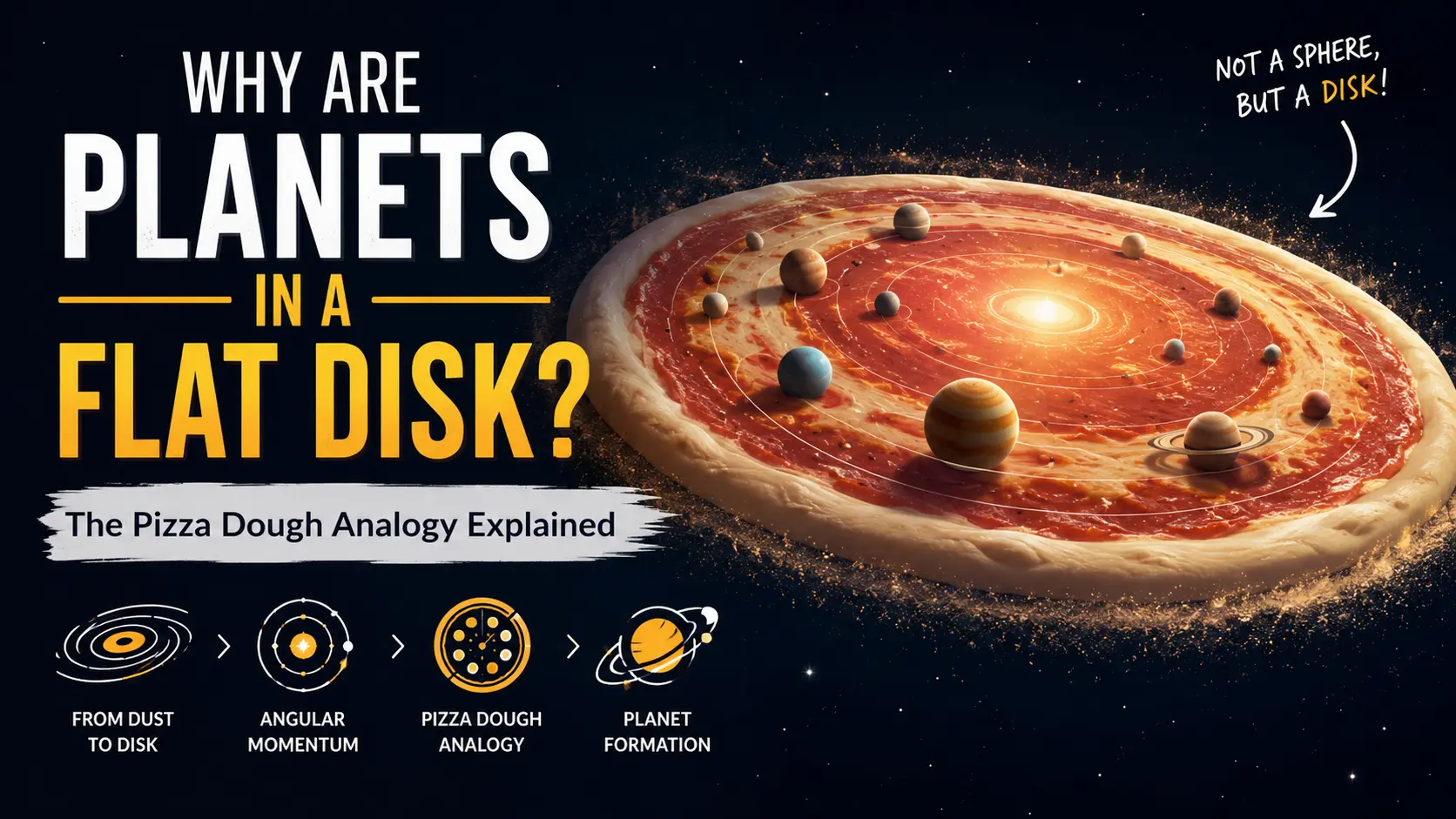
Look at any diagram of our solar system and you will notice something strange. All eight planets orbit the Sun on nearly the same flat plane, like marbles rolling on a dinner plate. But space is three-dimensional. There is no up or down in the vacuum. So why did nature choose a flat disk instead of a spherical swarm?
The answer lies in a fundamental rule of physics called conservation of angular momentum. Do not worry about the name. The concept is as simple as spinning pizza dough.
From Chaos to Order: The Spinning Cloud
Our solar system began as a giant, shapeless cloud of gas and dust roughly 4.6 billion years ago. This cloud was mostly leftover material from dead stars that exploded long before our Sun existed. You can read more about that stellar recycling process in our guide on how stars die.
Something disturbed this cloud. Perhaps a nearby supernova sent a shockwave through it. Gravity took over and the cloud started collapsing inward. As it shrank, it began to spin faster, just like an ice skater pulling in their arms during a pirouette.
This is where the magic happens. The spinning cloud could not collapse equally in all directions. Material falling toward the center along the spin axis had nothing to stop it. But material trying to fall in from the equator was flung outward by centrifugal force. Over millions of years, the cloud flattened into a rotating pancake. Astronomers call this a protoplanetary disk.
The Pizza Dough Test
Imagine holding a ball of pizza dough in your hands. If you toss it straight up without spinning, it stays roughly round. But if you spin it while tossing, the dough stretches outward and flattens into a perfect circle. Your hands provide the gravity pulling inward. The spin provides the outward push. The result is always a flat disk, never a sphere.
The exact same physics applies to star-forming clouds across the universe. We have even photographed real baby planets still forming inside these flat disks around young stars. The PDS-70 system is one famous example where astronomers captured a baby planet still being born inside a flat disk with its own potential moons.
Why Not a Sphere?
You might wonder what would happen if the original cloud had zero spin. In theory, it could collapse spherically. But in reality, every gas cloud in the galaxy has some tiny amount of rotation inherited from galactic tides and turbulent motions. Even a minuscule initial spin gets amplified enormously as the cloud shrinks. Conservation of angular momentum guarantees that amplification.
Think of it this way. A figure skater starting with barely noticeable rotation ends up spinning furiously once they pull their arms in. The cosmic version of pulling arms in is gravitational collapse spanning light-years. The end result is always, inevitably, a flat disk.
When the Rule Breaks
Our solar system follows the flat-disk rule beautifully. But not every planetary system is so orderly. Some exoplanets like GJ-3378b challenge this neat picture with tilted orbits or extreme eccentricities. These exceptions exist because planets do not always behave politely after formation. Gravitational tugs between neighboring worlds can tilt, stretch, or even eject orbits entirely. We will explore those cosmic rule-breakers in Part 2 of this series.
What Comes Next for Disk Research?
Astronomers are entering a golden age of protoplanetary disk observation. Current telescopes have given us stunning snapshots, but next-generation telescopes will soon capture these disks in unprecedented detail, revealing how individual planets carve gaps and spiral arms within the flat pancake of birth.
For now, remember this simple truth. Every time you see a diagram of our solar system laid out flat on a page, you are looking at the fossil record of a spinning cloud that obeyed the same physics as your favorite pizzeria.
To learn more about how scientists study planet-forming regions directly, check out NASA's Exoplanet Exploration portal for the latest imagery and mission updates. The European Southern Observatory also maintains an excellent protoplanetary disc image archive with annotated photos suitable for classroom use. Finally, for a deeper dive into the math behind angular momentum without heavy equations, Khan Academy offers a free angular momentum tutorial that pairs perfectly with the pizza dough analogy.