Stellar Physics
How Stars Die: White Dwarfs, Neutron Stars, and Supernovae
Discover the cosmic evolutionary end states of low-mass and high-mass stars across the universe.
• 2 min read
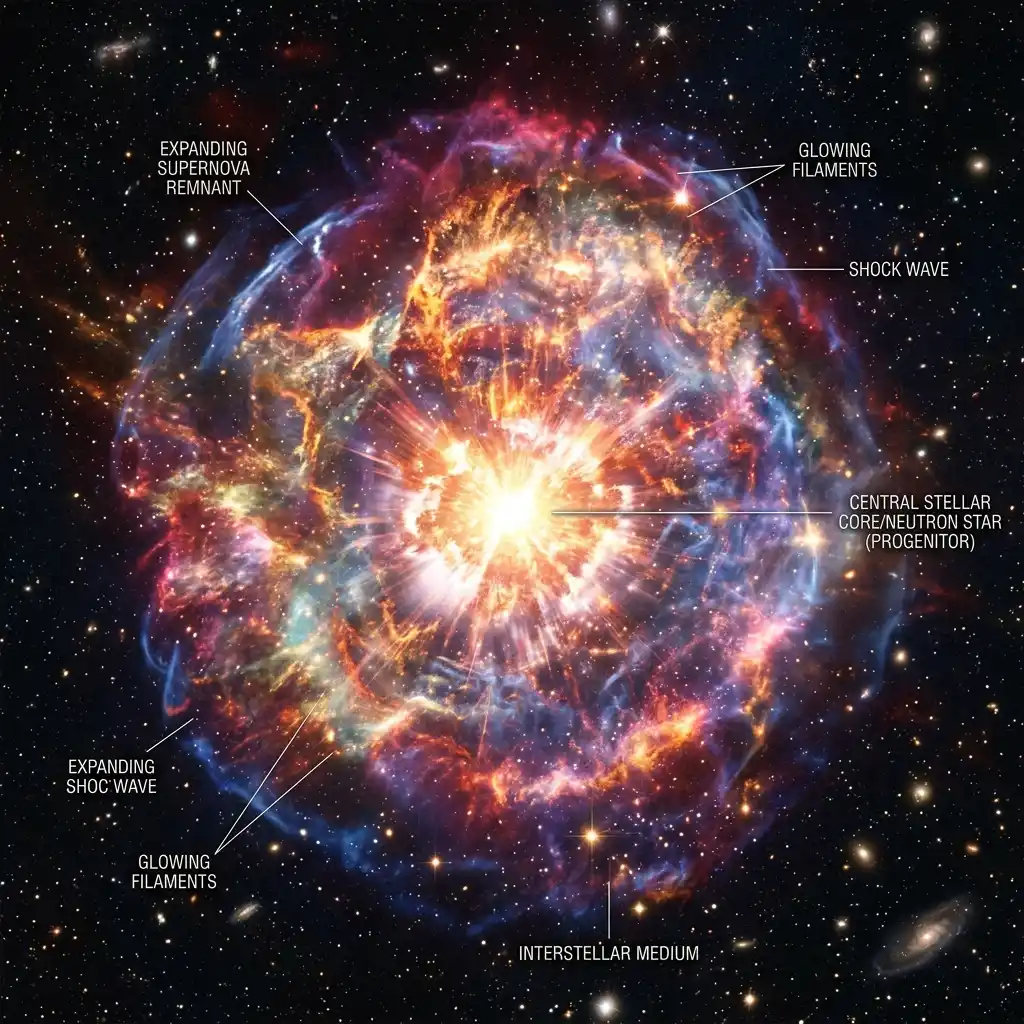
Every star in the night sky burns through nuclear fusion, balancing the inward crush of gravity with outward radiation pressure. But what happens when a star's nuclear fuel finally runs out?
The answer depends entirely on the star's initial mass.
1. Low-Mass Stars: White Dwarfs
Stars similar to our Sun (up to about 8 solar masses) lead relatively calm lives.
- Red Giant Phase: As hydrogen in the core depletes, the outer envelope expands dramatically into a red giant.
- Planetary Nebula: The gentle expulsion of the outer gas layers creates a glowing nebula.
- White Dwarf Core: The remaining dense carbon-oxygen core cools slowly over billions of years.
2. Massive Stars: Supernovae & Neutron Stars
Stars greater than 8 solar masses experience explosive ends.
- Iron Core Formation: Fusion continues through heavier elements until iron builds up in the core. Iron fusion absorbs energy rather than releasing it.
- Core Collapse Supernova: In less than a second, the iron core collapses, triggering a colossal explosion visible across entire galaxies.
- Neutron Star or Black Hole: If the remaining core mass is between 1.4 and 3 solar masses, protons and electrons merge into neutrons, creating an ultra-dense neutron star.
"The iron in our blood, the calcium in our bones, and the gold in our rings were synthesized in the nuclear furnaces of dying stars."
#stars#supernova#white-dwarf#neutron-star