What Is a Black Hole?
A simple explanation of black holes, event horizons, gravity, and what happens when matter gets too close.
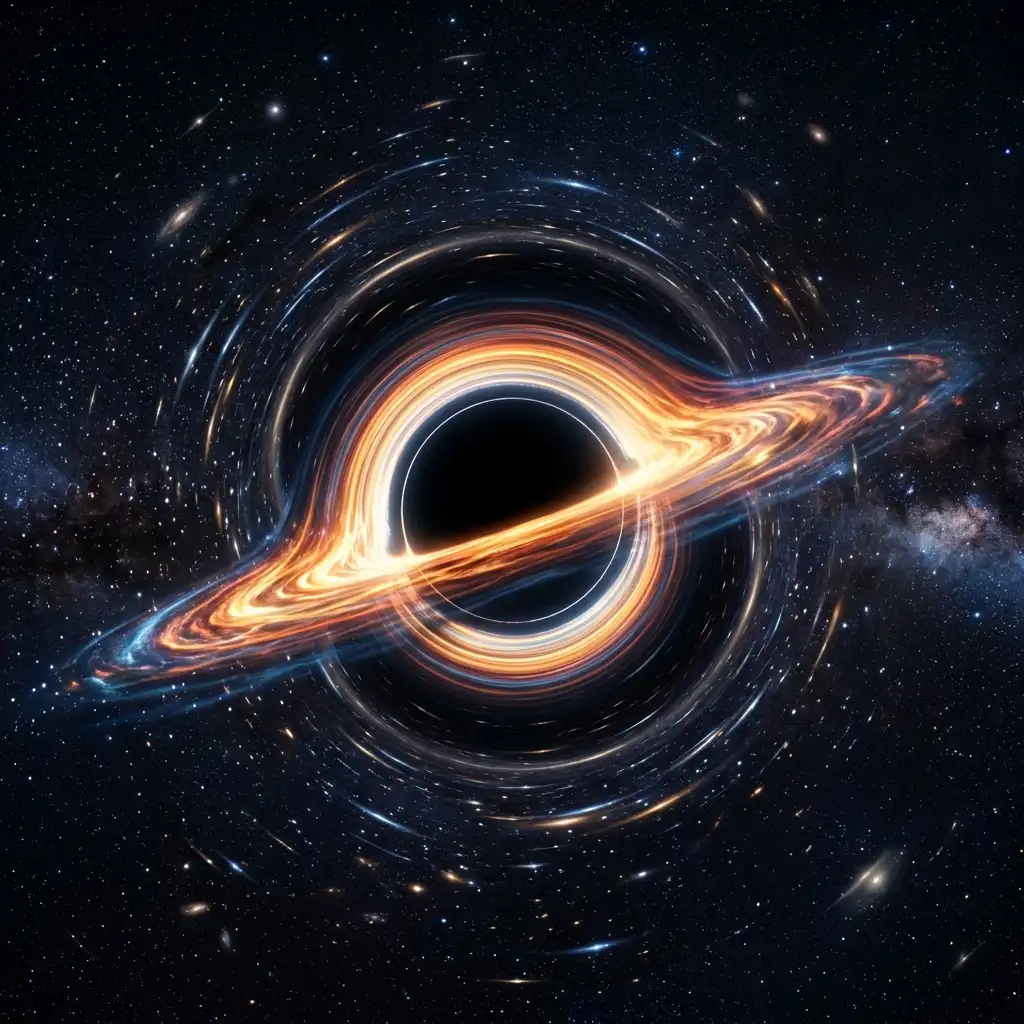
A black hole is one of the most intriguing and extreme objects in the known universe. It is a region of space where gravity is so strong that nothing—not even light—has enough speed to escape its pull.
Understanding a black hole doesn't require complex mathematical equations. At its core, the concept is about extreme concentration of mass.
How Is a Black Hole Formed?
Most stellar-mass black holes form when massive stars—stars at least 20 times more massive than our Sun—run out of nuclear fuel at the end of their lifecycles.
- Nuclear Fusion Ceases: The core can no longer produce outward radiation pressure to balance gravity.
- Gravitational Collapse: Gravity wins completely, collapsing the massive core inward in a fraction of a second.
- Supernova Explosion: The star's outer layers are blown outward in a cosmic explosion, leaving behind an ultradense gravitational point.
"A black hole is not a vacuum cleaner in space; it does not suck things in from afar. It simply has an extraordinary gravitational pull close to its boundary."
Anatomy of a Black Hole
To picture a black hole clearly, we break it down into three main anatomical parts:
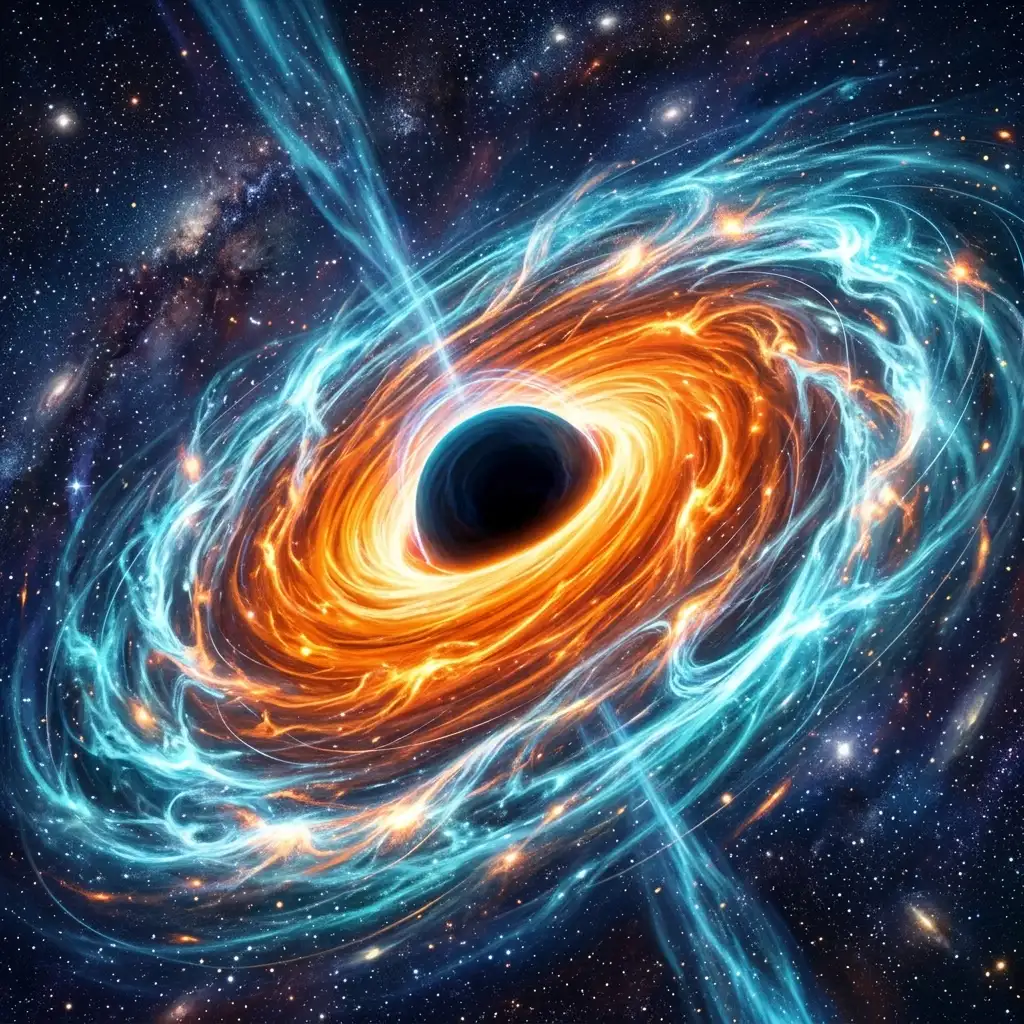
1. The Event Horizon
The event horizon is the theoretical spherical boundary surrounding a black hole. Once anything passes inside this boundary, its escape velocity exceeds the speed of light. Because light itself cannot escape, we can never directly see inside the event horizon.
2. The Accretion Disk
As gas, dust, and nearby stellar material get drawn toward the black hole, they form a rapidly rotating flattened ring called an accretion disk. Friction heats the swirling matter to millions of degrees, causing it to glow brightly in X-ray and visible light.
3. The Singularity
At the absolute center of a non-rotating black hole lies the singularity—a point where mass is thought to be compressed into an infinitely small volume, resulting in infinite density according to Einstein's theory of General Relativity.
Summary of Key Concepts
| Concept | Key Characteristic |
|---|---|
| Event Horizon | The point of no return for light and matter |
| Accretion Disk | Superheated glowing gas swirling around the boundary |
| Schwarzschild Radius | The radius of the event horizon based on mass |
| Singularity | The central point of concentrated mass |
// Calculate Schwarzschild radius (r = 2GM / c^2)
function calculateEventHorizonRadius(massInKg: number): number {
	const G = 6.6743e-11; // Gravitational constant
	const c = 299792458; // Speed of light (m/s)
	return (2 * G * massInKg) / (c * c);
}
Black holes remind us that space is far more dynamic and extraordinary than it appears from our quiet corner of the Solar System.