Roman vs James Webb: Why NASA's New Telescope Changes Everything
Launching August 30, 2026, NASA's Roman Space Telescope sees 100x wider than Hubble. Discover how it differs from James Webb and what it will reveal about dark energy.
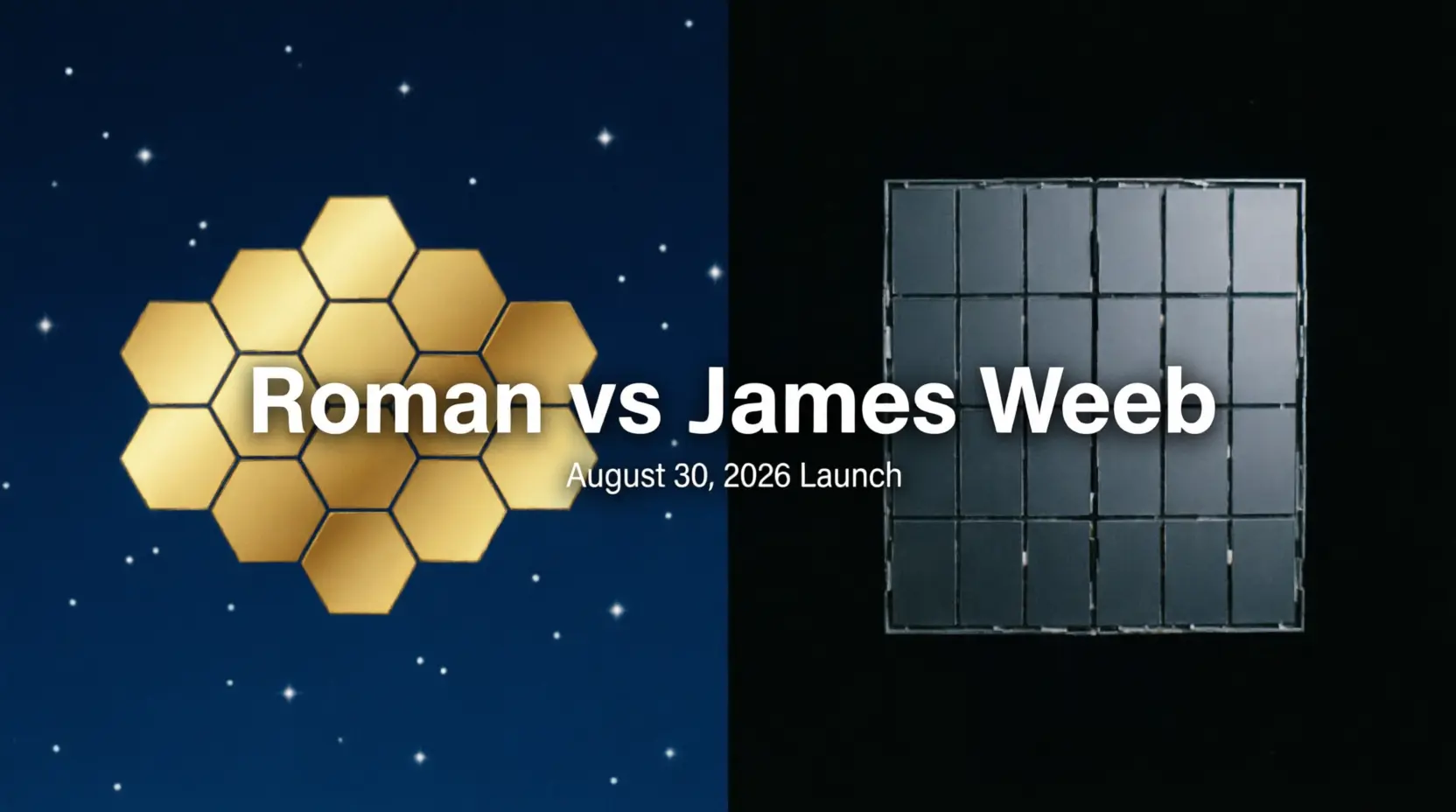
The James Webb Space Telescope has given us breathtaking images of the early universe, but NASA is not stopping there. On August 30, 2026, a new flagship observatory will launch into space: the Nancy Grace Roman Space Telescope.
While Webb acts like a powerful microscope zooming in on specific cosmic targets, Roman is designed to be a wide-angle survey camera. Together, they will revolutionize how we understand dark energy, exoplanets, and the structure of the cosmos.
Here is everything you need to know about NASA's next great observatory, explained simply.
The Core Difference: Wide Field vs Deep Focus
The easiest way to understand the difference between Roman and Webb is to think about photography:
- James Webb (JWST): Like using a telephoto lens. It captures incredibly detailed, high-resolution images of a very small patch of sky. It is perfect for studying the atmosphere of a single exoplanet or the heart of one distant galaxy.
- Roman Space Telescope: Like using a wide-angle drone camera. It captures massive areas of the sky in a single shot. According to NASA's official mission page, Roman's Wide Field Instrument provides a field of view 100 times larger than Hubble's infrared camera, while maintaining similar sharpness.
This means Roman can map billions of galaxies and thousands of exoplanets in the time it would take Webb to study just a handful. They are not competitors; they are partners. Roman finds the interesting targets across the vast sky, and Webb zooms in to study them in detail.
What Will Roman Study? Three Big Mysteries
Roman is built to answer some of the most fundamental questions in modern astrophysics. Its mission focuses on three main pillars:
1. Dark Energy and Cosmic Expansion
Scientists know the universe is expanding, and that expansion is accelerating. The invisible force driving this acceleration is called dark energy. Roman will map the positions and shapes of hundreds of millions of galaxies over billions of years of cosmic history. By creating this massive 3D map, researchers hope to measure exactly how dark energy has influenced the growth of the universe. As detailed by the Space Telescope Science Institute, these wide-field near-infrared surveys are essential for testing our current models of cosmology.
2. Finding Hidden Exoplanets
Most exoplanets discovered so far orbit very close to their stars. Roman will use a technique called gravitational microlensing to find planets that orbit much farther out, including Earth-sized worlds in the habitable zone. Microlensing occurs when a foreground star passes in front of a background star, briefly magnifying its light. If a planet orbits the foreground star, it creates a tiny extra blip in the brightness curve. This method allows Roman to detect cold, distant planets that other telescopes simply cannot see.
3. Ultra-Detailed Infrared Sky Surveys
Roman will continuously scan large portions of the sky in infrared light, which penetrates cosmic dust that blocks visible light. These surveys will reveal stellar nurseries, black hole activity, and the large-scale structure of the universe with unprecedented speed and coverage.
Launch Details: When and How
The Nancy Grace Roman Space Telescope is scheduled to launch on August 30, 2026, at 07:26 am EDT. It will ride atop a SpaceX Falcon Heavy rocket from Launch Complex 39A at NASA's Kennedy Space Center in Florida.
After launch, Roman will travel to the Sun-Earth Lagrange Point 2 (L2), the same stable orbit used by Webb and the European Space Agency's Gaia mission. From this vantage point, approximately 1.5 million kilometers from Earth, Roman will have an unobstructed view of deep space while keeping its sensitive instruments cool and shielded from solar radiation.
Why This Mission Matters Now
We live in a golden age of astronomy, but we still lack a complete picture of the universe. Webb showed us what the early universe looked like in exquisite detail. Roman will show us how that universe evolved on a grand scale.
By combining wide-field surveys with deep-focus observations, astronomers can finally connect the dots between individual cosmic objects and the overall structure of spacetime. Whether it is pinning down the nature of dark energy or discovering the next Earth-like world, Roman is poised to deliver answers that reshape textbooks.
Ready for Launch Day?
August 30 is more than just another rocket launch. It is the beginning of a new era in cosmic cartography. As Roman begins its wide-field scans, we will finally see the bigger picture of our universe.