Meet GJ 3378b: The Nearby Super-Earth That Just Got More Like Home
Astronomers have refined the mass of GJ 3378b, a super-Earth just 25 light-years away in the habitable zone. Learn why this nearby world is now a top candidate for life.
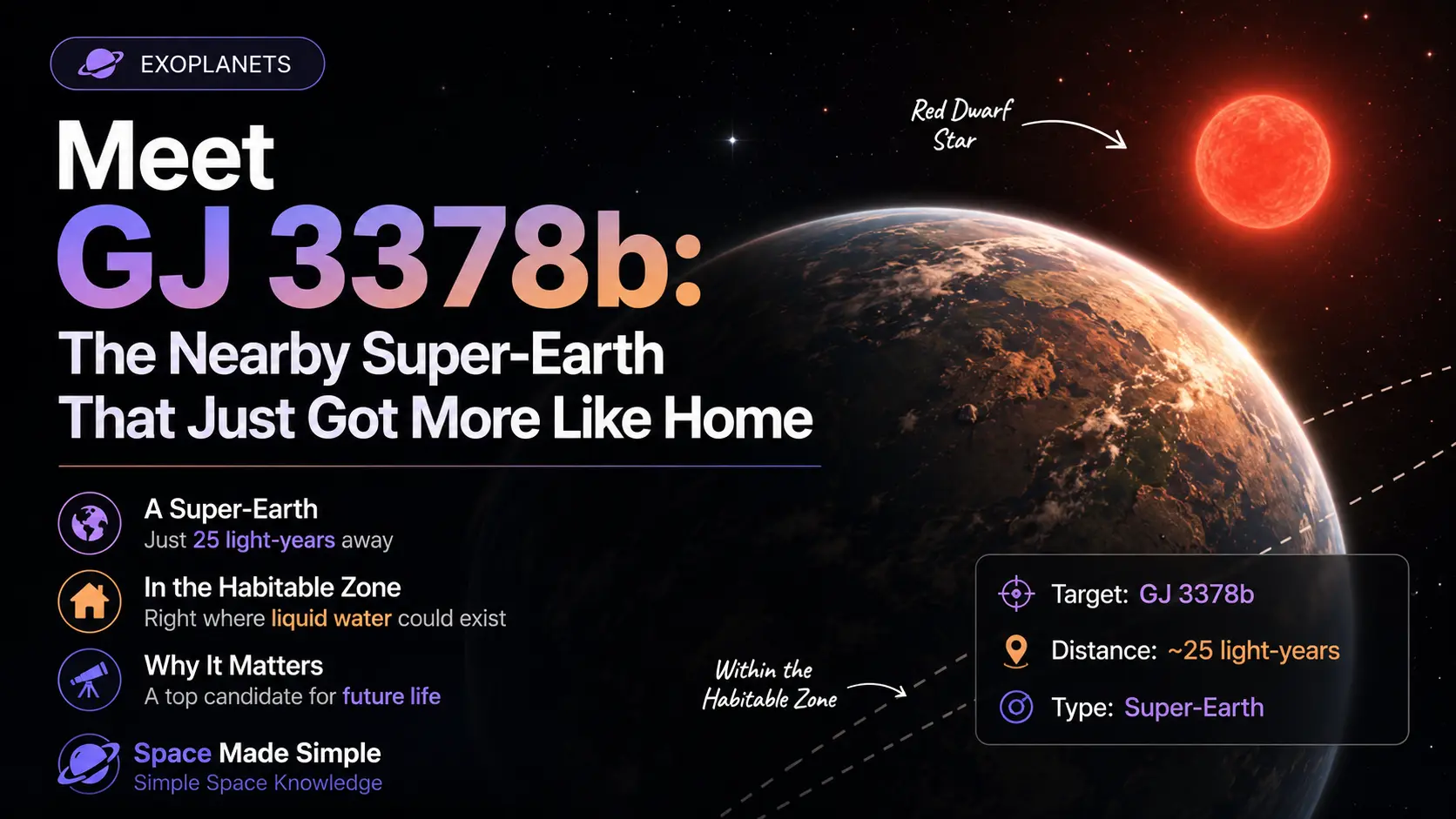
When we search for alien worlds that might host life, distance is usually our biggest enemy. Most potentially habitable planets are hundreds or thousands of light-years away, making them nearly impossible to study in detail. However, astronomers have recently turned their attention to a cosmic neighbor that is changing how we view nearby worlds. Located just 25 light-years from Earth, the super-Earth known as GJ 3378b has emerged as one of the most promising candidates for habitability in our solar neighborhood.
Why Size Matters for Alien Worlds
GJ 3378b was first detected in 2024, but initial observations suggested it was about five times more massive than Earth. A planet with that much gravity would likely hold onto a thick, crushing atmosphere similar to Neptune, making surface life as we know it unlikely. In 2026, a team led by UC Irvine astronomers used improved instruments to re-measure the planet and found something remarkable. The revised data shows GJ 3378b is actually only about 2.3 times the mass of Earth, placing it firmly in the rocky super-Earth category rather than being a mini gas giant.
This distinction is crucial because a lower mass means the planet can maintain a thinner atmosphere where liquid water could exist on the surface. You can read more about the specific methodology behind this mass revision in the official UC Irvine press release.
Sitting in the Goldilocks Zone
Mass alone does not make a planet habitable; location is equally important. GJ 3378b orbits a small, cool red dwarf star at just the right distance to be within the conservative habitable zone. This "Goldilocks zone" is the region around a star where temperatures allow liquid water to pool on a rocky surface without boiling away or freezing solid. Because the host star is much cooler than our Sun, the planet can be closer while still maintaining temperate conditions suitable for potential biology.
What Makes This Discovery Special
There are over 6,000 confirmed exoplanets in our catalog, yet very few sit in the habitable zone of stars within 10 parsecs (about 32 light-years) of Earth. GJ 3378b is among the most potentially Earth-like exoplanets known within this immediate solar neighborhood. Its proximity means future telescopes like the Nancy Grace Roman Space Observatory or upgraded ground-based arrays could directly analyze its atmosphere for biosignatures. For a deeper look at the technical parameters, check out the NASA Exoplanet Catalog entry for GJ 3378 b.
Simple Takeaways for Skywatchers
While we cannot see GJ 3378b with backyard telescopes, its discovery simplifies a complex truth about our universe. Rocky planets in habitable zones may be far more common around quiet red dwarfs than previously assumed. As measurement technology improves, worlds once dismissed as too massive or hostile are being reclassified as prime real estate for future exploration. To understand how scientists distinguish these signals from stellar noise, visit McDonald Observatory's explanation of the discovery.
The story of GJ 3378b reminds us that sometimes the best places to look for answers are right next door. As we refine our tools, the line between distant alien worlds and familiar earthly environments continues to blur.