PDS 70c Update: What the Latest 2026 Data Tells Us About Growing Planets
New 2026 measurements reveal how baby planet PDS 70c actually grows. Discover variable accretion rates, dust mass counts, and hints of a third planet.
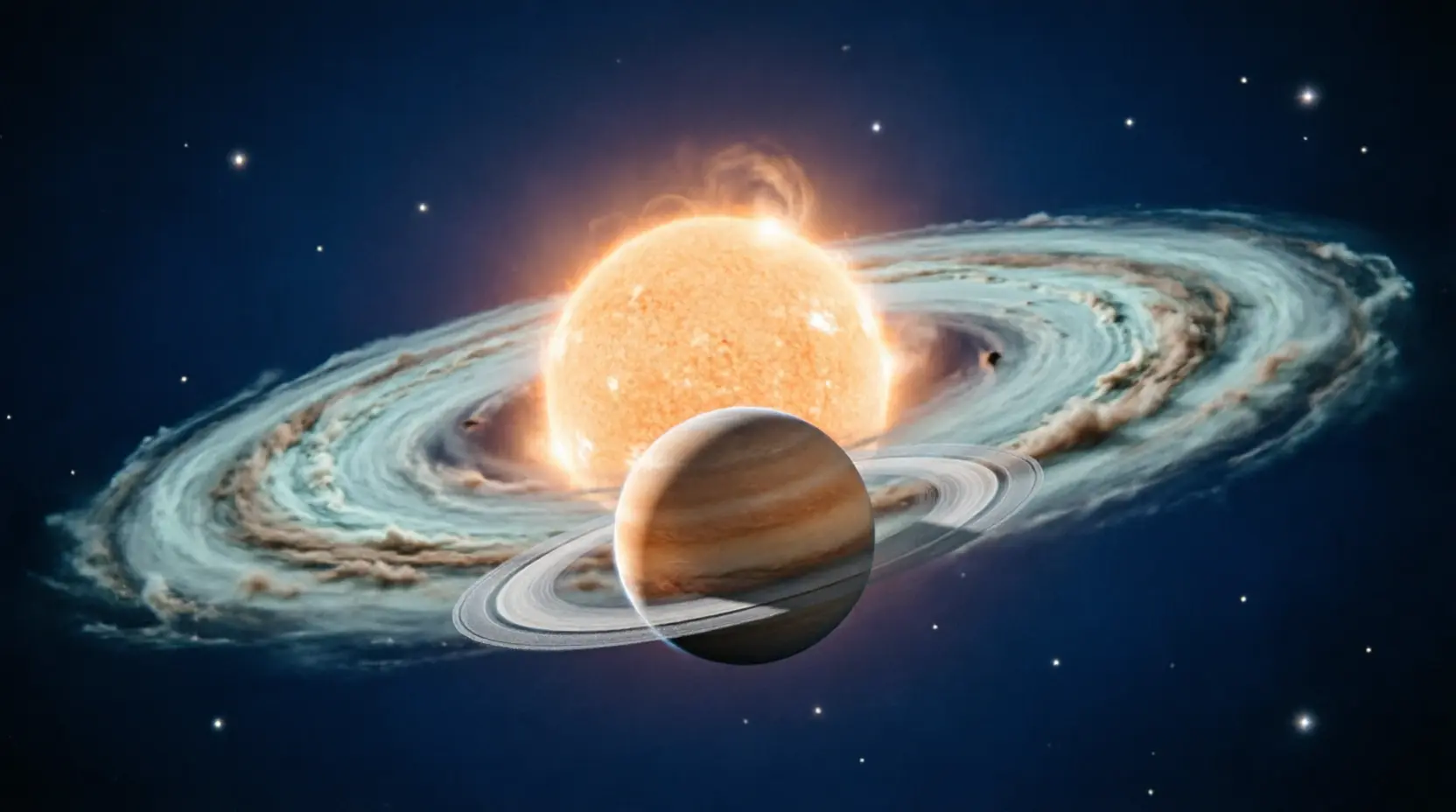
In our previous article, we looked at the stunning visuals of PDS 70c, a baby gas giant actively forming its own moons. But beautiful images only tell half the story. To truly understand how planets grow, astronomers need hard numbers. Throughout 2025 and early 2026, researchers have been crunching fresh data from JWST, ALMA, and ground-based observatories. The results are rewriting our textbooks on planet formation, revealing that growing a world is far more chaotic, dynamic, and unpredictable than we ever imagined.
Planets Don't Eat Steadily
When we first pictured PDS 70c feeding, we assumed it was a steady process, like water flowing smoothly down a drain. The latest data tells a very different story. A 2025 study published in Nature Astronomy reveals that PDS 70c experiences what scientists call variable accretion.
Think of it like a toddler at mealtime. Sometimes they eat everything in sight with incredible speed, and other times they push their plate away and barely take a bite. Astronomers tracking the system noticed that PDS 70c's brightness and gas intake fluctuate significantly over time. In some observation periods, the planet glows brightly as hot gas crashes onto its surface. In others, like the 2024 epoch, the signal drops so low that the planet becomes incredibly difficult to detect against the glare of its parent star. This tells us that planet growth is not a smooth, continuous line, but rather a series of energetic bursts followed by quiet pauses.
Weighing the Moon Factory
One of the biggest questions heading into 2026 was simple: exactly how much building material does PDS 70c have left for its future moons? Recent high-resolution measurements have finally given us a precise answer.
New analysis confirms the presence of an optically thick dust ring within the circumplanetary disk surrounding PDS 70c. According to data highlighted by the Extrasolar Planets Encyclopaedia, the dust mass co-located with PDS 70c ranges between 0.008 and 0.063 Earth masses. While that might sound small, it is more than enough raw material to construct up to three satellites the size of our own Moon. This 2026 measurement moves moon formation around exoplanets from pure theory into the realm of calculated probability. We now know the factory has enough inventory to finish the job.
A Possible Third Sibling
As astronomers tracked the orbital motion of PDS 70b and PDS 70c with greater precision, they noticed something tugging at the inner regions of the disk. The latest Keplerian motion models suggest the gravitational footprint of a third, unseen protoplanet hiding closer to the star.
This potential third sibling is a massive deal for astrophysics. Multi-planet systems are common in our universe, but catching them while they are still settling into their orbits is incredibly rare. If confirmed, this third object will help scientists understand how young planets avoid crashing into each other during the chaotic early stages of solar system assembly. It also explains some of the complex spiral patterns seen in the outer dust disk, which are likely being carved by the combined gravity of all three worlds working together.
Reading the Chemical Recipe
Perhaps the most exciting scientific leap in 2026 is our new ability to read the chemical DNA of a forming planet. Using JWST's advanced spectrographs, researchers can now analyze the light passing through the atmosphere of PDS 70c and compare it directly to the chemistry of the natal disk surrounding the star.
Why does this matter? Because it tells us where a planet gets its ingredients. By matching the ratio of water vapor, carbon monoxide, and other volatiles in the planet's atmosphere to specific zones in the disk, scientists can pinpoint exactly where PDS 70c gathered most of its mass. Did it form right where we see it today, or did it migrate inward from the colder outer edges? The early spectral data suggests PDS 70c is largely eating local food, accreting gas and dust from its immediate neighborhood rather than traveling across the disk. This gives us a real-time look at the core accretion model in action.
From Pretty Pictures to Hard Physics
The journey from a blurry dot of light to a fully characterized planetary system is happening faster than anyone predicted. The 2025 and 2026 data cycles have transformed PDS 70 from a pretty space photo into a rigorous physics laboratory. We now know that baby planets eat in bursts, we have weighed their moon-building supplies, we suspect they have hidden siblings, and we can read their chemical birth certificates.
As telescopes continue to monitor this young system, every new photon collected brings us one step closer to understanding our own origins. The chaos of PDS 70 is not just a distant spectacle. It is the blueprint of how worlds like Jupiter, and eventually Earth, came to be. Space is messy, dynamic, and beautifully complicated, and we are finally learning how to read the math behind the magic.