The Dwarf Planet That Changed Our Solar System Forever
Discover Eris, the distant dwarf planet that forced scientists to redefine what a planet is. A simple guide to the icy world beyond Pluto.
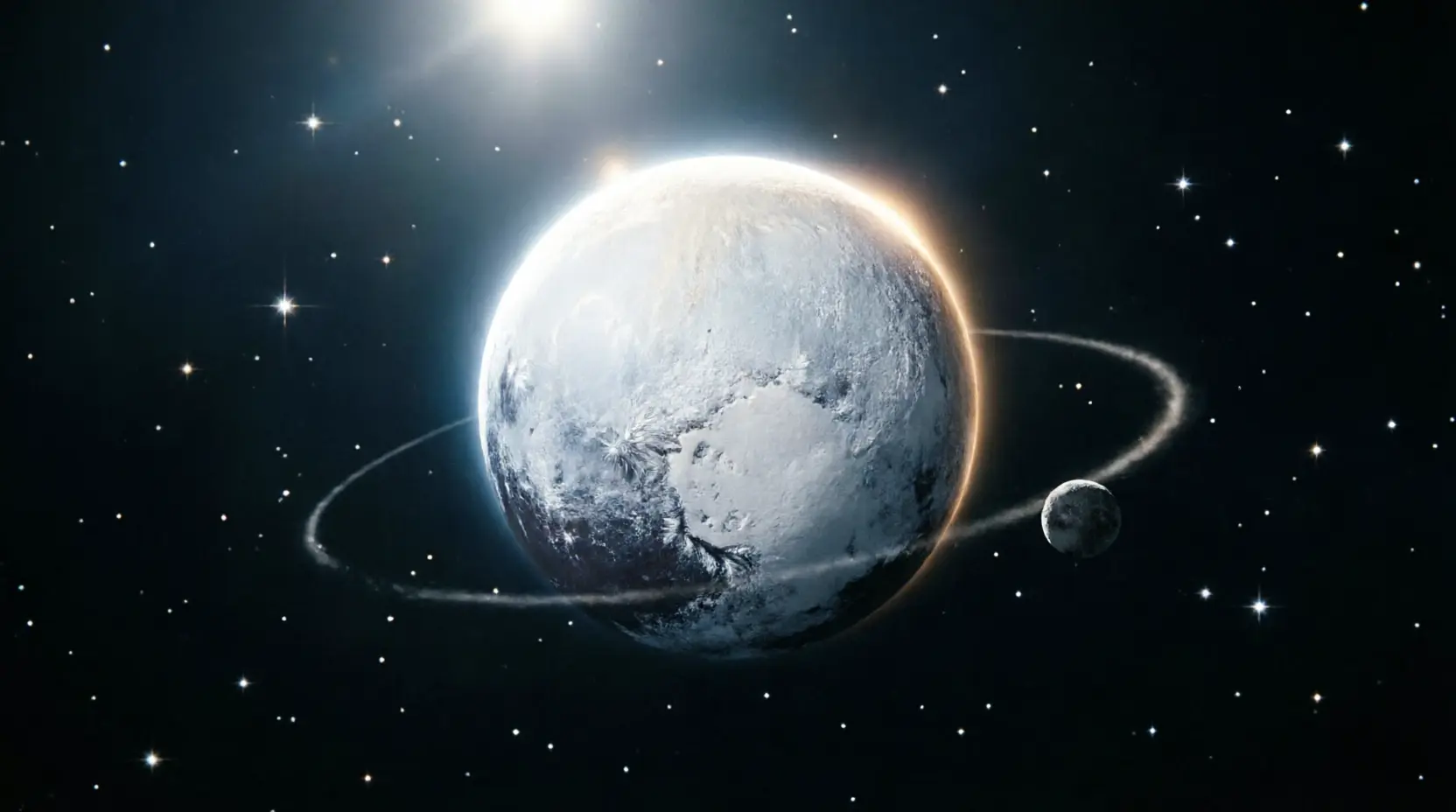
When we think of the solar system, we often picture eight neat planets orbiting the Sun. But in 2005, astronomers discovered a mysterious icy world far beyond Neptune that turned everything upside down. Its name is Eris, and it is the reason Pluto is no longer considered a planet.
If you have ever wondered why our solar system shrank from nine planets to eight, Eris is the answer. Let us explore this distant, frozen world in plain English.
What Exactly is Eris?
Eris is a dwarf planet located in a region called the Scattered Disc, which is an extension of the Kuiper Belt. While Pluto gets most of the fame, Eris is actually slightly more massive than Pluto, though they are very similar in size.
To put it simply, Eris is a giant ball of rock and ice. It orbits the Sun at a tremendous distance. At its farthest point, it is about three times farther from the Sun than Pluto is. Because of this extreme distance, one year on Eris takes roughly 558 Earth years.
Why Did Eris Cause Such a Fuss?
Before 2006, there was no strict scientific definition for the word "planet." When Eris was discovered, it appeared to be larger than Pluto. This created a big problem for astronomers. If Eris was a planet, then dozens of other similar icy bodies might also qualify, potentially giving us a solar system with 50 or more planets.
To solve this, the International Astronomical Union created three clear rules for planethood in 2006. A celestial body must orbit the Sun, be round due to its own gravity, and have "cleared its neighborhood" of other debris.
Eris meets the first two rules but fails the third. It shares its messy orbital zone with countless other icy rocks. Therefore, it was officially classified as a dwarf planet, and Pluto was reclassified alongside it.
A Frozen, Bright World
You might expect a world so far from the Sun to be dark and dull, but Eris is surprisingly bright. In fact, it is one of the most reflective objects in the entire solar system.
Scientists believe its surface is covered in a fresh layer of methane frost. Because Eris has a highly elliptical orbit, it occasionally moves close enough to the Sun for this ice to form a thin, temporary atmosphere before freezing back onto the surface when it drifts away again. This cycle keeps its surface looking pristine and white.
Dysnomia: The Tiny Companion
Eris does not travel alone. It has a small moon named Dysnomia, discovered shortly after Eris itself.
Dysnomia is crucial to our understanding of Eris. By watching how long Dysnomia takes to orbit its parent body, astronomers were able to calculate Eris's exact mass using basic physics. Without this tiny moon, we would still be guessing whether Eris was truly heavier than Pluto. You can read more about how moons help us weigh distant worlds on the NASA Solar System Exploration page.
More Than Just a Planet Killer
It is easy to remember Eris only as the object that demoted Pluto. However, that perspective misses the bigger picture. Eris taught us that the outer solar system is not empty space but a vast, dynamic reservoir of ancient icy bodies.
By forcing us to create better definitions, Eris helped us understand our cosmic neighborhood with much greater clarity. It may not be a major planet, but its impact on science is absolutely monumental. For beginners wanting to visualize where Eris sits compared to the classical planets, the NASA Eyes on the Solar System interactive tool is a fantastic resource.