Could TON 618 Swallow Our Galaxy? The Truth About Cosmic Safety
Is the universe's biggest black hole a threat to Earth? We explain why TON 618 is 18.2 billion light-years away and why cosmic expansion keeps us perfectly safe.
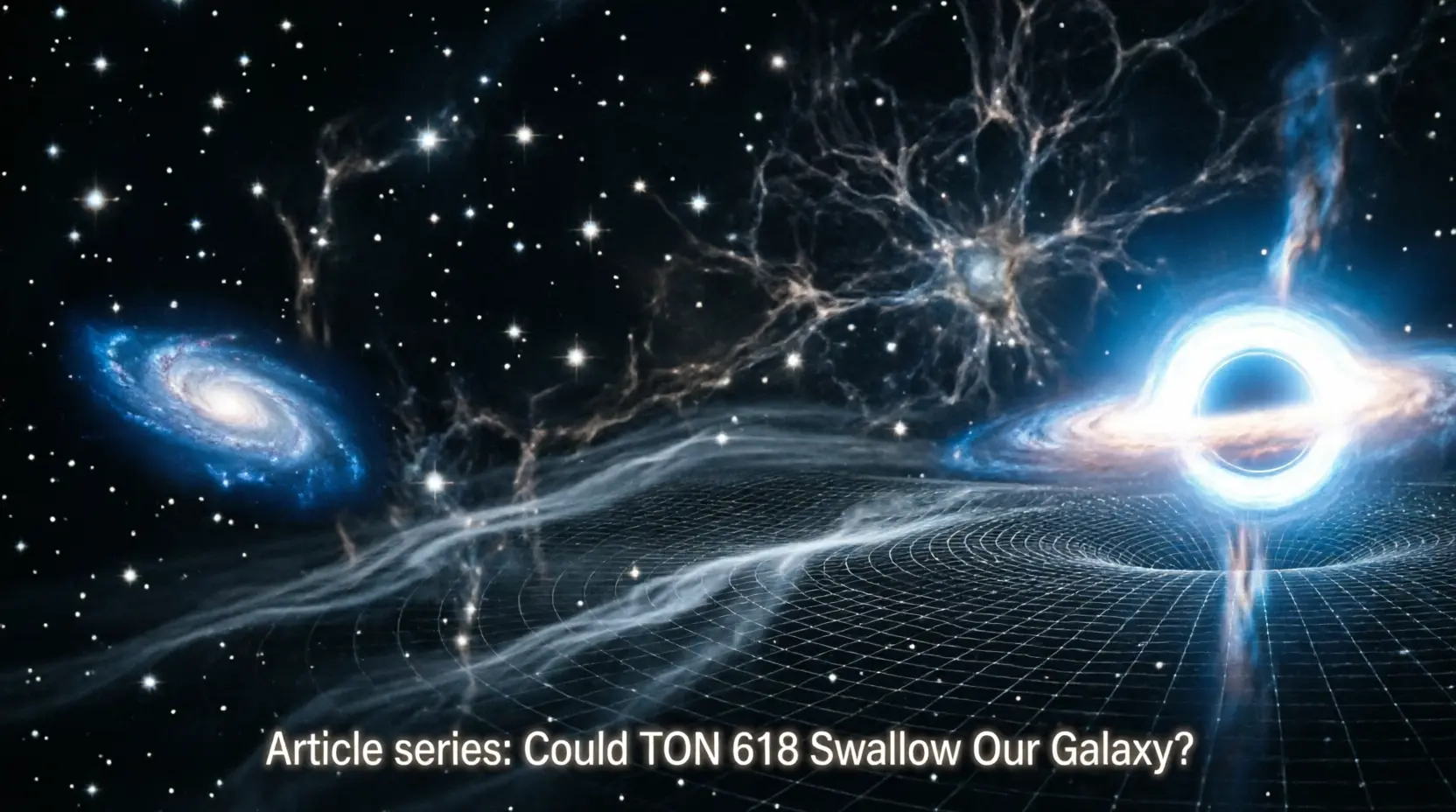
After learning that TON 618 weighs 40.7 billion times the mass of our Sun and shines with the power of 140 trillion stars, a very natural question arises. If something this impossibly massive and hungry exists in our universe, are we safe? Could its gravitational reach extend across the cosmos and eventually pull the Milky Way into its event horizon?
It is a question that pops up in every comment section and forum discussing ultramassive black holes. The short answer is an absolute and comforting no. But the long answer is far more interesting. Understanding why TON 618 cannot swallow our galaxy teaches us one of the most beautiful and counterintuitive rules governing our universe: the battle between gravity and the expansion of space.
Two Distances: Why the Numbers Seem Impossible
When you look up the distance to TON 618, you will often find two completely different numbers floating around. Some sources say it is 10.4 billion light-years away, while others claim it is 18.2 billion light-years away. Neither number is wrong. They simply measure two different things in an expanding universe.
The first number, 10.4 billion light-years, is the light travel time. It means the photons hitting our telescopes today left the quasar 10.4 billion years ago, when the universe was much younger and significantly smaller. We are literally looking back in time at a baby universe.
The second number, 18.2 billion light-years, is what cosmologists call the comoving distance. This measures where TON 618 actually is right now, at this exact moment in 2026. While that light was traveling toward us for over 10 billion years, the fabric of space itself was stretching. According to the National Radio Astronomy Observatory, this expansion pushed the physical location of TON 618 much farther away than the simple distance light could cover. You might wonder how something can be 18.2 billion light-years away if the universe is only 13.8 billion years old. The answer is that space can expand faster than light can travel through it. The object is not moving through space faster than light; the space between us is simply being created faster than light can cross it.
Gravity Has a Speed Limit and a Distance Limit
Now that we know TON 618 is currently sitting 18.2 billion light-years away, we can address the fear of it swallowing our galaxy. Gravity is incredibly powerful, but it follows a strict rule called the inverse-square law. This means that if you double your distance from a massive object, its gravitational pull does not just cut in half; it drops to one-quarter of its original strength. If you triple the distance, it drops to one-ninth.
At a distance of 18.2 billion light-years, the gravitational influence of TON 618 on our Solar System is so unimaginably weak that it is effectively zero. To put it in perspective, the gravitational pull you feel from the laptop on your desk, or even the building next door, is vastly stronger than the tug exerted by the most massive black hole ever discovered. Sagittarius A*, the modest four-million-solar-mass black hole at the center of our own Milky Way, holds our galaxy together simply because it is close. TON 618 is a giant, but it is a giant standing on the other side of the observable universe.
The Expanding Universe as a Cosmic Shield
Even if gravity could somehow reach further, the universe has a built-in defense mechanism protecting us from distant monsters. Dark energy is causing the expansion of the cosmos to accelerate. Galaxies that are not gravitationally bound to each other are constantly drifting apart at increasing speeds.
Our Milky Way is part of a local group of galaxies held together by mutual gravity. TON 618 resides in a completely different patch of the cosmos, far beyond our local gravitational neighborhood. The space between us and TON 618 is expanding so rapidly that any theoretical gravitational bridge between us is being stretched and snapped faster than it could ever form. We are not falling toward TON 618. We are permanently receding from it. Every second that passes, the gap between our galaxy and its event horizon grows wider. The universe is literally running away from the monster faster than the monster can chase.
What Would Happen in a Hypothetical Collision?
Science often learns the most by testing extreme hypotheticals. So let us temporarily ignore the 18.2-billion-light-year gap and imagine TON 618 was magically placed right next to the Milky Way. What would happen?
Despite its terrifying reputation, TON 618 would not instantly vacuum up our galaxy like a cosmic cleaner. Black holes do not suck. They simply provide a very deep gravity well. If TON 618 passed near us, the outer edges of the Milky Way would experience intense tidal forces. Stars would be ripped from their orbits, and the structure of our spiral arms would be severely distorted. However, because the event horizon is so physically large, the gravity gradient is surprisingly gentle until you get very close to the edge. Most of our galaxy would likely swing around the behemoth in a chaotic elliptical orbit rather than falling straight in. As noted by Science Focus, even the most massive black holes have entire galaxies of stars happily orbiting them without getting sucked in, proving that proximity does not guarantee consumption.
But again, this is purely a thought experiment. In reality, the cosmic distances are simply too vast for such an encounter to ever occur.
Looking Toward the Deep Future
We have now confirmed that TON 618 is safely locked away behind billions of light-years of expanding spacetime. It cannot reach us, and we cannot reach it. But if it is stuck out there, slowly feeding on its host galaxy and shining across the cosmos, what is its ultimate destiny? Will it continue growing forever, eventually consuming its entire corner of the universe? Or does nature have a hard stop for how big a single object can get?
In the fifth and final article of our series, we will zoom out to the deepest future of the cosmos. We will explore the theoretical limits of black hole growth, discuss what happens when quasars finally run out of fuel, and trace the incredible timeline of TON 618 from the early universe all the way to the end of time itself. The story of this monster is not just about how big it is today, but about what it tells us regarding the final fate of everything.