The Future of TON 618: Will It Keep Growing Forever?
What happens to the universe's biggest black hole in the end? Explore the theoretical growth limits of TON 618, quasar shutdown, and its 10^100-year evaporation timeline.
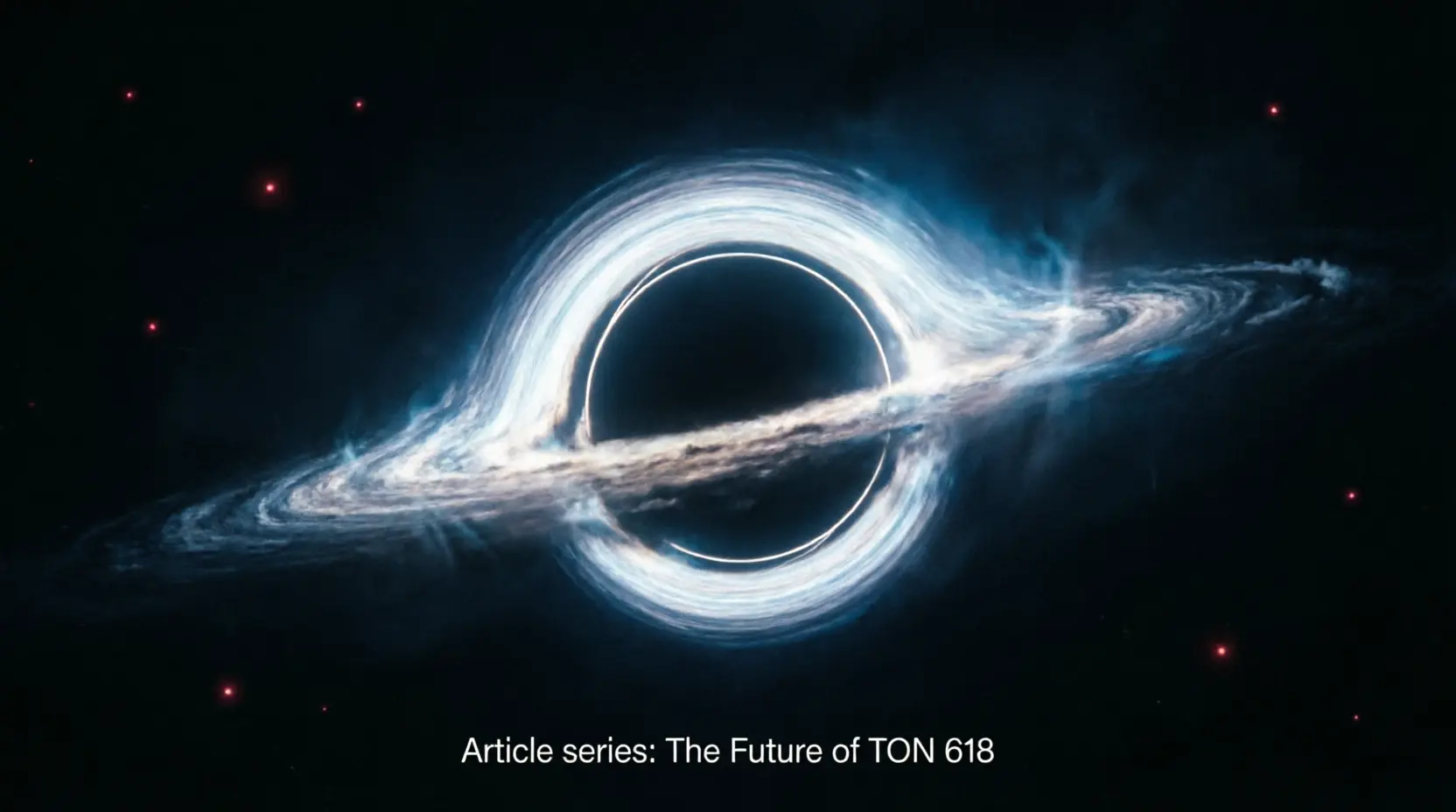
Throughout this series, we have explored the staggering scale of TON 618. We have visualized an event horizon wide enough to swallow our Solar System forty times over, unpacked the physics of a quasar shining with the power of 140 trillion suns, and confirmed that cosmic expansion keeps this monster safely locked billions of light-years away. But knowing what TON 618 is today naturally leads to the final, most profound question of all. What happens next?
Can a black hole grow infinitely? Will TON 618 eventually consume its entire corner of the universe? Or does nature have a built-in brake that prevents any single object from becoming too powerful? In this final article of our series, we will travel forward in time to trace the ultimate destiny of the largest black hole ever measured, from the peak of its quasar glory to the very last moments of the cosmos itself.
The Cosmic Speed Limit for Black Holes
It is tempting to imagine TON 618 as an unstoppable vacuum that will simply keep eating forever. However, astrophysics suggests there is a theoretical ceiling to how large a black hole can grow through normal feeding. In 2016, astrophysicist Andrew King published research proposing a natural growth limit of approximately 50 billion solar masses
The reason for this limit is beautifully ironic. As a black hole feeds, its accretion disk heats up and releases intense radiation. Once the black hole reaches a certain size, that outward radiation becomes so powerful that it literally blows the surrounding gas away before it can fall in. The monster essentially pushes its own food off the table. At 40.7 billion solar masses, TON 618 is already knocking on the door of this theoretical ceiling. While extreme factors like maximal rotational spin could theoretically push the limit higher toward 270 billion solar masses, TON 618 represents the upper echelon of what gravity alone can realistically build in our universe. It is not just big; it is physically maxed out.
How Quasars Commit Suicide
Even if TON 618 could somehow bypass the radiation pressure limit, it faces another inevitable problem: running out of fuel. Quasars are not permanent states of being. They are temporary tantrums of cosmic consumption.
The same extreme energy that makes TON 618 visible across 10 billion light-years is also its downfall. According to observations detailed by Dimension Zero, the intense radiation and relativistic jets from ultramassive quasars can drive star-forming gas completely out of their host galaxies. This process, known as quasar feedback, effectively sterilizes the surrounding environment. By shining too brightly, TON 618 is actively clearing out its own pantry.
Once the nearby gas reservoirs are depleted or expelled, the accretion disk will begin to thin. The friction will decrease, the temperature will drop, and the brilliant beacon of 140 trillion suns will slowly fade. The quasar will switch off. What remains will be the same 40.7-billion-solar-mass gravitational well, but it will go completely dark. TON 618 will transition from the brightest object in the sky to an invisible, silent giant sleeping at the center of a quiet galaxy.
The Long Wait: Entering the Black Hole Era
Fast forward trillions of years into the future. The universe as we know it today will be unrecognizable. Star formation will have ceased across the cosmos as hydrogen reserves are exhausted. Galaxies will drift apart, their stars burning out one by one until the night sky goes permanently black.
In this distant epoch, cosmologists predict the universe will enter what is called the Black Hole Era. With all the stars gone, black holes will become the dominant structures in existence. While smaller stellar black holes will slowly dominate the landscape, ultramassive giants like TON 618 will reign as the last true monuments of the classical universe. They will sit in the freezing dark, occasionally swallowing a stray rogue planet or a wandering neutron star, but mostly just waiting. This waiting period will last longer than any human mind can comfortably comprehend.
Hawking Radiation and the Final Evaporation
For decades, scientists believed black holes were truly eternal. Then Stephen Hawking demonstrated that quantum mechanics near the event horizon causes black holes to emit a faint thermal glow now known as Hawking radiation. This radiation carries away energy, which means the black hole slowly loses mass over time.
The catch is that the rate of evaporation is inversely proportional to mass. A small black hole evaporates relatively quickly, while a massive one leaks energy at an almost imperceptible crawl. For a black hole the size of our Sun, complete evaporation would take around 10 to the power of 67 years. For TON 618, the math scales up to truly absurd proportions. As discussed in recent quantum cosmology papers, an ultramassive black hole of this scale would require approximately 10 to the power of 100 years to fully evaporate.
That is a one followed by one hundred zeros. To put that number in perspective, the current age of our universe is only about 13.8 billion years, or roughly 10 to the power of 10 years. TON 618 will outlast every star, every galaxy, every planet, and every atom of ordinary matter by a margin so vast that mathematics itself struggles to describe it. According to Interesting Engineering, while Sagittarius A* will vanish in 10 to the power of 87 years, TON 618 will remain as one of the final anchors of reality long after everything else has dissolved into pure radiation.
The Last Light in a Dark Universe
Eventually, even the impossible timeline of 10 to the power of 100 years will pass. In the final moments of its existence, as TON 618 shrinks down to its last remaining kilograms, the evaporation rate will accelerate exponentially. The once-silent giant will release its remaining mass in a final, brilliant flash of gamma radiation.
That flash will be the last significant event in the history of the cosmos. After that, the universe will reach maximum entropy, a state of perfect, uniform darkness and cold. TON 618 began as a faint blue dot in a 1957 survey, grew into a record-breaking quasar that challenged our understanding of physics, and will end as the final punctuation mark at the end of spacetime's story.
Thank you for joining us on this five-part journey through the scale, physics, safety, and destiny of the universe's most extreme object. Space is vast, mysterious, and often terrifying, but breaking it down into simple pieces reminds us how incredible it is to exist in a universe capable of creating something like TON 618. Keep looking up, and keep making space simple.