How Big is TON 618? Visualizing the Unimaginable
TON 618 is 390 billion km wide. We break down its impossible size using simple Solar System comparisons and everyday analogies you can actually picture.
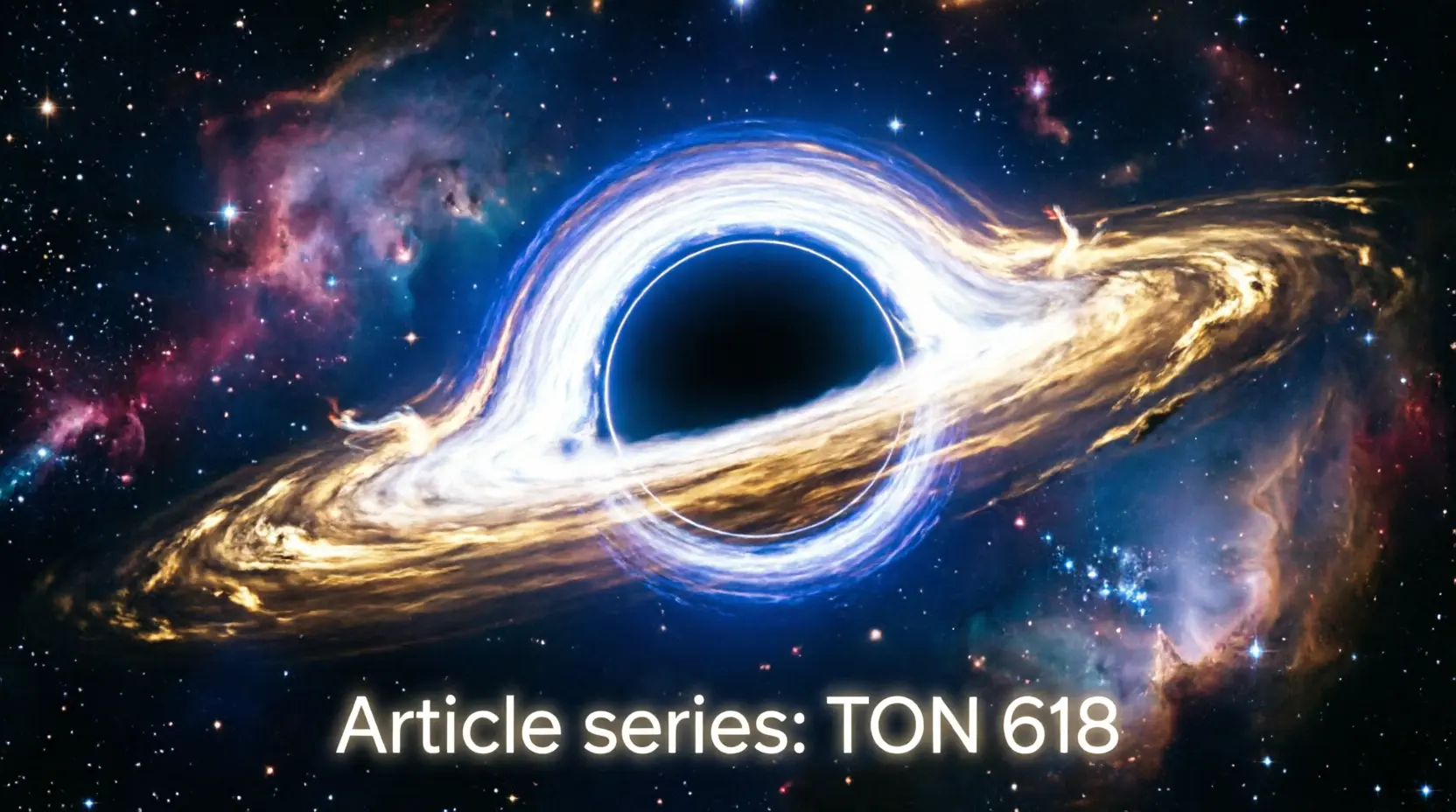
In our first article, we established that TON 618 holds the record for the most massive black hole ever directly measured, weighing in at a corrected 40.7 billion times the mass of our Sun. But mass is just a number on a screen. To truly understand what makes this object a cosmic monster, we need to talk about physical size.
Human brains evolved to understand distances like walking to the store or driving across a country. We were not built to comprehend hundreds of billions of kilometers. In this guide, we will strip away the abstract math and use familiar landmarks in our own Solar System to visualize the true, terrifying scale of TON 618.
The Numbers Behind the Void
When astronomers measure a black hole, they are not measuring a solid surface. They are measuring the event horizon, which is the invisible boundary where gravity becomes so strong that not even light can escape. For TON 618, this point of no return is staggeringly large.
Based on its 40.7 billion solar masses, the Schwarzschild radius of TON 618 extends roughly 1,300 Astronomical Units from its center. An Astronomical Unit is simply the average distance between Earth and the Sun. When you double that radius to get the full diameter, TON 618 spans approximately 390 billion kilometers, or about 242 billion miles. Reading those numbers does not give us much intuition, so let us put them into perspective.
Swallowing the Solar System Whole
The easiest way to grasp the size of TON 618 is to place our entire Solar System inside it. Most people think of Pluto as the edge of our planetary neighborhood. The average distance from the Sun to Pluto is about 40 Astronomical Units.
TON 618 has a radius of 1,300 Astronomical Units. This means if you placed the Sun exactly at the center of TON 618, the event horizon would extend more than 40 times farther out than Pluto's orbit. Mercury, Venus, Earth, Mars, Jupiter, Saturn, Uranus, Neptune, and Pluto would all be instantly swallowed without even touching the edge. Our entire Solar System would look like a tiny speck of dust floating inside a cavernous dark sphere. According to Space Wiki, this diameter is so vast that it dwarfs every planetary orbit we have ever mapped.
Everyday Analogies for Impossible Scales
If Solar System comparisons still feel too abstract, let us try shrinking everything down to objects you can hold in your hand. Scale models are the best tool for making the impossible feel real.
Imagine reducing our Sun down to the size of a single grain of sand. At that exact same scale, the event horizon of TON 618 would stretch out to the size of a large multi-story building. Think about that for a moment. A single grain of sand versus an entire office complex. That is the proportional difference between our life-giving star and the largest known black hole in the universe.
Another way to picture it is through travel time. If you could fly a commercial airplane at 900 kilometers per hour directly across the diameter of TON 618, the flight would take over 49,000 years to complete. You would need to pass the pilot seat down through thousands of generations just to reach the other side of the shadow.
Why Size Matters for Gravity
You might wonder why we focus so much on diameter instead of just sticking with mass. The size of the event horizon directly dictates how this monster interacts with its surroundings. A larger event horizon means a wider gravitational net.
Because TON 618 is so physically enormous, its tidal forces at the event horizon are actually surprisingly gentle compared to smaller stellar black holes. If you were falling into a small black hole, the difference in gravity between your head and your feet would stretch you into a noodle long before you crossed the threshold. With TON 618, the gravity gradient is so spread out across its 390-billion-kilometer width that you could theoretically cross the event horizon without immediately noticing anything strange. The sheer scale dilutes the extreme physics right at the edge.
Preparing for the Engine
Now that we have successfully placed TON 618 in our minds as a structure large enough to swallow our Solar System forty times over, a new question naturally arises. How does something this impossibly large feed itself? What happens to all the gas and starlight that falls into a pit this wide?
In the next article of our series, we will shift our focus from size to power. We will explore the physics of the accretion disk, explain why TON 618 shines brighter than 140 trillion Suns, and break down the mechanics of a quasar without using confusing textbook jargon. Understanding the size was step one. Understanding the engine is where things get truly spectacular.
For an interactive way to calculate how event horizons scale with mass, you can explore this Schwarzschild Radius Calculator to see the math behind the monster.