Teegarden’s Star: Is Earth’s Quiet Neighbor Actually Habitable?
Discover Teegarden’s Star, a quiet red dwarf with Earth-like planets. Learn why recent 2026 studies question its habitability and why it remains a top target.
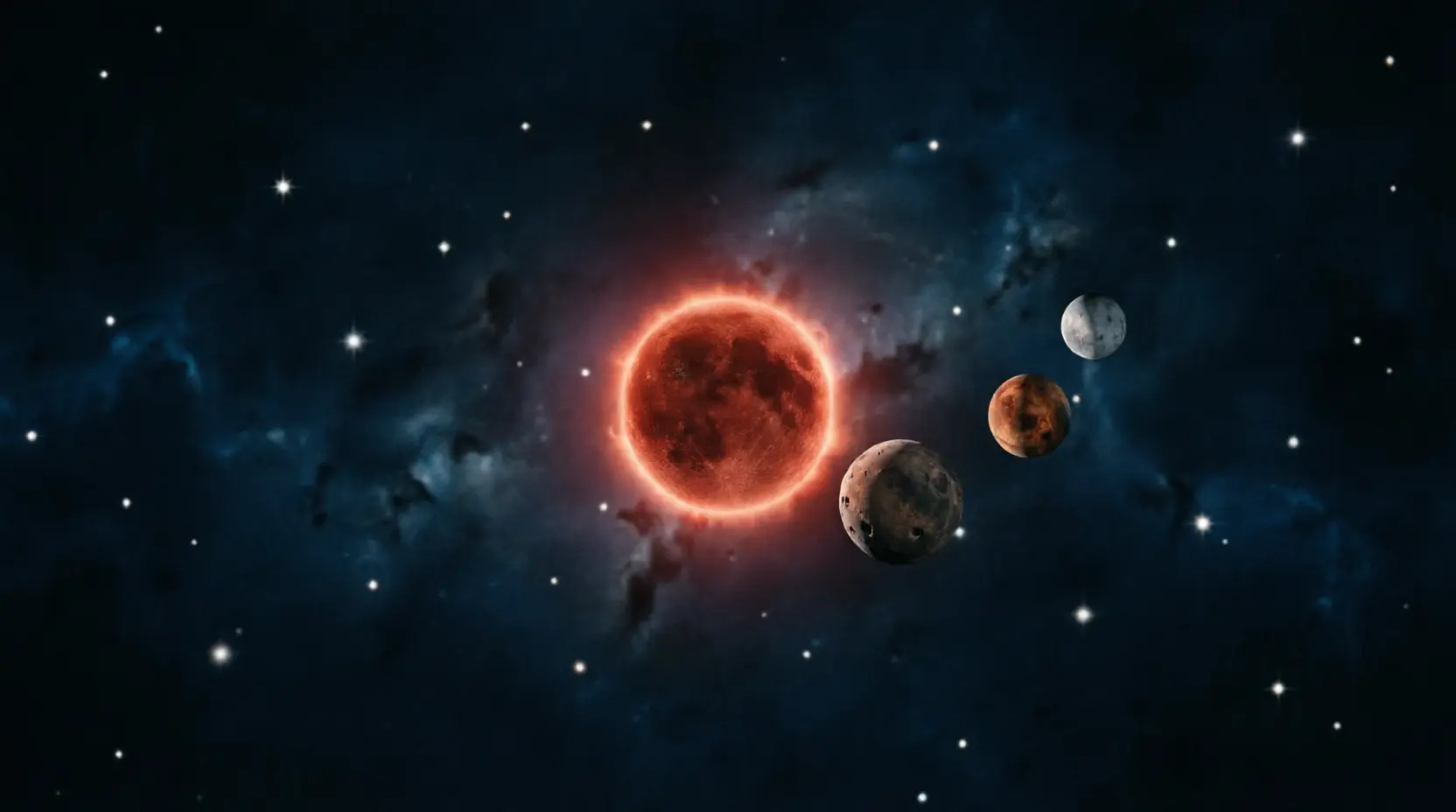
When we search for another Earth, we often look at stars that resemble our Sun. However, the most promising candidates might actually be hiding around much smaller, dimmer stars. One of the most exciting examples is Teegarden’s Star, a tiny red dwarf located just 12.5 light-years away. For years, astronomers have celebrated this system as a potential home for life. But new research in 2026 has added a twist to the story, making this nearby neighbor even more fascinating to study.
A Calm Star in a Chaotic Neighborhood
Most red dwarfs are notorious for being violent. They frequently erupt with massive stellar flares that can strip away the atmospheres of nearby planets. Teegarden’s Star is different. At roughly eight billion years old, it is nearly twice as old as our Sun and has settled into a remarkably calm state. This stability is crucial because it gives any potential biosphere billions of years to develop without being constantly blasted by harmful radiation.
This stellar tranquility makes the Teegarden system one of the best laboratories for understanding how life might survive around the most common type of star in our galaxy. You can learn more about why older red dwarfs are prime targets for astrobiology through Centauri Dreams
Three Worlds, One Big Question
Astronomers have confirmed at least three planets orbiting this small star. The two most famous are Teegarden b and Teegarden c, both of which have masses very similar to Earth. Planet b orbits closer to the star, while planet c sits further out. In 2024, researchers also confirmed a third world, Teegarden d, adding more complexity to this compact system.
For a long time, Teegarden b was considered a top-tier candidate for habitability because it receives an amount of starlight very similar to what Earth gets from the Sun. However, simplicity in astronomy can sometimes be misleading. Recent climate models suggest that planet b might be sitting right on the edge of a "runaway greenhouse" effect. This means it could be just warm enough to trigger a cycle where oceans evaporate entirely, turning the planet into a Venus-like hellscape rather than a second Earth.
Despite this thermal tightrope walk, scientists remain incredibly interested in the planet. Even if it is too hot for surface life, understanding exactly where the boundary lies helps us define the true limits of habitability. For a simple breakdown of these latest climate models, check out this summary from AAS Nova.
Why It Remains a Top Priority
Even with the uncertainty surrounding planet b's temperature, the Teegarden system remains a goldmine for future telescopes. Because the star is so close and relatively bright in infrared wavelengths, it is a primary target for next-generation observatories like the Large Interferometer For Exoplanets (LIFE). These instruments aim to directly analyze the atmospheres of rocky worlds, searching for chemical signatures that only biology can produce.
The fact that Teegarden b does not transit—meaning it does not pass directly in front of its star from our viewpoint—actually makes it a unique test case. Most atmospheric studies rely on transits, but new technologies will allow us to study non-transiting worlds by separating the planet's light from the star's glare. This capability is essential since most potentially habitable planets will not be perfectly aligned for transit observations. More details on this observational strategy can be found via Astrobiology.com.
What This Means for the Search for Life
Teegarden’s Star teaches us that finding another Earth is not just about matching mass or orbital distance. It is about understanding the delicate balance between a planet's atmosphere, its star's history, and the precise flow of energy. Whether Teegarden b turns out to be a lush ocean world or a scorching desert, studying it brings us one step closer to answering whether we are alone in the universe.
As telescope technology improves over the coming decade, this quiet little red dwarf will likely be among the first places where we get a definitive answer. Until then, it remains a beautiful reminder that the most interesting discoveries often come from the smallest, most unassuming corners of our cosmic neighborhood.