Black Hole Myths Debunked: What Science Actually Says
Think black holes suck everything like cosmic vacuums? Let us debunk common myths about black holes with simple science and recent discoveries.
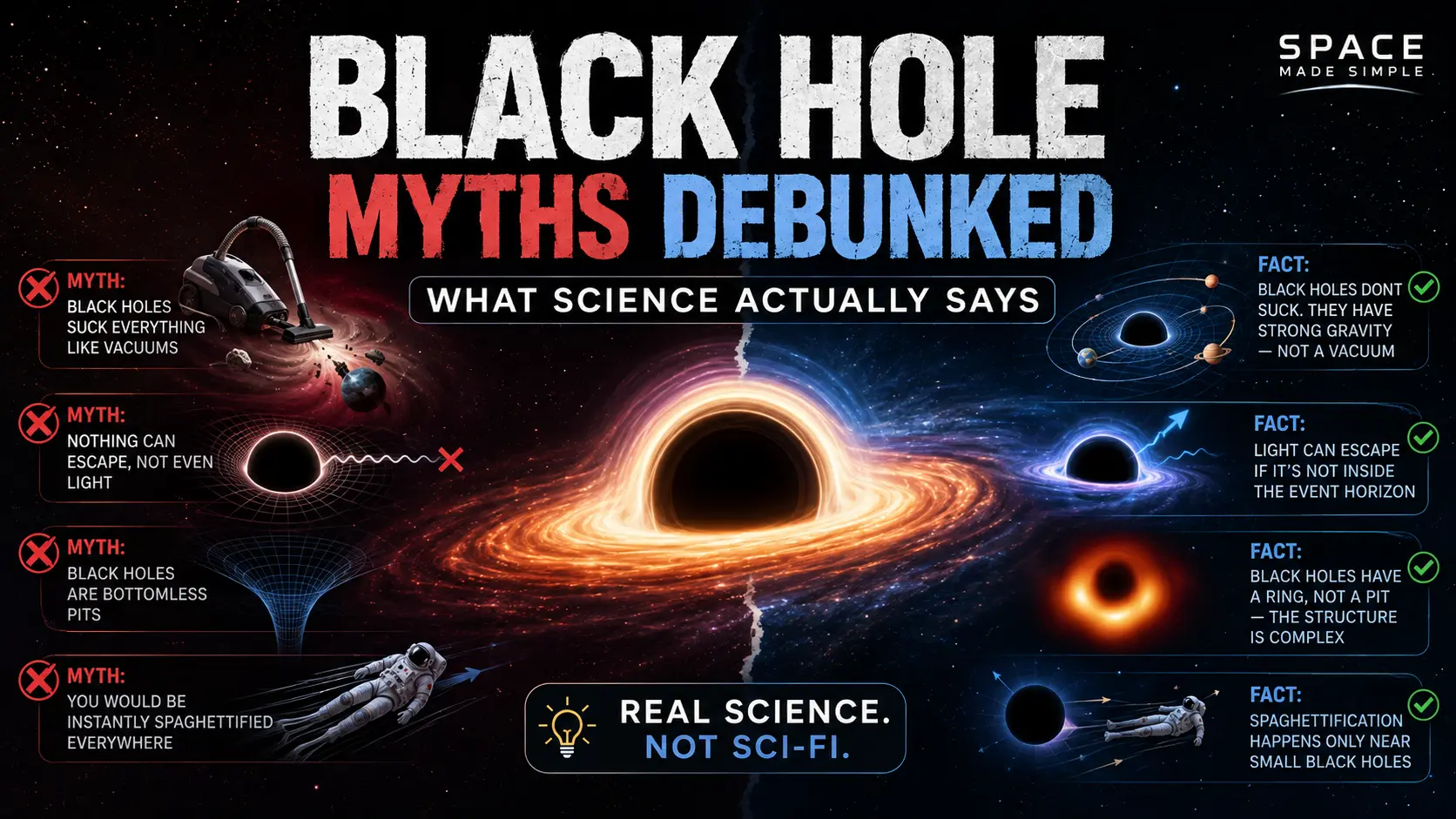
Black holes are arguably the most misunderstood objects in the universe. Movies show them as cosmic vacuum cleaners that suck in entire galaxies. Social media posts claim they are portals to other dimensions or eternal prisons from which nothing escapes. While black holes are genuinely strange, many popular beliefs about them are simply wrong. Let us separate science fiction from scientific fact using clear explanations and the latest discoveries.
If you missed earlier parts of this series, catch up on what a black hole is, what happens if you fall into one, and the four types of black holes explained. Now let us dismantle the myths one by one.
Myth #1: Black Holes Are Cosmic Vacuum Cleaners
The most persistent myth is that black holes actively suck in everything around them like giant space vacuums. In reality, a black hole's gravity behaves exactly like any other massive object at a safe distance. If you replaced our Sun with a black hole of the same mass, Earth's orbit would remain completely unchanged. We would freeze in darkness, but we would not spiral inward.
The "sucking" illusion comes from misunderstanding orbital mechanics. Objects only fall into a black hole if they cross the event horizon or lose orbital energy through friction in an accretion disk. At distances beyond a few Schwarzschild radii, gravity follows the same inverse-square law as stars and planets. Black holes do not reach out and grab things; things must come to them. This is why TON 618 cannot swallow our galaxy despite being billions of times more massive than the Sun.
Myth #2: You Can See a Black Hole Directly
Another common misconception is that we can photograph the black hole itself. What telescopes like the Event Horizon Telescope actually capture is the shadow cast by the event horizon against glowing accretion disk material. The black hole remains invisible by definition; no light escapes from within the event horizon. The bright ring in famous M87* and Sagittarius A* images is superheated plasma orbiting just outside the point of no return.
Even the "shadow" is not the event horizon itself but a region roughly 2.5 times larger where photon orbits become unstable. What we see is the silhouette of gravity bending light around an invisible object. Future instruments may resolve finer details, but the fundamental rule holds: the black hole itself emits no light we can detect directly.
Myth #3: Black Holes Live Forever
Many assume black holes are permanent fixtures of the cosmos. Stephen Hawking showed in 1974 that black holes slowly lose mass through quantum effects near the event horizon, now called Hawking radiation. Virtual particle pairs constantly pop into existence near the horizon; occasionally, one falls in while the other escapes, carrying away energy and reducing the black hole's mass.
For stellar-mass black holes, this evaporation process takes approximately 10^67 years, far longer than the current age of the universe. Supermassive black holes take even longer, around 10^100 years. So while black holes are not truly eternal, they will outlast stars, galaxies, and possibly protons themselves. In practical human timescales, they might as well be permanent, but cosmologically speaking, they have expiration dates.
Myth #4: Falling In Means Instant Spaghettification
Pop science often describes falling into a black hole as immediate "spaghettification," where tidal forces stretch you into a thin strand of atoms. This is true for stellar-mass black holes, where the gravity gradient between your head and feet is extreme near the event horizon. However, for supermassive black holes, the event horizon is so large that tidal forces at the crossing point are negligible.
You could theoretically cross the event horizon of a supermassive black hole without noticing anything unusual locally. The spaghettification would occur much deeper inside, closer to the singularity. This nuance matters because it means the experience of falling in depends entirely on the black hole's mass. We explored this in detail in our guide on what happens if you fall into a black hole.
Myth #5: All Black Holes Are Dangerous to Earth
Headlines sometimes warn that black holes pose existential threats to our planet. The nearest known stellar-mass black hole is roughly 1,500 light-years away, far too distant to affect Earth's orbit or safety. Even if a rogue black hole passed through the outer solar system, the odds of direct collision are astronomically low due to the vast emptiness of space.
Supermassive black holes reside at galactic centers, tens of thousands of light-years from Earth. They anchor galaxies rather than destroy them. The real cosmic risks to Earth come from asteroid impacts, gamma-ray bursts, or stellar evolution billions of years in the future, not from black holes. Understanding how stars die gives a more accurate picture of actual astrophysical hazards.
Myth vs Reality Quick Reference
Here is a fast lookup table to settle debates and correct misconceptions:
| Common Myth | Scientific Reality | Why People Believe It |
|---|---|---|
| Black holes suck everything in | Gravity works normally at distance; only close objects fall in | Movie depictions and "vacuum" analogies |
| We can see the black hole itself | We see the shadow and accretion disk, not the hole | EHT images look like a glowing object |
| Black holes last forever | Hawking radiation causes slow evaporation over immense timescales | Nothing seems to escape, so they seem permanent |
| Falling in always means instant spaghettification | Depends on mass; supermassive BHs have gentle horizons | Oversimplified pop-science explanations |
| Black holes threaten Earth | Nearest is 1,500+ light-years away; no realistic danger | Sensational headlines and sci-fi tropes |
Recent Discoveries That Changed Our Understanding
Black hole science is advancing rapidly. In August 2026, NASA's Swift mission detected the first dormant wandering supermassive black hole lurking 30,000 light-years from its galaxy's center, challenging assumptions that all supermassive black holes sit quietly at galactic cores. Meanwhile, JWST continues to find massive black holes in the early universe that shouldn't exist according to older formation models, forcing theorists to reconsider how quickly these objects can grow.
These findings remind us that black holes are not static monsters frozen in time. They migrate, merge, evaporate, and influence their surroundings in ways we are only beginning to map. Every new observation refines the boundary between myth and measurable reality.
Series Wrap-Up and Key Takeaways
Over four articles, we have journeyed from black hole basics to the edge of current research. Remember these core truths:
- Black holes do not suck; their gravity follows standard orbital mechanics at safe distances.
- We observe shadows and accretion disks, never the event horizon itself.
- Hawking radiation means black holes slowly evaporate, though over timescales far beyond human comprehension.
- Spaghettification depends on black hole mass; supermassive horizons are locally gentle.
- No known black hole poses any threat to Earth.
- Recent discoveries of wandering and early-universe black holes keep reshaping our models.
Black holes remain among the most fascinating laboratories for testing gravity, quantum mechanics, and cosmology. While this series ends here, the quest to understand them continues with every new telescope and gravitational wave detection. Explore our other articles on extreme cosmic objects and stellar evolution to keep expanding your space knowledge. The universe still has plenty of mysteries waiting to be simplified.