Types of Black Holes Explained: From Stellar to Supermassive
Discover the four types of black holes in simple terms. Learn how stellar, intermediate, supermassive, and primordial black holes form and differ.
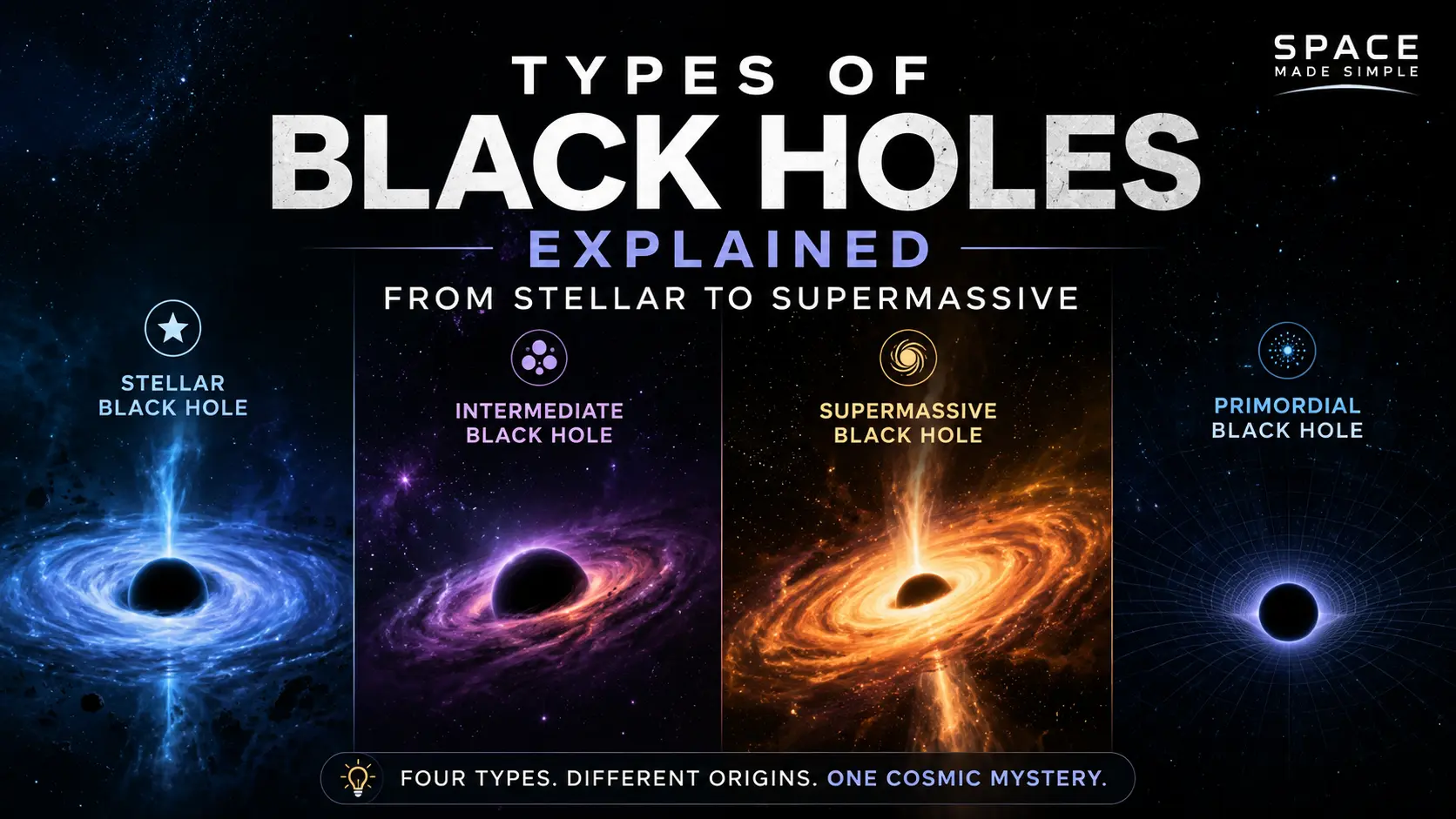
When most people picture a black hole, they imagine a single monstrous void devouring everything nearby. But not all black holes are the same. Just like stars come in different sizes and life stages, black holes fall into distinct categories based on their mass, origin, and behavior. Understanding these types helps explain how galaxies evolve, why gravitational waves ripple through space, and what the universe looked like in its earliest moments.
If you are new to black holes, start with what a black hole is and what happens if you fall into one. Now let us break down the four main types astronomers recognize today.
Stellar-Mass Black Holes: The Most Common Type
Stellar-mass black holes are the lightweight champions of the black hole family, weighing between 4 and 100 times the mass of our Sun. They form when massive stars exhaust their nuclear fuel and collapse under their own gravity, triggering a supernova explosion. The core left behind compresses into a singularity surrounded by an event horizon.
These are the most abundant black holes in the universe, scattered throughout galactic disks like our Milky Way. Because they are relatively small and often isolated, they are difficult to detect unless they have a companion star feeding them material. When gas spirals inward, it heats up and emits X-rays, giving astronomers a beacon to find them. Recent studies suggest there could be millions of stellar-mass black holes wandering silently through our galaxy, invisible until they briefly lens background starlight or merge with another compact object.
Intermediate-Mass Black Holes: The Missing Link
Between stellar and supermassive black holes lies a mysterious category: intermediate-mass black holes, ranging from 100 to 100,000 solar masses. For decades, these were considered the "missing link" because few candidates had been confirmed. Astronomers expected them to exist as stepping stones that grow into supermassive giants, but observational evidence was scarce.
That changed recently. In July 2025, astronomers caught an intermediate-mass black hole named NGC 6099 HLX-1 actively devouring a star in a distant galaxy, producing a bright X-ray flare that confirmed its mass range. Additionally, strong evidence now points to an intermediate-mass black hole lurking in the Omega Centauri globular cluster, tugging on nearby stars in ways only a 40,000-solar-mass object could explain. These discoveries suggest intermediate black holes may be more common than previously thought, hiding in dense star clusters where mergers can build them up over time.
Supermassive Black Holes: Galactic Anchors
At the heavy end of the spectrum sit supermassive black holes, weighing millions to billions of solar masses. Nearly every large galaxy hosts one at its center, including our Milky Way's Sagittarius A* and the record-breaking TON 618. How they grew so large remains an active area of research, but leading theories involve continuous gas accretion and repeated mergers over cosmic time.
Supermassive black holes shape their host galaxies through powerful feedback mechanisms. As material falls in, it releases enormous energy that can heat surrounding gas and suppress star formation, effectively regulating galactic growth. The James Webb Space Telescope recently measured the mass of a dormant supermassive black hole from the early universe at six billion solar masses, proving these giants existed remarkably soon after the Big Bang. You can explore the extreme physics of the largest known example in our guide to TON 618, the largest black hole explained.
Primordial Black Holes: Relics from the Big Bang
The fourth category is still hypothetical but gaining serious attention: primordial black holes. Unlike the other three types, these would not have formed from dying stars. Instead, they could have collapsed directly from density fluctuations in the first fractions of a second after the Big Bang. Their masses could range from tiny asteroid-scale objects to thousands of solar masses.
Primordial black holes have re-emerged as a viable dark matter candidate in recent years. A 2026 study showed that primordial black holes in the asteroid-mass window could account for all of the universe's dark matter without violating existing observational constraints. While none have been directly detected yet, upcoming microlensing surveys and gravitational wave observatories may finally confirm whether these ancient relics populate the cosmos. If they exist, they would be the oldest black holes in existence, predating the first stars by hundreds of millions of years.
Four Types of Black Holes at a Glance
Comparing the four categories side by side makes their differences clear:
| Type | Mass Range | How It Forms | Where Found | Confirmed? |
|---|---|---|---|---|
| Stellar-Mass | 4-100 solar masses | Core collapse of massive stars | Galactic disks, binary systems | Yes, abundant |
| Intermediate | 100-100,000 solar masses | Mergers or direct collapse in clusters | Globular clusters, dwarf galaxies | Yes, rare but confirmed |
| Supermassive | Millions-billions solar masses | Accretion and mergers over cosmic time | Center of large galaxies | Yes, in most galaxies |
| Primordial | Asteroid-mass to thousands solar masses | Density fluctuations after Big Bang | Throughout universe (hypothetical) | Not yet detected |
This table shows why classification matters: each type tells a different story about cosmic evolution, from stellar death to the universe's first moments.
Why Black Hole Classification Matters
Categorizing black holes is not just academic bookkeeping. Each type serves as a probe for different physical regimes. Stellar-mass mergers produce gravitational waves detectable by LIGO, helping test general relativity in strong-field conditions. Intermediate black holes reveal how structure builds hierarchically in the universe. Supermassive black holes constrain models of galaxy formation and feedback. Primordial black holes, if confirmed, would revolutionize our understanding of dark matter and early-universe cosmology.
Together, these four classes form a complete picture of how gravity sculpts the cosmos across all scales. As telescopes like JWST, LISA, and next-generation X-ray observatories come online, we will likely discover new subtypes and refine these boundaries further.
Key Takeaways
- Black holes fall into four main categories: stellar-mass, intermediate, supermassive, and primordial.
- Stellar-mass black holes are the most common, born from supernovae of massive stars.
- Intermediate-mass black holes were long considered missing links but are now being confirmed in globular clusters.
- Supermassive black holes anchor galactic centers and regulate star formation through feedback.
- Primordial black holes remain hypothetical but are strong dark matter candidates according to 2026 research.
- Classification helps scientists probe different eras of cosmic history and test fundamental physics.
What Is Next in the Black Hole Series?
We have covered what black holes are, what happens when you fall into one, and how they are classified by mass. In our final installment, we will tackle the biggest misconceptions about black holes and replace them with what science actually says. Stay tuned, and revisit our beginner's guide to black holes if you need a refresher before the series finale.