What Is a Pulsar? The Cosmic Lighthouse Explained Simply
Discover what a pulsar is in simple terms. Learn how these spinning zombie stars form, why they pulse like cosmic lighthouses, and compare them to regular stars.
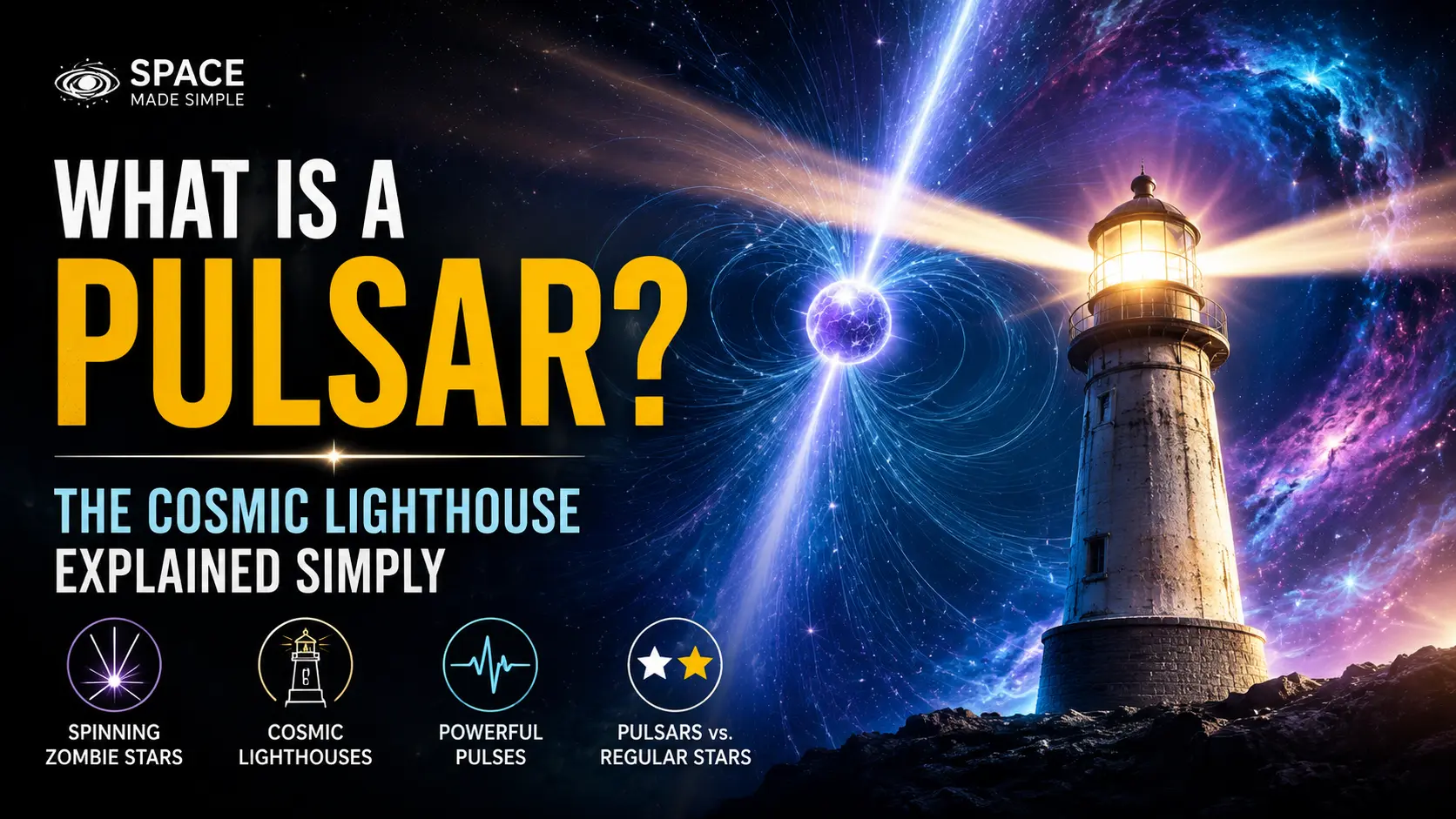
Imagine a star that has died, collapsed into a city-sized ball, and now spins hundreds of times per second while blasting beams of energy across the universe. It sounds like science fiction, but this object is real. Astronomers call it a pulsar, and it is one of the most fascinating "zombie stars" in existence.
If you have ever wondered what a pulsar is or why astronomers are so obsessed with them, you are in the right place. Let us break down these cosmic lighthouses without the complicated jargon.
How Does a Pulsar Form?
To understand a pulsar, we first need to understand its dramatic birth. Pulsars do not just appear out of nowhere; they are the leftovers of massive stars.
When a star much heavier than our Sun runs out of fuel, it can no longer support its own weight. The core collapses in a fraction of a second, triggering a colossal explosion known as a supernova. While the outer layers are blasted into space, the core gets crushed under immense gravity.
This crushing force squeezes protons and electrons together to form neutrons. The result is a neutron star, an object so dense that a single teaspoon of its material would weigh billions of tons on Earth. If this newborn neutron star spins rapidly and has a strong magnetic field, it becomes a pulsar.
Why Do Pulsars Pulse? The Lighthouse Effect
The name "pulsar" comes from "pulsating star," but the star itself is not actually expanding and contracting like a beating heart. The pulsing effect is entirely an illusion of perspective.
Think of a lighthouse on a rocky coast. The lamp inside rotates continuously, emitting a steady beam of light. However, if you are standing on a ship at sea, you only see a flash when the beam sweeps directly across your line of sight. Between flashes, the beam is pointing elsewhere, and the lighthouse appears dark.
Pulsars work exactly the same way. They emit continuous beams of radiation from their magnetic poles. Because the magnetic axis is usually tilted relative to the rotation axis, the beam sweeps through space like a lighthouse. When that beam crosses Earth, our telescopes detect a brief, incredibly precise pulse. This mechanism is often referred to as the lighthouse effect.
Pulsar vs. Regular Star vs. Black Hole
Pulsars occupy a strange middle ground in stellar evolution. They are far denser than normal stars but have not quite crossed the threshold to become black holes. Here is a simple comparison to visualize the difference:
| Feature | Pulsar (Neutron Star) | Regular Star (Like Our Sun) | Black Hole |
|---|---|---|---|
| Size | ~20 km wide (city-sized) | ~1.4 million km wide | Varies (singularity + event horizon) |
| Mass | 1-2x the Sun's mass | 1x Solar mass | 3x+ the Sun's mass |
| Density | Extreme (atomic nucleus level) | Moderate (plasma/gas) | Infinite (at singularity) |
| Light Source | Magnetic beam & residual heat | Nuclear fusion in core | None (traps all light) |
| Rotation | Up to 700+ times per second | ~27 days (Sun's equator) | Can spin near light speed |
Why Are Pulsars Important to Science?
Pulsars are not just cool oddities; they are essential tools for modern astronomy. Because their pulses are so regular, some millisecond pulsars rival atomic clocks in precision. Scientists use them for three major purposes:
- Cosmic Navigation: Just as GPS satellites help us navigate Earth, pulsars could serve as a galactic positioning system for future deep-space probes.
- Detecting Gravitational Waves: By monitoring tiny irregularities in pulsar timing across the galaxy, astronomers can detect ripples in spacetime caused by merging supermassive black holes.
- Testing Extreme Physics: Pulsars allow us to study matter under conditions impossible to recreate in laboratories on Earth, helping us understand the fundamental forces of nature.
Key Takeaways
- A pulsar is a highly magnetized, rotating neutron star formed from a supernova.
- The "pulse" is a lighthouse effect caused by beams sweeping past Earth, not physical expansion.
- Pulsars are city-sized but contain more mass than our Sun.
- They serve as ultra-precise cosmic clocks and navigation beacons.
- Not all neutron stars are pulsars; they must be oriented correctly for us to detect their beams.
Final Thoughts
Pulsars remind us that the universe is full of extremes. From violent stellar deaths emerge objects of breathtaking precision and beauty. As telescopes like FAST and CHIME continue to discover new pulsars, our understanding of these cosmic lighthouses will only grow deeper. Next time you look up at the night sky, remember that somewhere out there, a zombie star is spinning in the darkness, faithfully keeping time for the cosmos.