Meet TON 618: The Largest Black Hole Ever Found
ExDiscover TON 618, the record-breaking black hole with 40 billion solar masses. Learn its true size, quasar power, and why recent 2026 data changed everything.plained Simply
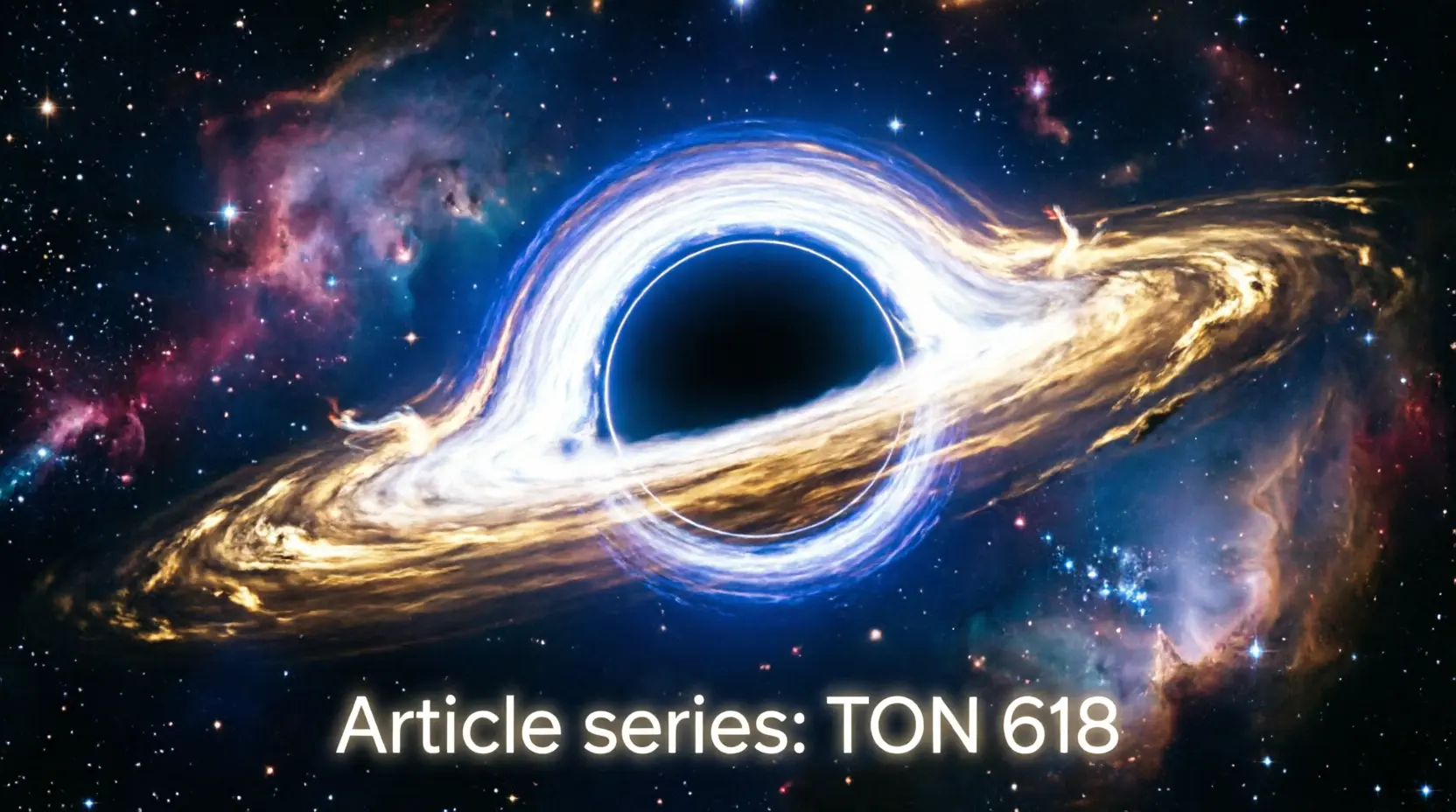
When we talk about the biggest objects in the universe, our brains struggle to comprehend the scale. But there is one cosmic entity that consistently breaks every record we thought possible: TON 618. For years, internet videos claimed this monster weighed 66 billion times the mass of our Sun. However, updated research in 2026 has refined that number to a more accurate, yet still mind-bending, 40.7 billion solar masses. Even with this correction, TON 618 remains the most massive black hole ever directly measured by humanity.
If you have ever wondered what sits at the absolute extreme of cosmic scales, you are in the right place. Let us strip away the complex jargon and understand what TON 618 actually is, how we found it, and why the latest data makes it even more fascinating.
Not Just a Black Hole, But a Quasar
It is important to clarify a common misconception. When astronomers point their telescopes at TON 618, they do not see a dark void. They see one of the brightest objects in the known universe. TON 618 is technically a quasar.
A quasar is an extremely luminous active galactic nucleus powered by a supermassive black hole. As gas, dust, and stars fall toward the event horizon, they form a swirling accretion disk that heats up to millions of degrees. This friction releases staggering amounts of light and radiation across the electromagnetic spectrum. The black hole itself is invisible, but the chaotic feast surrounding it outshines entire galaxies. TON 618 shines with the luminosity of 140 trillion Suns, making it visible from over 10 billion light-years away.
From Faint Star to Cosmic Monster
The story of TON 618 is a perfect example of how science evolves. It was first cataloged in 1957 during the Tonantzintla survey in Mexico, where it appeared as nothing more than a faint blue star. At the time, nobody suspected it was anything special.
Everything changed in 1970 when a radio survey in Bologna, Italy detected strong radio emissions coming from the same coordinates. This confirmed it was not a star, but a quasar. Decades of spectroscopic analysis followed, allowing astronomers to measure the speed of gas orbiting its center. By applying simple gravitational physics to those orbital speeds, scientists were able to weigh the invisible object at its core. What started as a dot on a photographic plate turned out to be the heaviest single object ever identified.
Why the Mass Changed from 66 Billion to 40.7 Billion
You might be wondering why so many sources still cite 66 billion solar masses while current scientific consensus points to 40.7 billion. The answer lies in better measurement techniques.
The original 66-billion figure came from older models that assumed certain properties about the broad emission lines in the quasar's spectrum. As Sky at Night Magazine explains, newer calibration methods and larger telescope datasets have allowed researchers to refine those calculations. The revised 40.7-billion-solar-mass figure is now considered far more reliable. Do not let the lower number disappoint you. At 40.7 billion solar masses, TON 618 still outweighs all the stars in our Milky Way galaxy combined by a significant margin.
What JWST Revealed in 2026
For decades, TON 618 was so bright that its own glare completely washed out the galaxy hosting it. Astronomers knew a host galaxy had to exist, but they could not study it. That changed with the James Webb Space Telescope.
Recent 2026 observations have finally pierced through the quasar's blinding light to reveal the structure of the surrounding host galaxy. According to Vision Times, these new images confirm that TON 618 sits at the heart of a massive elliptical galaxy, providing crucial clues about how such monstrous black holes co-evolve with their stellar environments. This discovery transforms TON 618 from an isolated curiosity into a key piece of the galaxy formation puzzle.
What Comes Next?
TON 618 challenges our understanding of physical limits. How did something get this big? Is there a theoretical ceiling to black hole growth? And perhaps most importantly for our imagination, just how large is 40.7 billion solar masses in real, tangible terms?
In the next article of this series, we will leave the numbers behind and focus entirely on visualization. We will compare TON 618 to our Sun, our Solar System, and even the distance between stars, using simple analogies that make the impossible feel almost graspable. Stay tuned, because the scale of this monster deserves its own dedicated exploration.
For a visual sense of how TON 618 compares to other giant black holes, check out this NASA animation sizing up the universe's biggest black holes.