The Physics of a Monster: How TON 618 Powers a Quasar
Why is the darkest object in space also the brightest? Learn how TON 618's accretion disk powers a quasar shining with 140 trillion suns, explained simply.
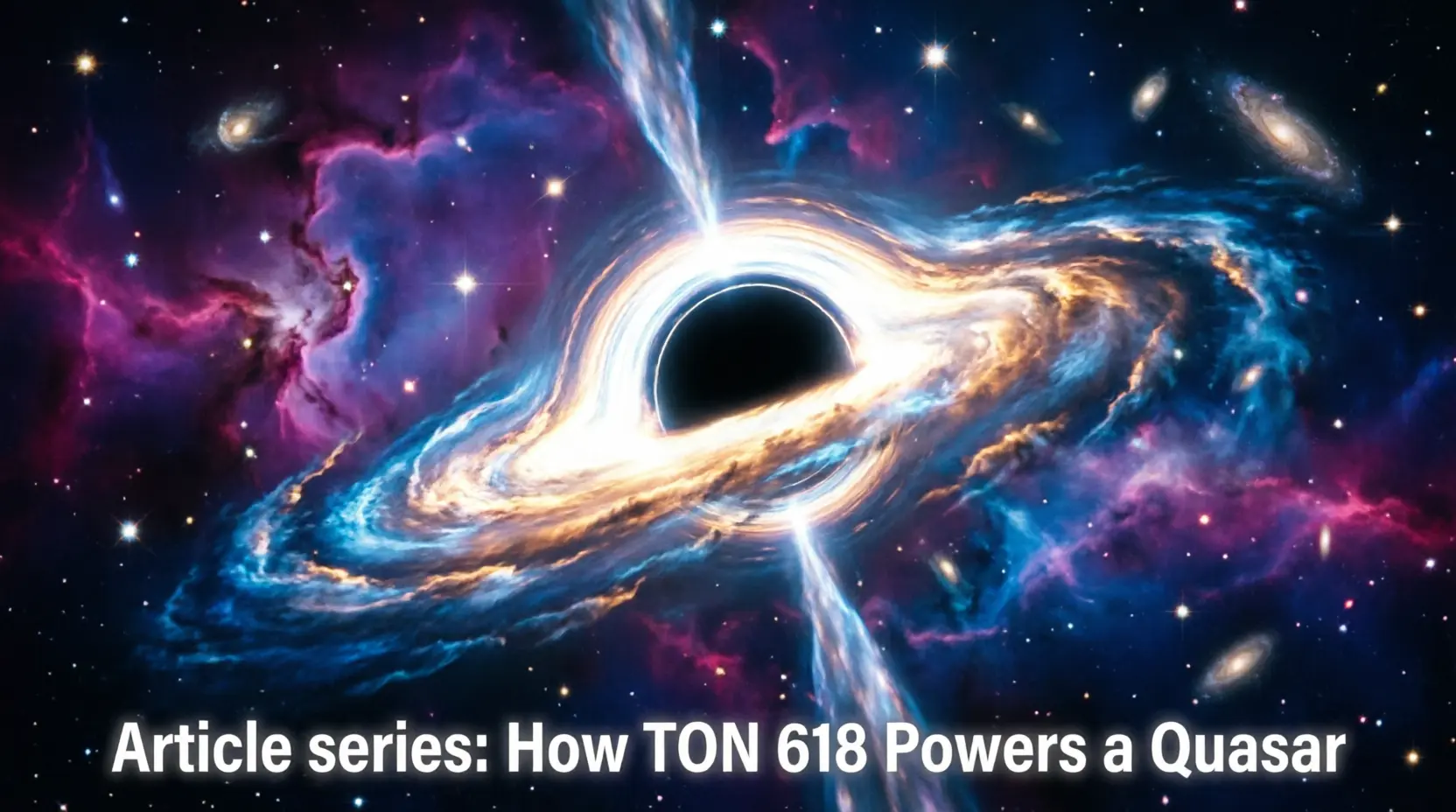
When you hear the words black hole, you probably picture a silent, dark void floating in empty space. It is the ultimate cosmic trap, a place where light goes to die. So how does it make sense that TON 618, the most massive black hole ever measured, is also one of the brightest objects in the entire observable universe?
This apparent contradiction is exactly what makes TON 618 so fascinating. The secret lies in understanding the difference between the black hole itself and the violent engine surrounding it. In this article, we will break down the simple physics of quasars and accretion disks, explaining how falling matter transforms into a beacon visible across 10 billion light-years of empty space.
Black Hole Versus Quasar: Clearing the Confusion
Before we explain the light, we need to separate two terms that people often use interchangeably. A black hole is a gravitational object defined by its event horizon, the boundary past which nothing can return. A quasar, on the other hand, is not the hole itself. A quasar is the spectacular light show produced when a supermassive black hole actively feeds on surrounding material.
Think of it like a campfire. The black hole is the dark, cold pit in the center where the ashes fall. The quasar is the roaring, brilliant flame dancing around the edge. TON 618 is technically both. It contains an ultramassive black hole weighing 40.7 billion times our Sun, but because it is currently consuming vast amounts of gas and dust, we observe it as a hyper-luminous quasar. If the black hole stopped eating, the quasar would turn off, leaving only invisible gravity behind.
The Accretion Disk: Where Gravity Becomes Light
So where does all that incredible brightness come from? The answer is friction and speed.
Gas clouds, shattered stars, and cosmic dust near TON 618 do not fall straight into the center like a rock dropping into a well. Because the black hole is spinning and has immense angular momentum, this infalling material spirals inward, forming a flat, swirling structure called an accretion disk. As described by NASA Science, these disks are rings of gas and dust that emit intense light across many wavelengths, including visible light and X-rays.
Inside this disk, particles are forced to orbit at nearly the speed of light. They constantly crash and rub against each other, generating unimaginable amounts of heat. We are talking about temperatures reaching millions of degrees. At those extremes, matter stops behaving like a normal gas and becomes a glowing plasma. This superheated plasma radiates energy so efficiently that it converts gravitational pull directly into pure electromagnetic light. It is the most efficient energy production process in the known universe, far surpassing the nuclear fusion that powers our own Sun.
Shining Brighter Than 140 Trillion Suns
The numbers behind the TON 618 quasar are difficult to process without proper context. Astronomers estimate that the accretion disk of TON 618 emits light equal to 140 trillion times the luminosity of our Sun.
To visualize that power, consider our home galaxy. The Milky Way contains between 100 billion and 400 billion stars. If you combined the light of every single star in our galaxy, TON 618 would still outshine the entire collection by a factor of over a thousand. All of that energy is being generated in a region of space that, while enormous compared to our Solar System, is incredibly compact on a galactic scale. It is like packing the light output of thousands of galaxies into a single bright dot.
This extreme radiation does not just travel outward into empty space. According to Space Wiki, the energy pouring out of TON 618 is so intense that it excites hydrogen atoms in the surrounding nebula, forcing the gas clouds themselves to glow brightly in specific ultraviolet wavelengths. The monster does not just shine; it forces the surrounding universe to light up with it.
The Feeding Rate of a Cosmic Vacuum
To maintain a brightness of 140 trillion suns, TON 618 requires a constant and massive supply of fuel. It cannot shine this brightly on reserves alone. Current astrophysical models suggest that this behemoth is actively consuming the equivalent of one to two entire solar masses every single year.
Imagine swallowing something the size of our Sun, completely vaporizing it, and converting its mass into raw light, not over a million years, but annually. This continuous feasting is what keeps the accretion disk hot and the quasar active. The immense gravity of the 40.7-billion-solar-mass core acts as a relentless vacuum, pulling in anything that wanders too close to the inner edge of the disk. Once matter crosses that final threshold, it vanishes from our observable universe forever, leaving only its energy behind as radiation.
What Happens When the Fuel Runs Out?
Understanding the engine of TON 618 naturally leads to a slightly unsettling question for anyone living in the same universe. If this object is actively eating stars and shining with the power of 140 trillion suns, what does that mean for the rest of the cosmos? Is its gravity reaching out across billions of light-years to pull in more fuel? Could something this powerful ever threaten our own galactic neighborhood?
In the next article of our series, we will tackle the most common fear surrounding ultramassive black holes. We will calculate the actual safe distance, explain why expansion of the universe protects us, and answer the question directly: Could TON 618 ever swallow our galaxy? The short answer will bring you a lot of relief, but the long answer teaches us something beautiful about how spacetime actually works.