When Pulsars Break: Glitches, Nulling, and Cosmic Mysteries
Discover why ultra-precise pulsars sometimes glitch or go silent. Learn about starquakes, superfluid interiors, and the unsolved mysteries of nulling in simple terms.
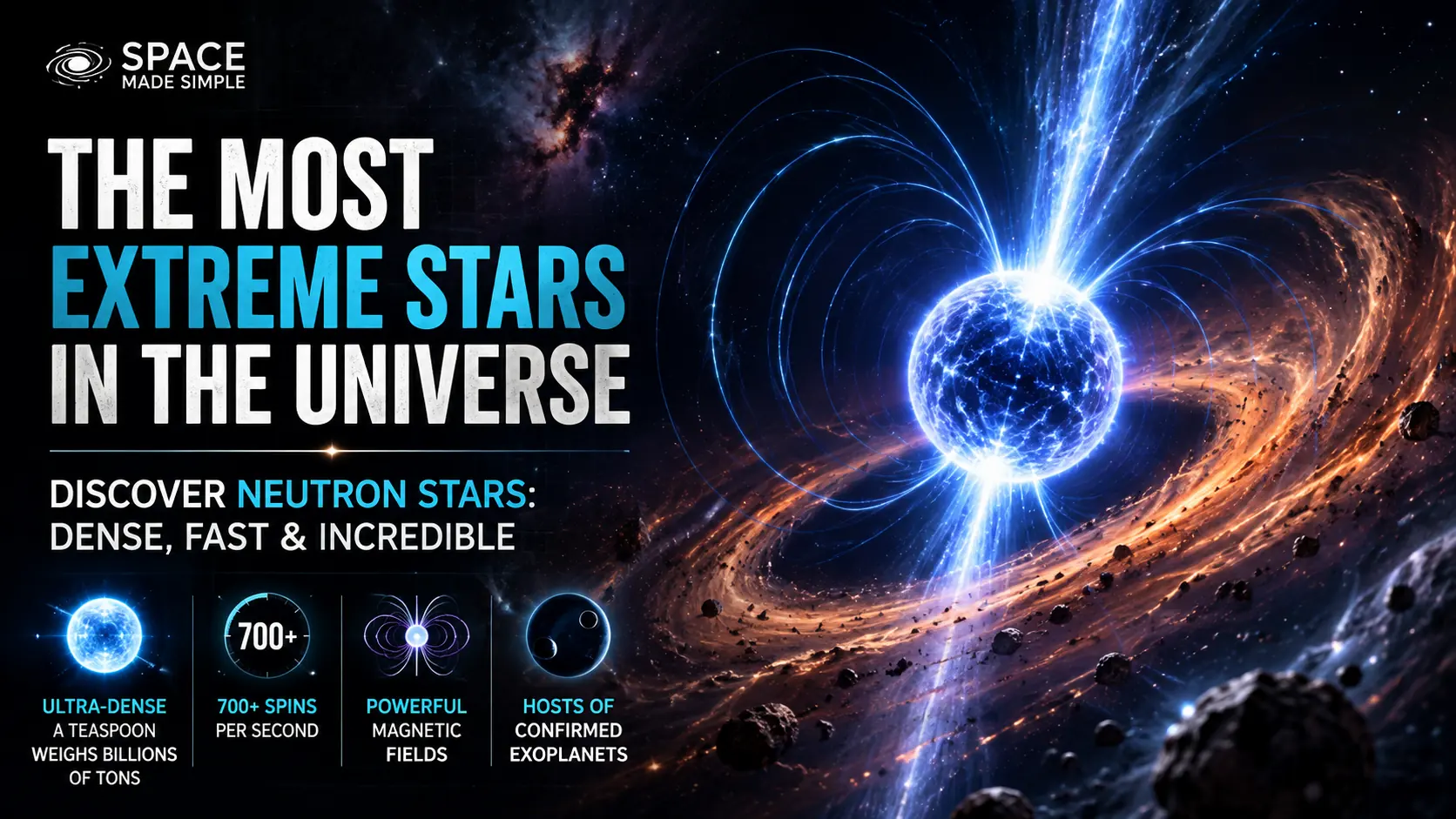
We have learned that pulsars are nature’s most precise clocks, spinning with such regularity that they rival atomic timekeepers. But even the best clocks can skip a beat. Sometimes, these cosmic metronomes suddenly speed up without warning. Other times, they simply stop pulsing altogether for minutes or hours. These events are called glitches and nulling, and they remind us that pulsars are not perfect machines but complex, dynamic objects hiding secrets deep within their exotic interiors.
If you missed our earlier guides, start with what a pulsar is and how millisecond pulsars get recycled. Now, let us explore what happens when these zombie stars break their own rules.
What Is a Pulsar Glitch?
A glitch is a sudden, tiny increase in a pulsar’s rotation rate. The change is minuscule, typically one part in a million, but it is permanent. After a glitch, the pulsar continues spinning faster than before, gradually settling into a new rhythm over weeks or months.
Think of a figure skater spinning on ice. If she pulls her arms inward, she spins faster due to conservation of angular momentum. A pulsar glitch works similarly, but instead of arms moving, something inside the star shifts abruptly, transferring rotational energy from the interior to the outer crust. This causes the entire star to spin up almost instantaneously.
Why Do Glitches Happen? Superfluids and Starquakes
The leading explanation involves superfluidity. Deep inside a neutron star, neutrons flow without friction as a quantum superfluid. This inner fluid rotates independently of the solid outer crust, storing angular momentum in quantized vortices. Normally, these vortices remain pinned to the crust. But when stress builds up, they suddenly unpin and rush outward, dumping angular momentum into the crust and causing a glitch. This mechanism is supported by observations showing post-glitch relaxation consistent with superfluid dynamics.
An alternative theory suggests starquakes, where the rigid crust cracks under stress like an earthquake, permanently shrinking the star’s moment of inertia and speeding up its rotation. Both mechanisms may operate in different types of pulsars, making glitches a window into physics we cannot replicate on Earth.
Glitch vs Nulling at a Glance
Glitches and nulling are both timing irregularities, but they affect pulsars in fundamentally different ways. Here is how to tell them apart:
| Feature | Glitch | Nulling |
|---|---|---|
| What Changes | Rotation speed increases permanently | Radio emission temporarily disappears |
| Duration | Permanent shift, recovery over weeks-months | Seconds to hours, then resumes normally |
| Cause | Internal angular momentum transfer | Magnetospheric emission switch-off |
| Frequency | Rare (young pulsars glitch every few years) | Common (some pulsars null 30% of the time) |
| Detectability | Seen in pulse arrival times | Seen as missing pulses in raw data |
This distinction matters because glitches probe the star’s interior, while nulling reveals processes in the magnetosphere above the surface.
Pulsar Nulling: When the Lighthouse Goes Dark
Nulling occurs when a pulsar’s radio beam simply stops emitting detectable radiation, even though the star keeps spinning. It is not a mechanical failure; the lighthouse is still rotating, but the light has been switched off. Nulling was first discovered in 1970 and remains poorly understood.
Recent research suggests nulling is a stochastic process driven by instabilities in the pulsar’s magnetosphere. In 2026, astronomers reported time-variable periodic nulling in PSR B0751+32, where the star alternates between active and null states in a predictable cycle. This challenges older models that treated nulling as purely random and hints at underlying order in the chaos. Some millisecond pulsars, long thought immune to such behavior, have also shown rare glitches, blurring the line between young and recycled populations.
Why These Mysteries Matter
Glitches and nulling are not just curiosities; they are critical noise sources for pulsar timing arrays searching for gravitational waves. To detect nanohertz ripples in spacetime, scientists must model every source of timing variation perfectly. Understanding glitches helps distinguish true gravitational signals from internal stellar noise. Meanwhile, nulling studies constrain models of particle acceleration near neutron stars, informing theories about high-energy astrophysical plasmas.
These phenomena also test quantum mechanics at macroscopic scales. Superfluid vortex dynamics in pulsars offer the only natural laboratory for studying quantum turbulence under extreme gravity and density. Every glitch observed brings us closer to mapping the equation of state of matter beyond nuclear saturation.
Series Wrap-Up and Key Takeaways
Over three articles, we have journeyed from pulsar basics to recycling and now to their most enigmatic behaviors. Remember these core points:
- Glitches are sudden spin-ups caused by superfluid vortex unpinning or starquakes in the neutron star interior.
- Nulling is temporary cessation of radio emission due to magnetospheric instabilities, not mechanical failure.
- Glitches change rotation permanently; nulling changes emission temporarily.
- Recent discoveries show periodic nulling patterns and rare glitches in millisecond pulsars, challenging old assumptions.
- Studying these irregularities advances gravitational wave detection and quantum physics under extreme conditions.
Pulsars are far more than steady beacons. They are living laboratories where gravity, quantum mechanics, and plasma physics collide. While this series concludes here, the universe of simple space explanations continues. Explore our other articles on exoplanets, black holes, and cosmology to keep your cosmic curiosity alive. The next mystery is always just one click away.