Why Don't All Asteroids Burn Up in Earth's Atmosphere? Simple Physics Explained
Ever wonder why some space rocks reach Earth while others vanish? Learn the simple physics of size, speed, and composition that determine if an asteroid survives atmospheric entry.
Every day, Earth is bombarded by tons of space debris. Most of it vanishes in a flash of light high above our heads. But occasionally, a rock survives the fiery descent and lands on the ground as a meteorite.
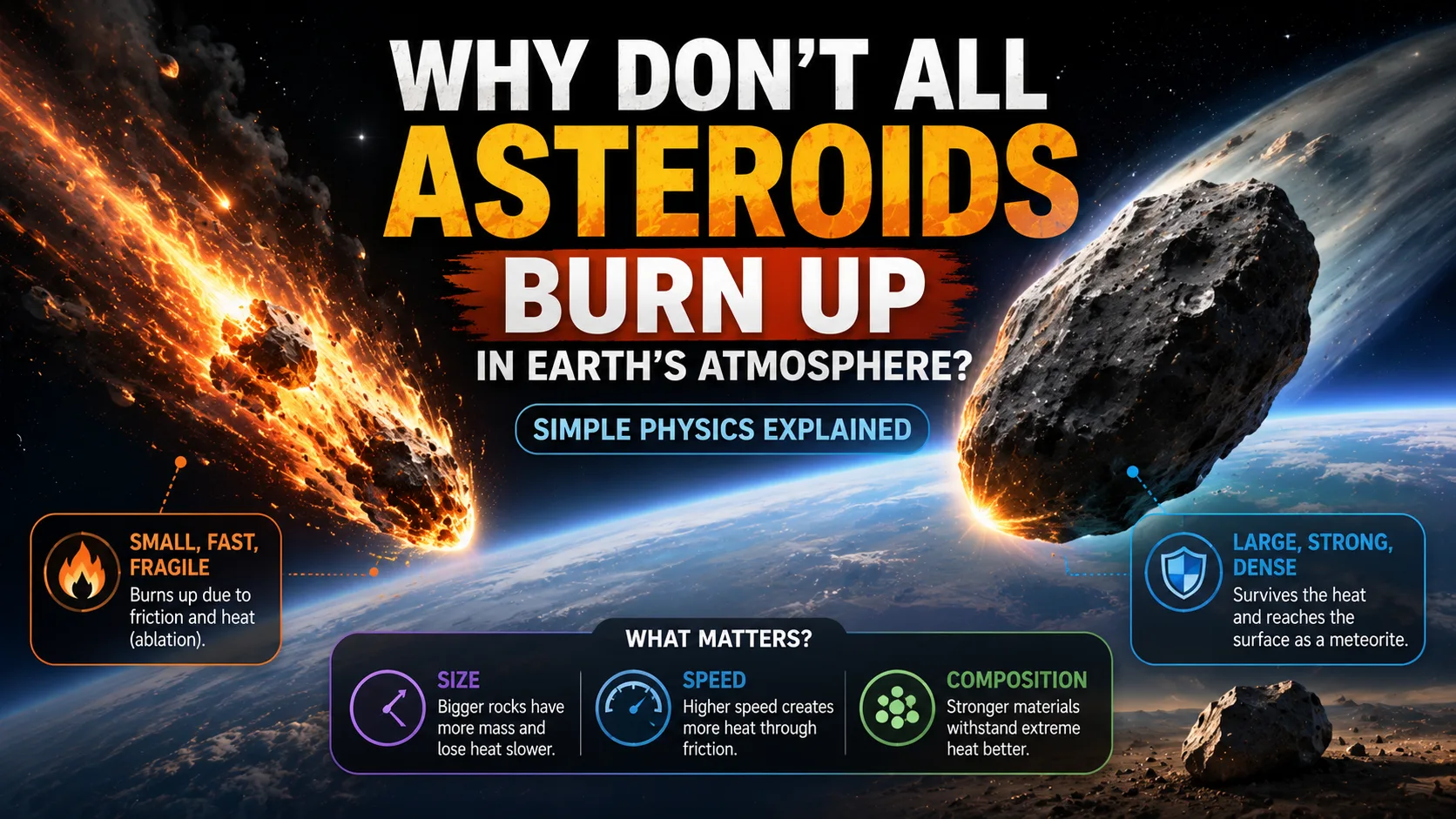
Why does this happen? Why don't all asteroids and meteoroids burn up completely? The answer lies in a fascinating battle between three simple factors: size, speed, and composition.
The Atmospheric Shield: Earth's First Line of Defense
Before we dive into why some objects survive, let's understand what they're up against. Earth's atmosphere acts like a protective shield. When a space object enters at high speed, it slams into air molecules with tremendous force.
This isn't just "friction" in the traditional sense. At hypersonic speeds (typically 11 to 72 kilometers per second), the air in front of the object can't move out of the way fast enough. It compresses violently, creating a shock wave that heats the air to thousands of degrees Celsius. This superheated plasma is what causes the glowing streak we see as a meteor.
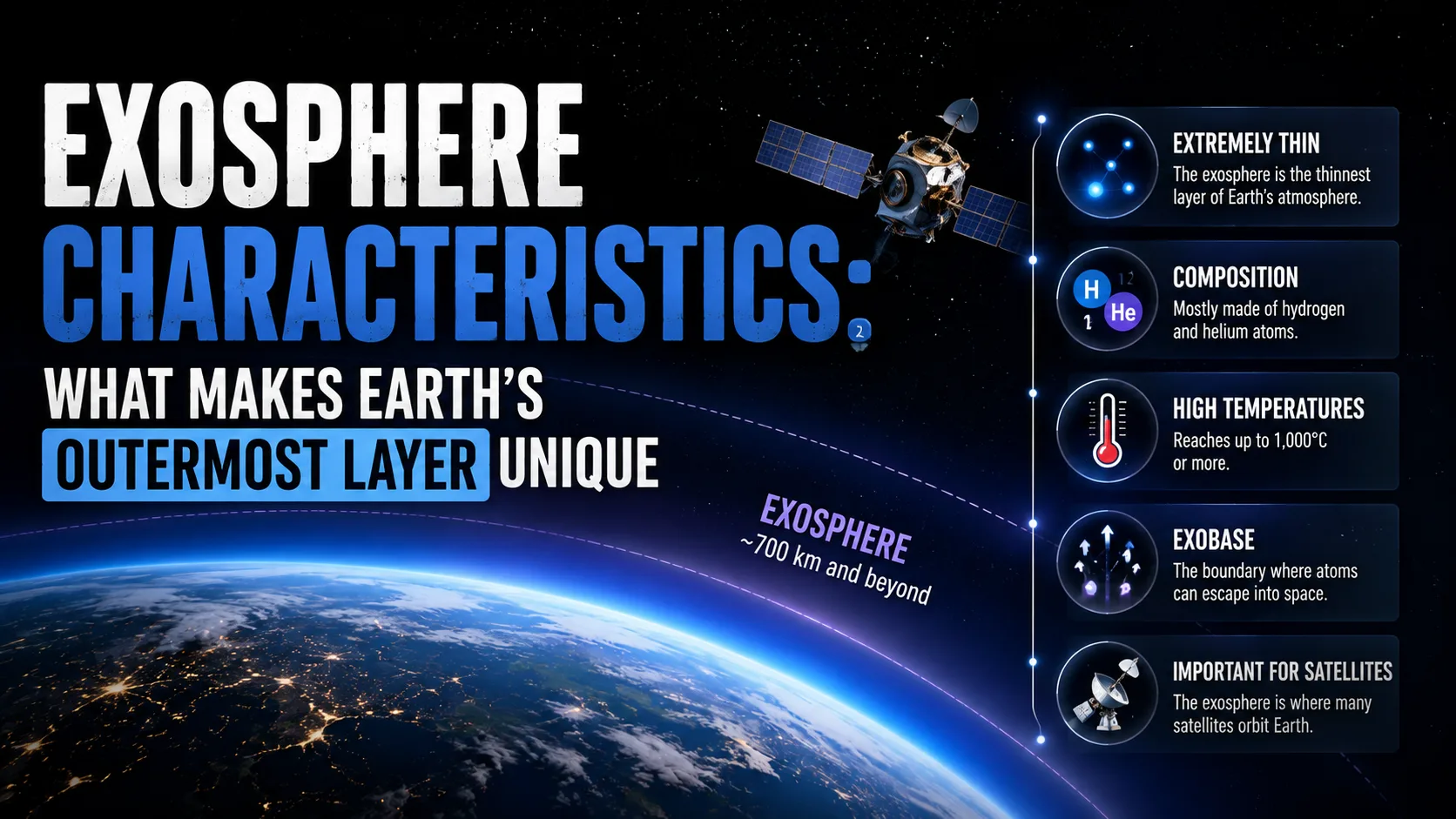
For context on where this process begins, the exosphere is the outermost layer of our atmosphere where these high-speed encounters first occur.
Factor 1: Size Matters More Than You Think
The single most important factor determining survival is mass. According to NASA's meteorite facts, most meteoroids are tiny—some as small as a grain of sand. These disintegrate almost instantly.
Here's a rough guide to survival thresholds:
- Dust to pebble-sized (<1 cm): Almost always burns up completely. Creates faint meteors.
- Marble to fist-sized (1-10 cm): May partially survive if entering slowly or at a shallow angle. Often fragments.
- Basketball-sized and larger (>30 cm): High probability of surviving as a meteorite, though significant mass is lost through ablation.
- Car-sized and larger: Will definitely reach the surface, potentially causing significant damage.
The reason size matters so much is geometry. As an object travels through the atmosphere, it loses mass from its surface through ablation (burning away). A larger object has a smaller surface-area-to-volume ratio, meaning it loses a smaller percentage of its total mass during the brief passage through the atmosphere.
Factor 2: Speed Is the Great Destroyer
Entry velocity dramatically affects survival chances. Objects entering at higher speeds experience exponentially more heating and deceleration forces.
Typical entry speeds range from:
- 11 km/s (minimum, for objects catching up to Earth from behind)
- 20-25 km/s (average for most meteoroids)
- Up to 72 km/s (maximum, for head-on collisions with retrograde objects)
A meteoroid entering at 70 km/s experiences roughly 40 times more kinetic energy than one entering at 11 km/s. This means far more intense heating and greater structural stress. Slower entries give objects a much better chance of surviving intact.
As explained in detail by HowStuffWorks, entry speed determines the amount of friction and compression heating an object experiences, directly influencing whether it reaches the ground.
Factor 3: Composition Determines Strength
Not all space rocks are created equal. Their internal structure and material strength play crucial roles:
Iron-Nickel Meteorites: These are the toughest survivors. Composed primarily of metal, they have high melting points and structural integrity. Iron meteorites are overrepresented in museum collections precisely because they survive atmospheric entry more reliably than stony types.
Stony Meteorites: Made mostly of silicate minerals, these are more fragile. They often fragment or explode mid-air due to thermal stress and aerodynamic pressure. Many stony meteoroids break apart before reaching the surface.
Cometary Debris: Typically very porous and weak, composed of ice and loosely bound dust. These almost never survive as meteorites. They create beautiful meteor showers but rarely produce recoverable specimens.
The Ablation Process: How Space Rocks Lose Mass
Ablation is the key mechanism that protects Earth's surface. As a meteoroid heats up, its outer layers melt and vaporize, carrying heat away from the interior. This sacrificial cooling allows the core to remain relatively cool—if the object is large enough.
Think of it like sweating. Your body releases moisture that evaporates and cools you down. Similarly, a meteoroid sheds hot material to protect its remaining mass. However, unlike sweating, ablation permanently removes material. If too much is lost, nothing remains.
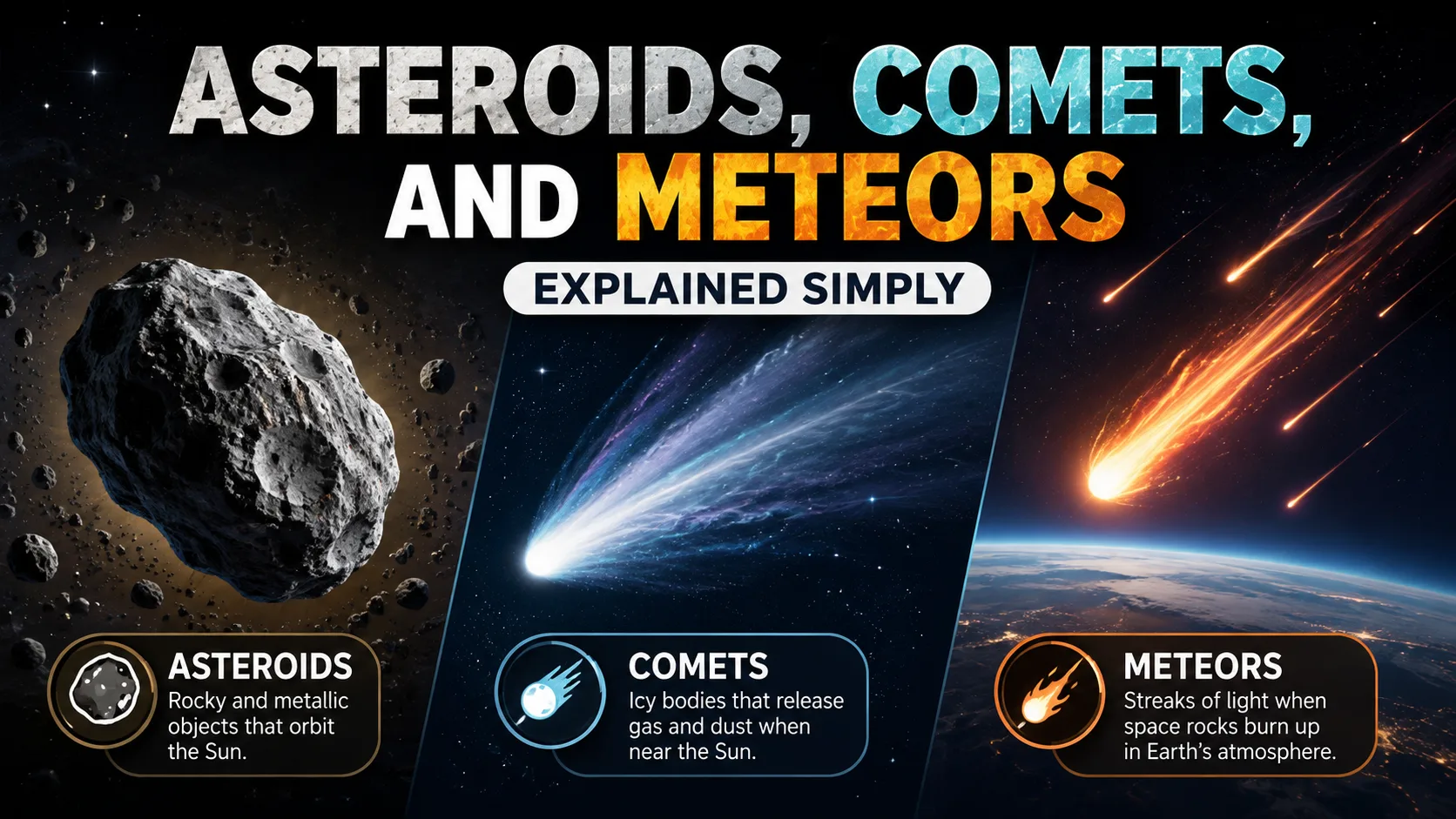
For a deeper understanding of how different space objects behave during entry, our article on the difference between asteroids, comets, and meteors explains the terminology and physics behind each stage.
Angle of Entry: The Overlooked Variable
The trajectory matters too. A steep, vertical entry minimizes time spent in the atmosphere but maximizes peak heating rates. A shallow entry spreads the deceleration over a longer path, reducing peak temperatures but increasing total exposure time.
Very shallow entries can even cause objects to skip off the atmosphere like stones skipping across water, never fully penetrating to lower altitudes. Moderate angles (around 30-45 degrees) often provide the best balance for survival, allowing sufficient deceleration without excessive peak heating.
Real-World Examples: Survivors and Casualties
Chelyabinsk (2013): A ~20-meter asteroid entered at ~19 km/s and exploded at 30 km altitude. Despite being relatively large, its stony composition and high speed caused catastrophic fragmentation. Only small fragments reached the ground.
Sikhote-Alin (1947): An iron meteoroid of similar size survived much better due to its metallic composition, producing numerous large meteorites despite entering at comparable speeds.
Tunguska (1908): Likely a stony asteroid or comet fragment that completely disintegrated at 5-10 km altitude. No meteorites were recovered, suggesting either weak composition or extreme entry conditions.
These cases illustrate how composition and structure can matter as much as raw size.
Why This Knowledge Protects Us
Understanding atmospheric filtering isn't just academic. For planetary defense scientists tracking potentially hazardous asteroids, knowing which objects might survive helps assess true impact risk. A 50-meter iron asteroid poses a very different threat than a 50-meter rubble pile, even if both are detected at the same distance.
This connects directly to ongoing monitoring efforts described in our guide on how scientists track dangerous asteroids. Detection alone isn't enough—we must also predict atmospheric behavior to evaluate real danger levels.
The Bottom Line
Not all asteroids burn up because survival depends on a combination of:
- Size: Larger objects lose proportionally less mass
- Speed: Slower entries generate less destructive heating
- Composition: Stronger materials resist fragmentation and ablation
- Entry Angle: Trajectory affects heating duration and intensity
Earth's atmosphere is remarkably effective at filtering out small and weak objects. But for anything larger than about a meter, especially if made of metal or entering slowly, survival becomes likely. This natural shield has protected life on Earth for billions of years—but understanding its limits helps us prepare for the rare exceptions that do get through.