The Dark Side of Proxima Centauri: Flares and the Future of Interstellar Travel
Red dwarfs like Proxima Centauri are known for their intense magnetic activity. They frequently produce massive bursts of energy called stellar flares.
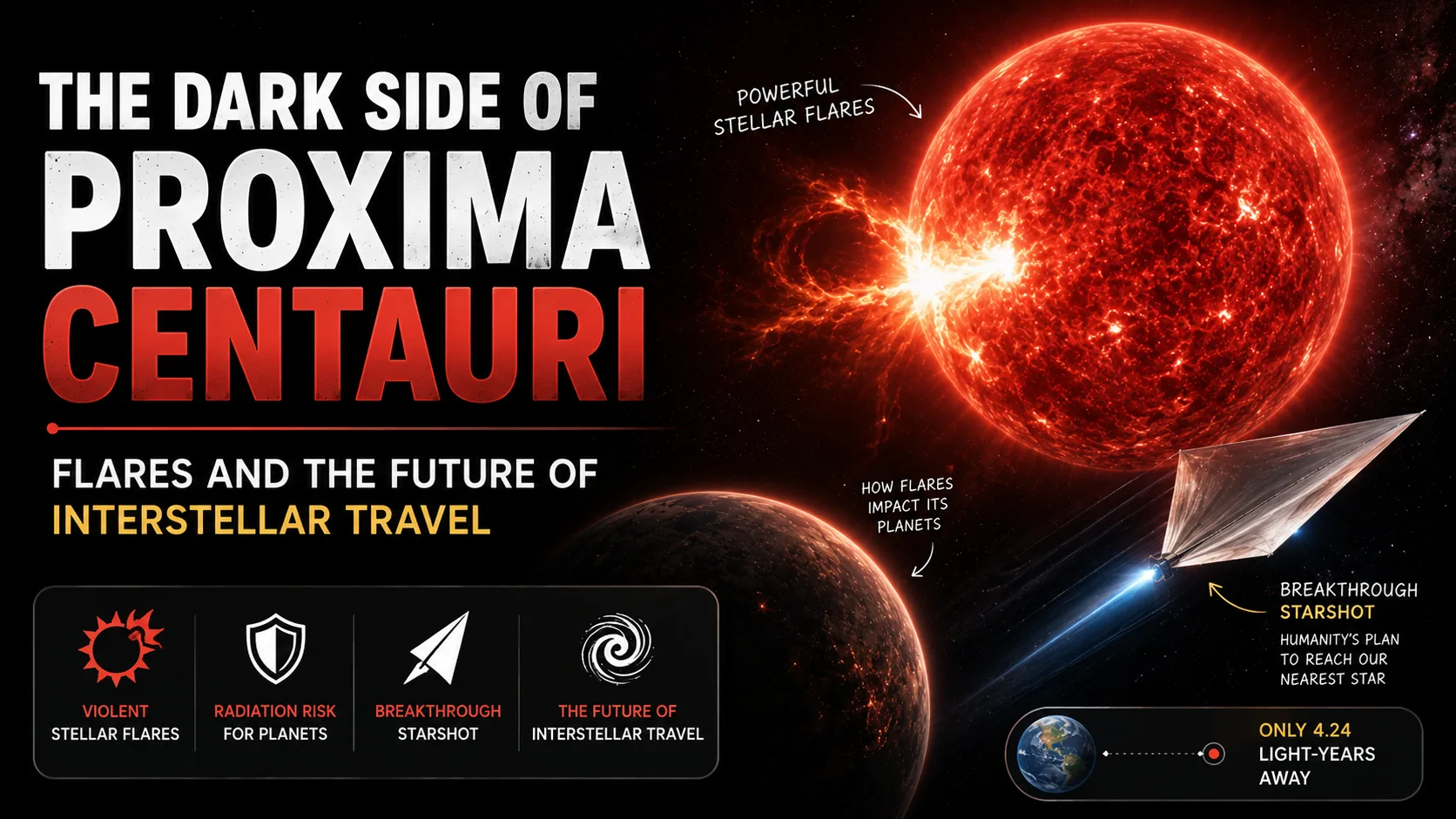
We have learned that Proxima Centauri is our closest neighbor and that it hosts a potentially habitable planet, Proxima Centauri b. But this tiny red dwarf has a dangerous secret. It is not a calm, quiet star like our Sun; it is a volatile and unpredictable neighbor.
The Danger of Stellar Flares
Red dwarfs like Proxima Centauri are known for their intense magnetic activity. They frequently produce massive bursts of energy called stellar flares. In 2016, astronomers observed a flare from Proxima Centauri that was so powerful it made the star thousands of times brighter for just a few minutes.
These flares release huge amounts of ultraviolet (UV) and X-ray radiation. For any life on Proxima b, this would be a major threat. The radiation could strip away the planet's atmosphere over time, leaving it exposed to the harsh vacuum of space. This is one of the main reasons why scientists are still debating whether Proxima b is truly habitable.
A Challenge for Future Explorers
If we ever decide to send humans or robots to Proxima Centauri, these flares will be a significant engineering challenge. Any spacecraft or habitat would need heavy shielding to protect against the sudden spikes in radiation. It is a reminder that "habitable" does not always mean "safe."
The Dream of Breakthrough Starshot
Despite the dangers, the dream of visiting our nearest star is alive and well. One of the most exciting projects is Breakthrough Starshot. The idea is simple but revolutionary: instead of sending a large, slow spaceship, we could send thousands of tiny, lightweight "starships" propelled by powerful lasers from Earth.
These tiny probes could theoretically reach 20% of the speed of light, allowing them to arrive at Proxima Centauri in just 20 years. While this is still a concept, it represents a major shift in how we think about interstellar travel.
Why Study Proxima Centauri?
You might ask, "Why go through all this trouble for a small, flaring star?" The answer is that Proxima Centauri is our testing ground. By studying its planets and its environment, we learn what to look for in other solar systems. It helps us understand the limits of life in the universe and pushes our technology to new heights.
Conclusion of the Series
From its discovery as our closest neighbor to the mysteries of its planets and the challenges of its violent nature, Proxima Centauri has taught us a lot. It is a world of contrasts: a tiny star with a big influence, and a potential home for life that is also a hazardous environment.
As we continue to explore the cosmos, Proxima Centauri will likely remain a primary target for our telescopes and, hopefully one day, our spacecraft. Thank you for joining us on this journey through our cosmic backyard!