Proxima Centauri: The Closest Star to Earth Explained Simply
Proxima Centauri is classified as a red dwarf. This means it is much smaller and cooler than our Sun. In fact, it has only about 12% of the Sun's mass and is roughly seven times smaller in size.

When we look up at the night sky, it is easy to feel small. But did you know that there is a star right next door? It is called Proxima Centauri, and it is the closest known star to our Sun.
Located just over four light-years away, Proxima Centauri is part of the Alpha Centauri triple star system. While it is our cosmic neighbor, it is very different from the bright yellow sun we see every day. In this article, we will explore what makes this tiny star so special and why astronomers are keeping a close eye on it.
A Tiny Red Dwarf in a Big System
Proxima Centauri is classified as a red dwarf. This means it is much smaller and cooler than our Sun. In fact, it has only about 12% of the Sun's mass and is roughly seven times smaller in size. If you were to place Proxima Centauri next to the Sun, it would look like a small, dim ember compared to a blazing bonfire.
Despite its small size, Proxima Centauri is surprisingly old. Scientists estimate it is between 4 and 6 billion years old, which makes it roughly the same age as our Solar System. It is located in the southern constellation of Centaurus and is too faint to be seen with the naked eye from most places on Earth.

How Far Is "Next Door"?
In space, distances are huge. Proxima Centauri is approximately 4.25 light-years away from us. To put that into perspective, a light-year is the distance light travels in one year, which is about 9.44 trillion kilometers.
Even though it is the "closest" star, it is still incredibly far away. Our fastest current spacecraft would take tens of thousands of years to reach it. This vast distance is why Proxima Centauri remains a mystery that we can only study through powerful telescopes.
Why Is Proxima Centauri Important?
You might wonder why we care about such a small, distant star. There are two main reasons:
- It is our nearest laboratory: Because it is so close, we can study it in more detail than any other star outside our Solar System. It helps us understand how red dwarfs, the most common type of star in the galaxy, behave.
- It has planets: Proxima Centauri is not alone. It hosts at least three known planets, including Proxima Centauri b, which orbits within the star's habitable zone.
The Challenge of a Flaring Star
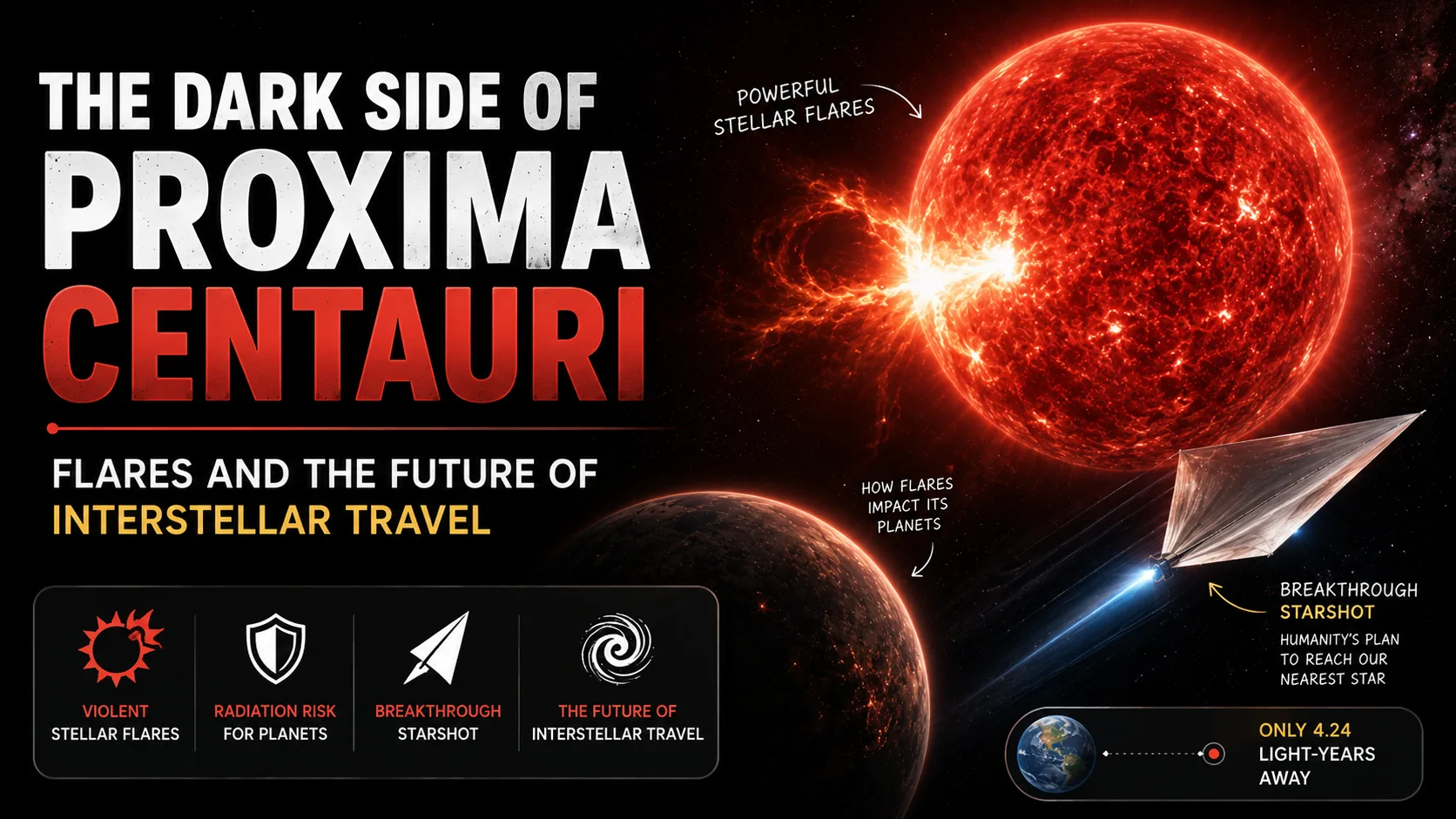
While having planets is exciting, Proxima Centauri is also known for being quite active. Red dwarfs often produce powerful bursts of energy called stellar flares. These flares can release huge amounts of ultraviolet radiation, which might make it difficult for life to survive on its planets.
This "temperamental" nature of Proxima Centauri is a major topic of debate among scientists. Is it a friendly neighbor or a dangerous one? We will dive deeper into its planets and their chances of hosting life in the next articles of this series.
Conclusion
Proxima Centauri may be small, but it holds a big place in our hearts and in scientific research. As our closest stellar neighbor, it serves as a stepping stone for future interstellar exploration. Whether it is a destination for humanity or simply a window into the lives of red dwarfs, Proxima Centauri continues to fascinate us.
Stay tuned for the next part of our series, where we will take a closer look at Proxima Centauri b, the exoplanet that might just be Earth's cousin.