Cosmic Trio: Why Finding Three Black Holes in One Baby Galaxy Changes Everything
Astronomers just found three active supermassive black holes in a single young galaxy.
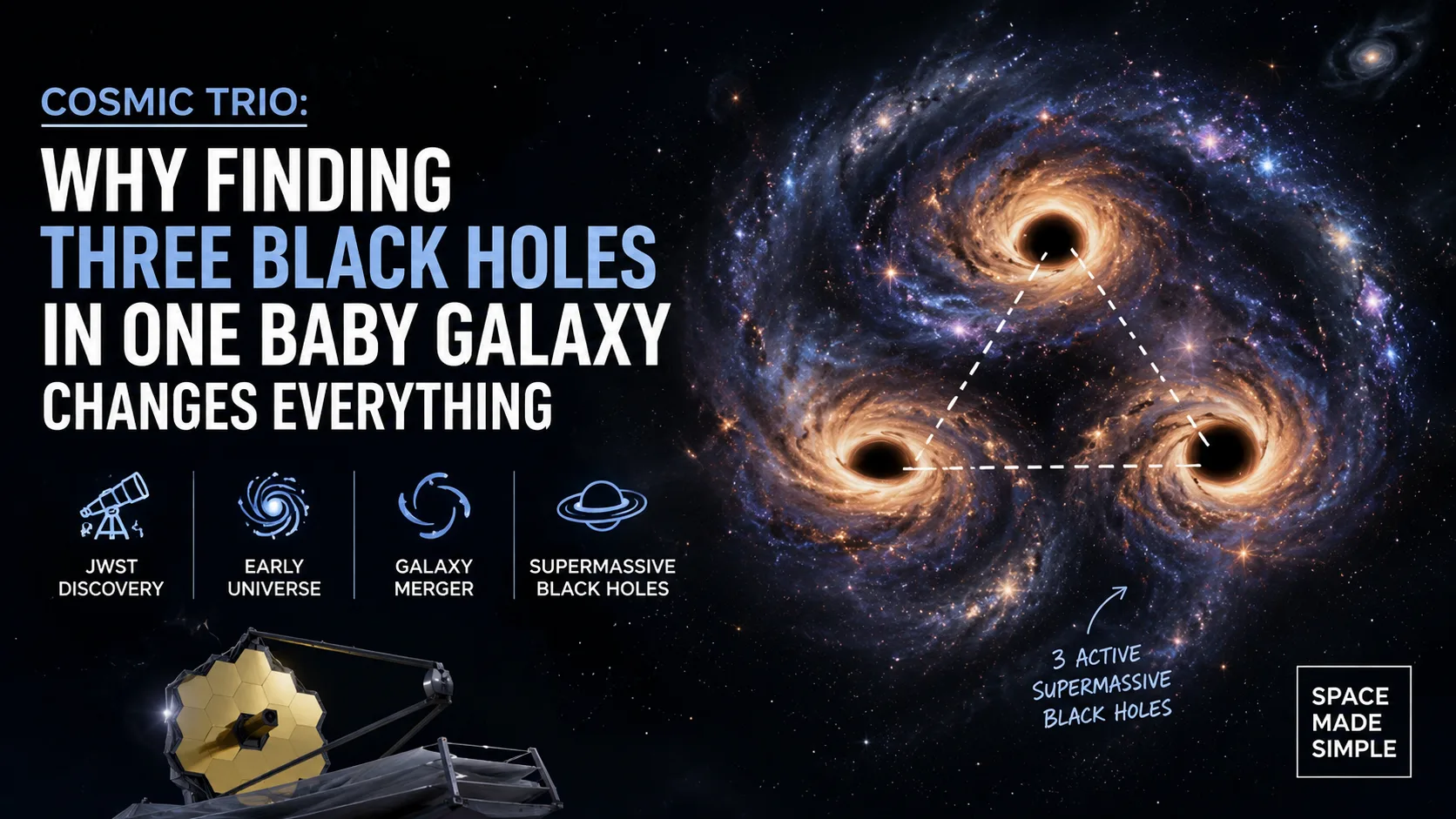
For decades, astronomers assumed that young galaxies in the early universe typically hosted only one central supermassive black hole. That assumption has now been shattered. On August 12, 2026, researchers announced the discovery of three actively feeding supermassive black holes packed into a single distant galaxy, offering an unprecedented glimpse into how cosmic giants grew up together.
This finding is not just a record-breaker; it fundamentally reshapes our understanding of galaxy evolution when the universe was barely a billion years old. If you are new to these objects, start with our guide on what is a black hole before diving into this breakthrough. Here is what makes this "cosmic trio" so special and why it matters for the future of astronomy.
A Snapshot of the Infant Universe
The galaxy hosting this rare trio is named J0148-4214. It sits more than 12.5 billion light-years away from Earth, meaning we are observing it as it existed only 1.2 billion years after the Big Bang. At this epoch, the universe was still in its chaotic teenage phase, with galaxies frequently colliding and merging.
Finding even one active black hole at this distance is challenging. In fact, JWST previously stunned scientists by revealing MoM-z14, an impossible early galaxy that defied existing formation models. Finding three active black holes in the same system suggests that bringing massive black holes together was far more efficient and common in the early universe than previously thought. This efficiency helps explain how some black holes became so enormous so quickly after the Big Bang.
How JWST Spotted the Invisible
Black holes do not emit light, so how did scientists find them? The team used the James Webb Space Telescope to detect specific spectral fingerprints left by hydrogen gas swirling at extreme speeds near each black hole's gravitational pull.
Because two of the black holes are separated by only 620 light-years, they appear as a single blur even to JWST. Researchers solved this using a clever technique called spectro-astrometry, which measures tiny spatial shifts in light emissions across the galaxy to pinpoint multiple sources within one pixel . Think of it like hearing three distinct voices singing in harmony and being able to tell exactly where each singer stands, even if you cannot see them individually.
Three Giants, Different Appetites
The trio is surprisingly diverse in both size and behavior:
- The Heavyweight: Approximately 80 million solar masses, currently feeding at a modest rate.
- The Overeater: Only 0.6 million solar masses but consuming matter faster than theoretical limits predict (exceeding the Eddington limit).
- The Outsider: About 2 million solar masses, located 5,500 light-years from the galactic center rather than in the core.
The fact that the smallest central black hole is eating the fastest challenges simple models of black hole growth. For context on how extreme accretion works, our explainer on TON 618 quasar accretion disk physics breaks down similar high-energy feeding processes in greater detail. It implies that during galaxy mergers, smaller black holes can temporarily outpace their larger companions in accumulating mass.
Why This Matters for Future Discovery
The central pair of black holes is expected to merge within the next few hundred million years. Such mergers produce ripples in spacetime known as gravitational waves. Confirming that triple systems exist in the early universe validates predictions for upcoming observatories like the Laser Interferometer Space Antenna (LISA), which is designed specifically to detect these ancient collisions.
This discovery also supports the idea that black hole merging served as a "fast route" for rapid growth in the infant universe, complementing the slower process of steady gas accretion. For readers new to cosmology, imagine building a city not brick by brick, but by merging three entire towns at once; that is essentially what happened in J0148-4214.
Looking Ahead
While this is the first confirmed triple active black hole system in the distant universe, it is unlikely to be the last. As JWST continues its survey and new instruments come online, astronomers expect to uncover more examples of these crowded cosmic nurseries. Each new trio will help refine the timeline of how galaxies and their central monsters co-evolved during the universe's most formative era.
For those interested in following similar breakthroughs, the ESA/Webb News Portal regularly publishes accessible updates on JWST discoveries that continue to rewrite textbooks.
The cosmos, it seems, was never as lonely or as simple as we once imagined. Even in its infancy, the universe was already orchestrating complex dances between gravity, light, and time.