Tau Ceti’s Ghost Planets: Why Detection Is So Hard
scientists still cannot agree whether this nearby star actually hosts planets at all. What were once celebrated as Earth-sized candidates are now suspected to be "ghost planets"
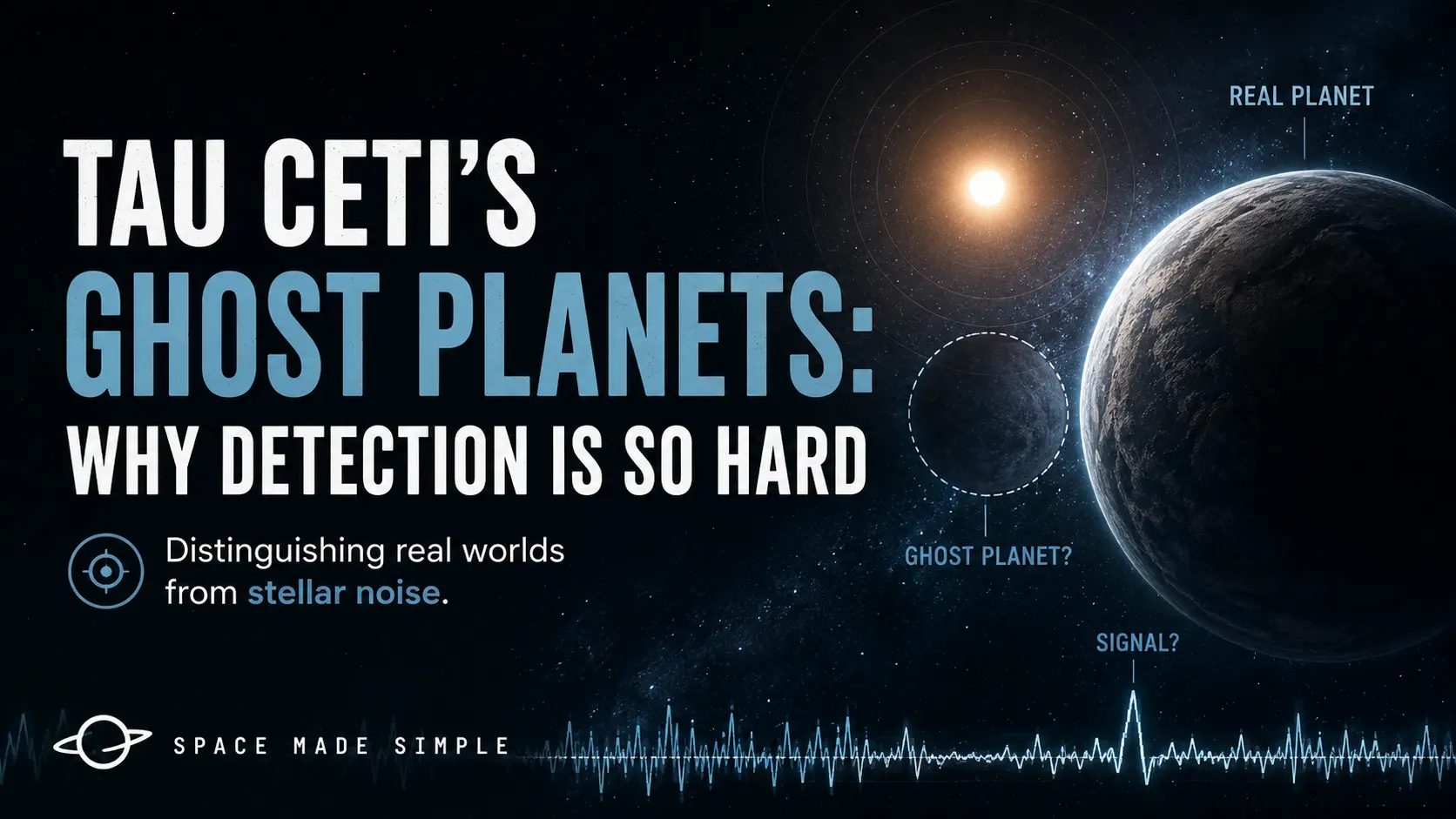
In the previous part of this series, we explored why Tau Ceti is such a compelling solar twin. Now comes the twist: despite decades of study, scientists still cannot agree whether this nearby star actually hosts planets at all. What were once celebrated as Earth-sized candidates are now suspected to be "ghost planets"—signals that mimic worlds but originate from the star itself. Understanding this mystery reveals why finding exoplanets is far more complex than pointing a telescope at the sky.
The Radial Velocity Method Simplified
Most Tau Ceti planet claims come from the radial velocity method. This technique does not image planets directly. Instead, it measures tiny wobbles in a star’s motion caused by gravitational tugs from orbiting bodies. When a planet pulls on its star, the star shifts slightly toward and away from Earth, changing the color of its light in a predictable pattern.
The problem is that these wobbles are minuscule. An Earth-mass planet induces a velocity change of less than 10 centimeters per second—slower than a crawling baby. Detecting this requires extreme precision and long-term data. For Tau Ceti, multiple research teams have analyzed the same datasets and reached conflicting conclusions. Some see clear planetary signals; others see only stellar activity masquerading as planets. To understand how tricky planetary environments can be, compare this with our overview of GJ-3378b and habitable zone super-Earths, where confirmation also required years of debate.
Stellar Noise: The Planet Impostor
Stars are not perfectly stable spheres. They rotate, develop magnetic spots, erupt with flares, and pulsate with internal waves. All of these phenomena create Doppler shifts that look identical to planetary signals. Tau Ceti, though sun-like, has an 11-year magnetic cycle similar to the Sun’s. During active phases, its surface turbulence produces noise that overlaps with the expected frequencies of hypothetical planets.
This is why many original Tau Ceti planet candidates have been downgraded or retracted. Advanced statistical models now attempt to separate true orbital signals from stellar jitter, but the line remains blurry. The lesson is universal: extraordinary claims require extraordinary filtering. For another example of how nearby stars challenge detection limits, revisit our piece on Teegarden’s Star and its debated habitable worlds.
Candidate Planets: e, f, g, and h
Despite the controversy, four candidates persist in catalogs: Tau Ceti e, f, g, and h. Candidates e and f attracted the most attention because their orbits placed them near the habitable zone. Candidate g and h are closer-in super-Earths with shorter periods. NASA’s Exoplanet Archive lists them, but with cautionary flags indicating disputed status.
What makes Tau Ceti unique is not the number of candidates, but the intensity of scrutiny they’ve received. Because the star is so bright and close, it serves as a testing ground for detection algorithms. Every new analysis refines our ability to tell real planets from ghosts elsewhere in the galaxy. Even null results here advance the field more than easy confirmations around quieter stars.
Why Uncertainty Is Progress
It might seem disappointing that Tau Ceti’s planets remain unconfirmed. But science thrives on doubt. Each failed confirmation teaches us what instrumental precision, data length, and modeling sophistication are truly needed. Future missions like the Roman Space Telescope will observe Tau Ceti with capabilities designed specifically to overcome current limitations.
Until then, Tau Ceti stands as a humble reminder: the universe does not yield its secrets easily. Ghost planets are not failures—they are signposts pointing toward better methods, sharper instruments, and deeper understanding. In Part 3 of this series, we’ll explore what life would actually face if these worlds do exist, debris disk and all.