Could Life Survive Tau Ceti? Debris, Bombardment, and Future Telescopes
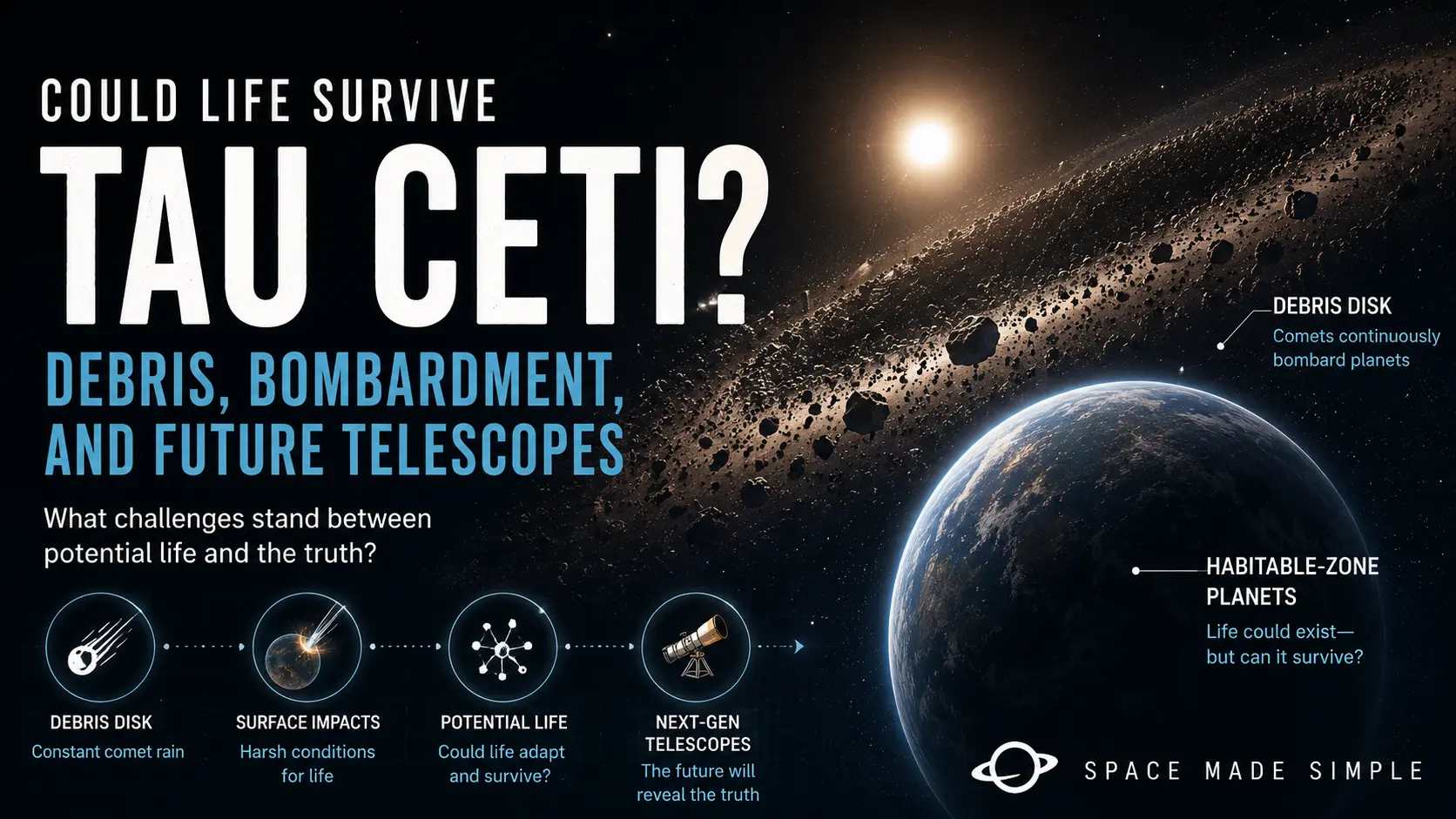
Even if Tau Ceti hosts habitable-zone planets, a massive debris disk may rain comets on their surfaces.
We’ve explored why Tau Ceti is our nearest sun-like neighbor and why its ghost planets remain unconfirmed. Now comes the most provocative question: if worlds do exist in its habitable zone, could anything actually live there? The answer hinges not just on starlight and orbital distance, but on a chaotic ring of dust and ice that surrounds the star. This debris disk transforms Tau Ceti from a simple solar twin into a cautionary tale about planetary habitability.
The Habitable Zone Is Not Enough
Tau Ceti’s habitable zone—the region where liquid water could theoretically persist—spans roughly 0.55 to 1.16 astronomical units from the star. Candidates e and f have orbited within or near this band in various studies, sparking hopes for temperate, Earth-like conditions. However, being in the habitable zone is merely the first filter for life; it says nothing about atmospheric retention, magnetic shielding, or impact history.
For comparison, Venus and Mars both sit near the edges of our Sun’s habitable zone, yet neither hosts surface life today. At Tau Ceti, the problem is compounded by stellar luminosity differences and uncertain planetary masses. To understand how nuanced habitable zone definitions can be, revisit our explainer on GJ-3378b and super-Earth habitability, where orbital position alone failed to guarantee clement conditions.
A Comet Storm Without End
Observations reveal that Tau Ceti harbors more than ten times the amount of asteroidal and cometary material found in our solar system. ALMA data shows this debris disk extends inward close to the habitable zone, meaning any resident planet would endure relentless bombardment. On early Earth, similar impacts delivered water and organic molecules—but also caused mass extinctions and sterilized surfaces repeatedly.
At Tau Ceti, the bombardment rate may never have dropped to safe levels. Keck Observatory analyses conclude that this intense comet flux probably reduces habitability significantly, even for planets with otherwise favorable orbits. Life might emerge in subsurface oceans or brief inter-impact windows, but complex biospheres seem unlikely under such cosmic artillery fire. For deeper context on how debris disks shape planetary fates, see ALMA’s detailed observations of Tau Ceti’s disk .
What Future Telescopes Will Reveal
Current instruments cannot directly image Tau Ceti’s potential planets or measure their atmospheres. That changes with the Nancy Grace Roman Space Telescope, scheduled for launch in 2026. Roman’s wide-field infrared capabilities will enable unprecedented astrometric precision, potentially confirming or ruling out planetary signals that radial velocity alone cannot resolve. Ground-based observatories like the Extremely Large Telescope will complement this by targeting reflected light from nearby sun-like stars.
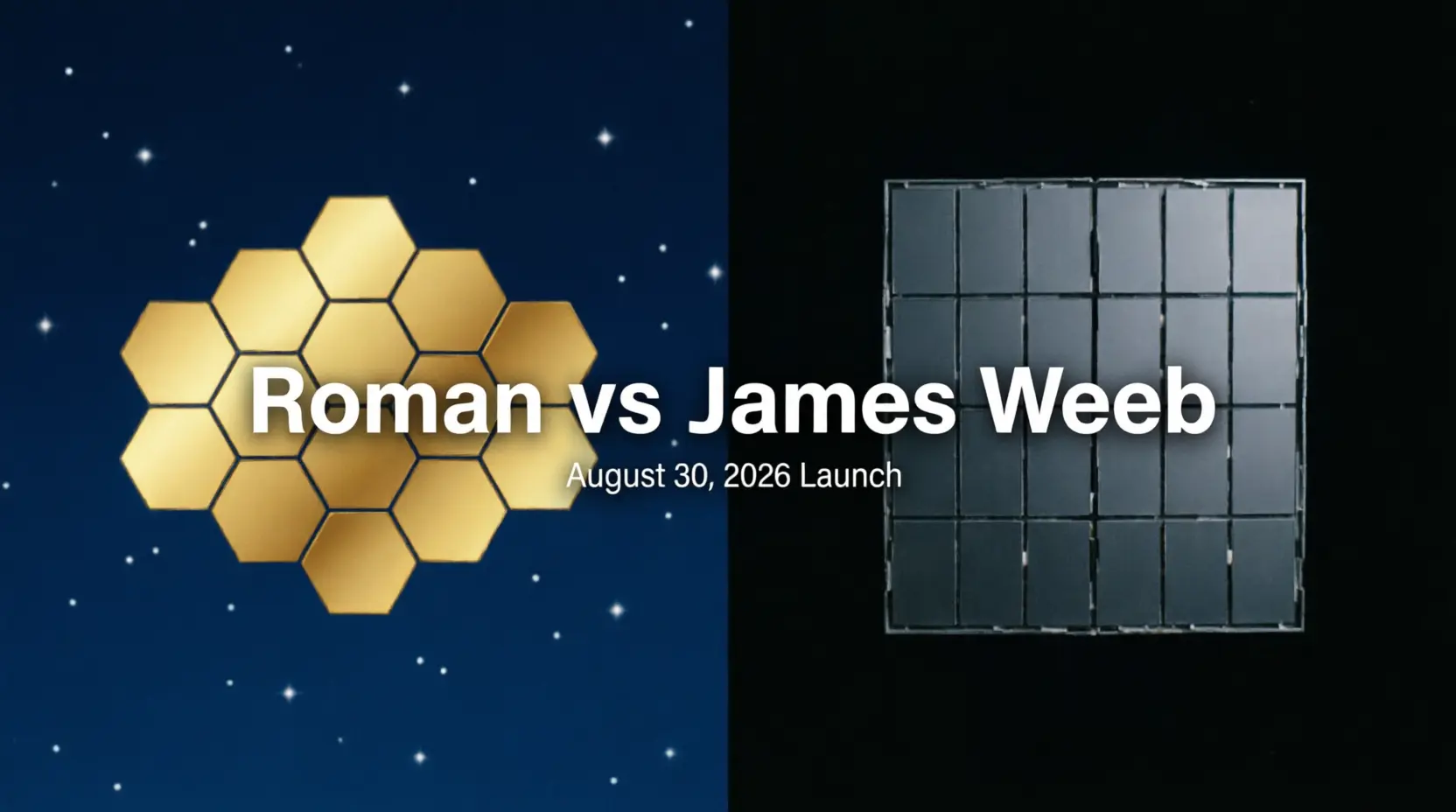
These missions represent humanity’s best chance to move beyond statistical candidates and toward actual characterization. Until then, Tau Ceti remains a hypothesis wrapped in stardust. For more on how next-generation observatories compare, check our breakdown of Roman Space Telescope vs James Webb in 2026, which outlines why Roman is uniquely suited for nearby stellar surveys.
A Mirror, Not a Promise
Tau Ceti teaches us that proximity does not guarantee familiarity. Its sun-like spectrum invites hope, but its dusty reality demands humility. Whether it hosts barren rocks battered by comets or hidden oases beneath cratered crusts, the system forces us to refine our definitions of habitability itself.
In the end, Tau Ceti’s greatest value may not be as an abode for life, but as a benchmark for detecting it elsewhere. Every null result sharpens our tools; every confirmed non-detection narrows the search. As telescopes grow larger and models grow wiser, this nearest sun-like neighbor will keep asking the same quiet question: are we typical, or are we alone?