How Do Scientists Track Dangerous Asteroids? A Simple Guide to Near-Earth Object Monitoring
Discover how scientists detect, track, and monitor dangerous asteroids approaching Earth. Learn about NASA's NEO program, telescopes, radar systems, and planetary defense technology in simple terms.
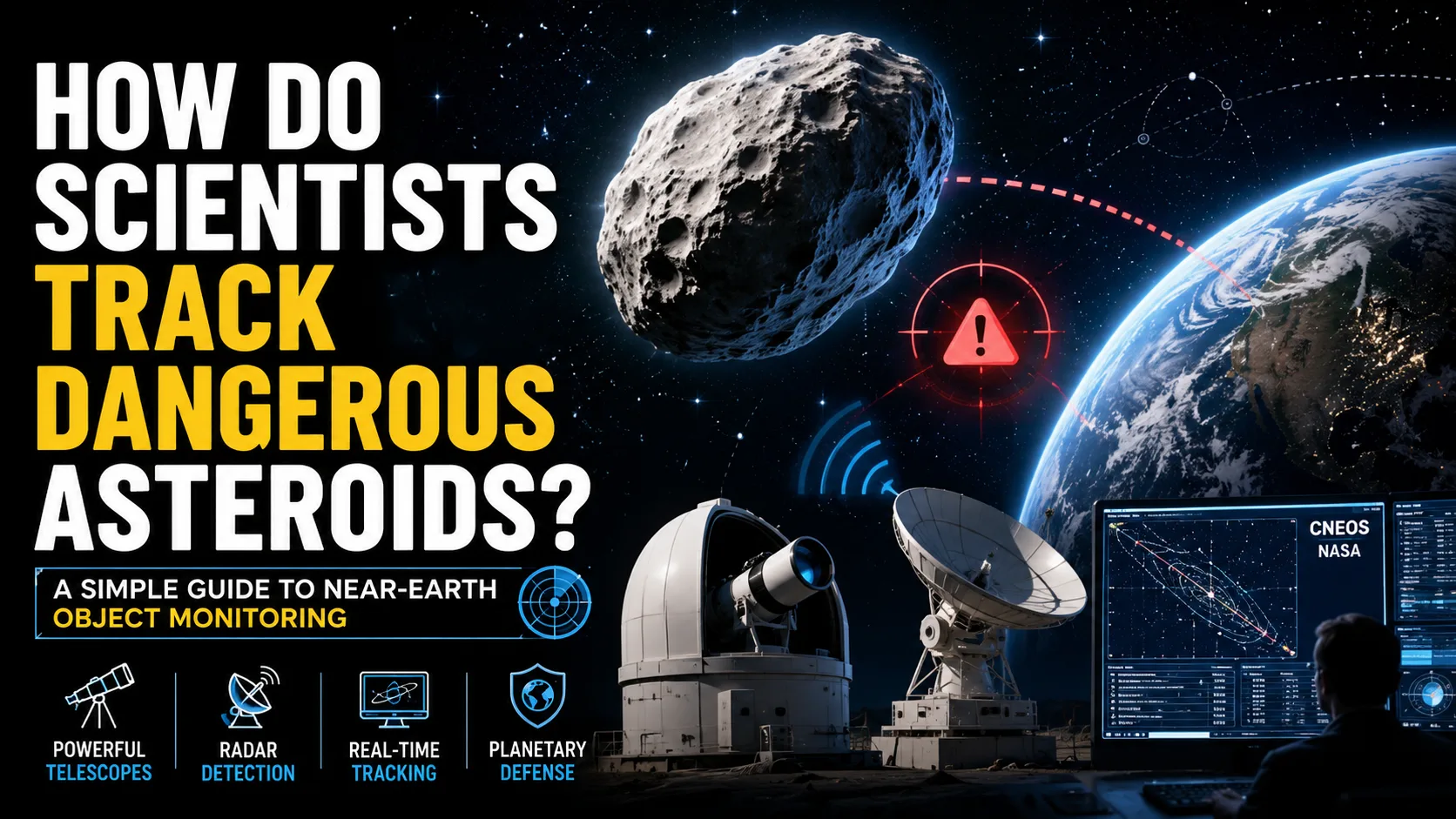
Imagine a rock the size of a house hurtling through space toward Earth. Sounds like something from a Hollywood movie, right? But for scientists around the world, tracking these cosmic visitors is very real—and very important work.
Every day, thousands of asteroids zip past our planet. Most are tiny and burn up in the atmosphere. But some are large enough to cause serious damage if they hit. So how do scientists keep watch on these potentially dangerous objects? Let's break it down in simple terms.
What Are Near-Earth Objects?
First, let's clarify what we're talking about. Near-Earth Objects (NEOs) are asteroids or comets whose orbits bring them close to Earth. Specifically, an NEO is any small Solar System body that comes within 1.3 astronomical units (AU) of the Sun. Since Earth orbits at about 1 AU from the Sun, this means NEOs can come relatively close to our planet.
Not all NEOs are dangerous. In fact, most pass by safely. But scientists pay special attention to Potentially Hazardous Asteroids (PHAs)—those that come within 0.05 AU of Earth and are larger than about 140 meters across. These are the ones that could cause regional or even global damage if they impacted.
The Detection Process: Finding Needles in a Cosmic Haystack
Tracking asteroids isn't easy. Space is vast, and asteroids are often dark, small, and moving fast. Here's how scientists find them:
Step 1: Sky Surveys with Powerful Telescopes
Astronomers use specialized telescopes to scan the night sky repeatedly. These aren't your typical backyard telescopes—they're powerful instruments designed to detect faint, moving objects against the background of fixed stars.
The process works like this:
- Take multiple images of the same patch of sky, spaced several minutes apart
- Compare the images to spot objects that have moved
- Calculate the object's trajectory based on its movement
This method is similar to how you might notice a car moving in a series of photographs taken from the same spot. Stars stay still, but asteroids move.
Major survey programs include:
- Pan-STARRS (Panoramic Survey Telescope and Rapid Response System) in Hawaii
- Catalina Sky Survey in Arizona
- ATLAS (Asteroid Terrestrial-impact Last Alert System) with telescopes in Hawaii, Chile, and South Africa
These surveys discover thousands of new asteroids every year.
Step 2: Calculating Orbits
Once an asteroid is spotted, scientists need to figure out where it's going. This involves complex mathematics and computer modeling.
The Center for Near-Earth Object Studies (CNEOS) at NASA's Jet Propulsion Laboratory is the go-to resource for this. CNEOS calculates asteroid and comet orbits and determines their probability of impacting Earth.
Think of it like predicting where a ball will land after you throw it. If you know the ball's speed, direction, and the forces acting on it (like gravity), you can calculate its path. Scientists do the same with asteroids, accounting for the gravitational pull of the Sun, planets, and even other asteroids.
Step 3: Refining Predictions with Radar
For asteroids that come particularly close to Earth, scientists use radar to get more precise measurements. Radar bounces radio waves off the asteroid and measures how long they take to return.
This technique provides:
- Exact distance measurements
- Size and shape information
- Rotation rate
- Surface characteristics
Radar observations are crucial because they dramatically improve orbit predictions. An asteroid tracked only by optical telescopes might have an uncertain path, but adding radar data can narrow down its future position significantly.
Who's Watching? Global Cooperation in Action
Asteroid tracking isn't just a one-country effort. It's a global collaboration involving space agencies, observatories, and research institutions worldwide.
NASA's Role
NASA leads the charge through its Planetary Defense Coordination Office. The agency funds numerous ground-based telescopes and is developing NEO Surveyor, a space telescope specifically designed to detect near-Earth objects that are difficult to see from the ground.
NEO Surveyor will use infrared detectors to find asteroids that reflect little visible light. Scheduled to launch in the coming years, it aims to discover 90% of near-Earth objects larger than 140 meters: the size threshold for potentially hazardous asteroids.
ESA's Contribution
The European Space Agency runs its own Space Situational Awareness (SSA) program, which includes monitoring near-Earth objects. ESA collects data from telescopes and radar systems worldwide, contributing to the global database of known asteroids.
ESA's Planetary Defence Office works closely with international partners to assess impact risks and coordinate response strategies.
International Collaboration
Organizations like the Minor Planet Center (MPC) serve as clearinghouses for asteroid observations. When any astronomer spots a new object, they report it to the MPC, which verifies the discovery and distributes the information globally.
This cooperation ensures that no potentially dangerous asteroid goes unnoticed.
From Detection to Defense: What Happens Next?
Finding an asteroid is only the first step. Once a potentially hazardous object is identified, scientists continuously monitor it to refine its orbit prediction.
If an asteroid has even a small chance of hitting Earth decades in the future, scientists will:
- Increase observation frequency - Track it more closely with multiple telescopes
- Improve orbit calculations - Use additional data to reduce uncertainty
- Assess impact probability - Determine the likelihood of collision
- Plan mitigation strategies - Develop options to deflect the asteroid if needed
The good news? We've never found an asteroid on a confirmed collision course with Earth in the foreseeable future. However, scientists estimate we've only discovered about 40% of potentially hazardous asteroids larger than 140 meters. That's why ongoing detection efforts are so critical.
Learning from Success: The DART Mission
In 2022, NASA proved that we can actually change an asteroid's path. The DART (Double Asteroid Redirection Test) mission deliberately crashed a spacecraft into the asteroid Dimorphos, successfully altering its orbit.
This milestone demonstrated that planetary defense isn't just science fiction—it's achievable technology. If we detect a dangerous asteroid early enough, we could potentially deflect it using similar methods.
Why This Matters for You
You might wonder: "Should I be worried about asteroid impacts?" The short answer is no—at least not right now. Scientists are actively monitoring the skies, and no known large asteroid poses an imminent threat.
However, understanding how asteroid tracking works helps us appreciate the sophisticated systems protecting our planet. It also highlights why continued investment in space surveillance is essential. The earlier we detect a potentially hazardous asteroid, the more time we have to respond.
The Bottom Line
Tracking dangerous asteroids involves:
- Powerful telescopes scanning the sky nightly
- Complex calculations to predict orbital paths
- Radar observations for precise measurements
- Global cooperation among space agencies and observatories
- Continuous monitoring to refine predictions
Thanks to these efforts, we're building an increasingly complete catalog of near-Earth objects. While there's still work to be done, the systems in place give us our best chance at detecting any potential threats well in advance.
So the next time you look up at the night sky, remember: there's a global network of scientists working around the clock to make sure those twinkling lights don't include any unwanted visitors heading our way.
Want to learn more about other objects in our solar system? Check out our guide to comet C/2025 A7 ATLAS to understand how these icy visitors differ from asteroids.