Why Haumea Looks Like a Rugby Ball: The Solar System’s Strangest Dwarf Planet
Discover why dwarf planet Haumea is shaped like a rugby ball. Learn how its extreme 4-hour spin creates the most unusual shape in our solar system.
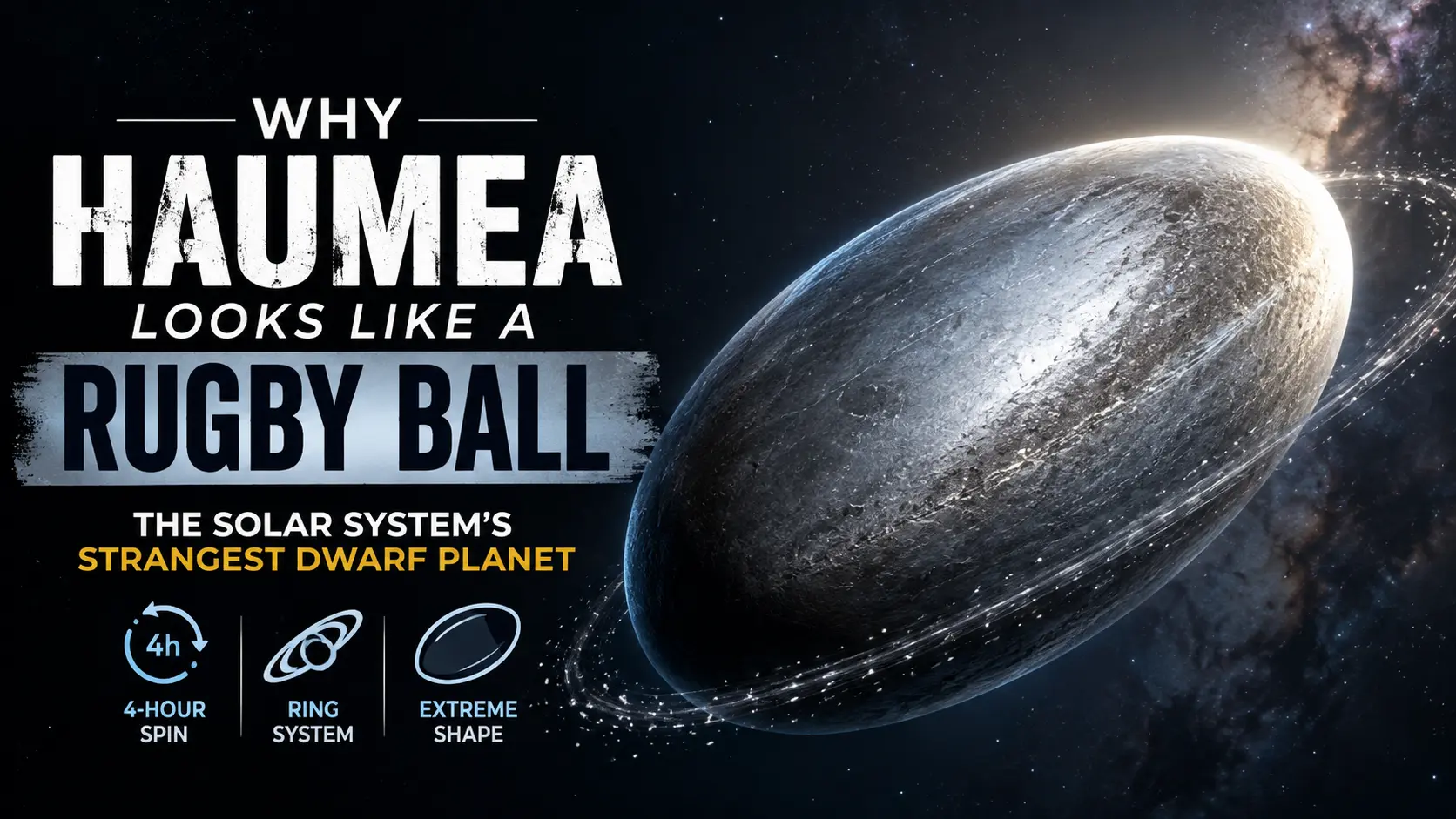
When you picture a planet or dwarf planet, you probably imagine a perfect sphere. But in the cold, distant reaches of our solar system, there is a world that breaks all the rules. Meet Haumea, a dwarf planet shaped more like a cosmic rugby ball than a traditional celestial body.
Located far beyond Neptune in the Kuiper Belt, Haumea is one of the most fascinating oddities astronomers have ever found. Its strange, elongated shape is not a glitch in our telescopes. It is the direct result of one of the most extreme spins in the entire solar system.
The Extreme Spin That Stretches a World
Most large objects in space are round because their own gravity pulls them equally toward the center. This balance is called hydrostatic equilibrium. However, Haumea rotates at a mind-boggling speed. It completes one full spin on its axis in just under four hours.
To put this into perspective, Earth takes 24 hours to rotate once. Even Jupiter, the fastest-spinning major planet, takes about 10 hours. Haumea’s incredible rotational velocity creates massive centrifugal force. Just like spinning wet clay on a potter's wheel causes it to flatten and stretch outward, Haumea’s rapid spin physically distorts its icy body into an ellipsoid.
Understanding the Jacobi Ellipsoid Shape
Scientists classify Haumea’s specific shape as a "Jacobi ellipsoid." While that sounds complicated, it simply means the object has three different axis lengths due to its rotation and density. It is flattened at the poles and significantly stretched at the equator.
Haumea is currently the only known dwarf planet in our solar system with this distinct non-spherical shape. If you want to compare it with other members of this exclusive club, you can read about Eris and its place in the solar system to see how differently dwarf planets can behave. Unlike Eris, which maintains a near-perfect spherical shape despite being smaller, Haumea proves that spin matters just as much as mass when shaping a world.
What Caused Such Incredible Speed?
Astronomers believe Haumea was not always spinning this fast. The leading theory suggests that billions of years ago, Haumea suffered a catastrophic collision with another large Kuiper Belt object. This massive impact likely blasted away much of its outer ice layer and transferred enormous angular momentum, acting like a giant cosmic push that set it spinning wildly.
This violent history also explains why Haumea’s surface is covered in highly reflective, crystalline water ice. The collision may have exposed fresh ice from beneath its crust. For more context on how unique these distant icy worlds are, check out our guide on Makemake and its methane atmosphere, another dwarf planet with a completely different surface composition.
A Window Into Solar System Violence
Haumea’s rugby ball shape is more than just a visual curiosity. It is a frozen record of the chaotic, violent environment of the early solar system. According to NASA’s official dwarf planet profile, studying Haumea helps scientists understand how collisions and rotational forces shaped the outer edges of our cosmic neighborhood.
The next time you look up at the night sky, remember that not everything in space is perfectly round. Some worlds are stretched, scarred, and spinning wildly through the dark. In Part 2 of this series, we will dive even deeper into Haumea’s mysteries, including the surprising discovery of its very own ring system and two tiny moons. Stay tuned!
For those who want to explore the official classification criteria that make Haumea a dwarf planet rather than a regular asteroid, the International Astronomical Union’s Pluto and dwarf planet page provides excellent background reading on how we categorize these distant worlds.