Haumea’s Ring and Moons: Secrets of a Cosmic Collision
Explore how an ancient collision created Haumea’s ring system and two moons, Hi'iaka and Namaka. Discover the only known collisional family in the Kuiper Belt.
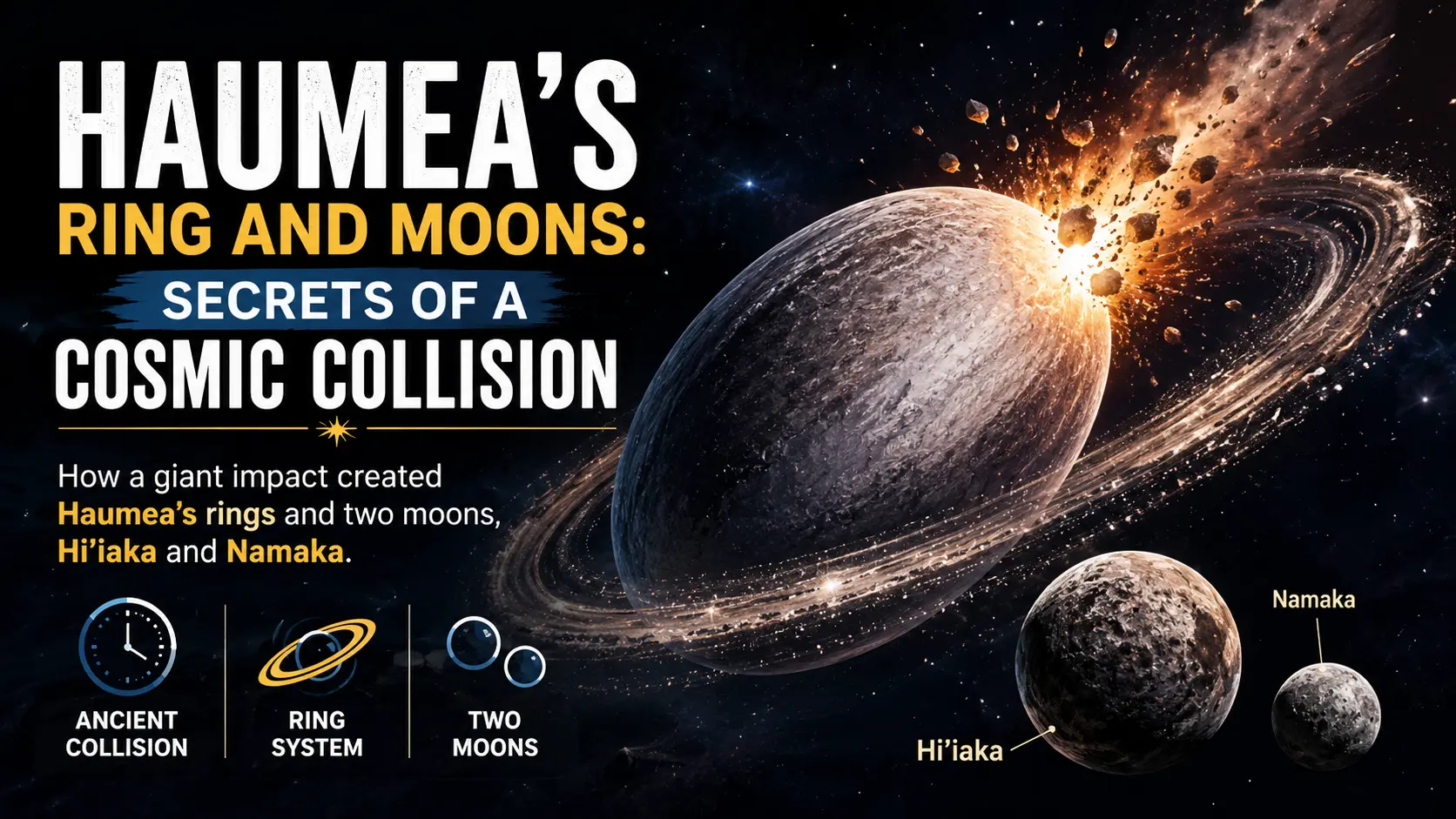
In our previous article about why Haumea looks like a rugby ball, we explored how extreme rotation stretched this dwarf planet into the most unusual shape in the solar system. But Haumea’s surprises do not end with its elongated body. This distant icy world also hides a delicate ring and two tiny moons, all born from the same violent event that shaped it.
Unlike the familiar rings of Saturn or Jupiter, Haumea’s ring system was a complete shock to astronomers. Its existence, along with its satellites Hi'iaka and Namaka, provides some of the strongest evidence we have for ancient collisions in the outer solar system.
The First Ring Beyond the Giant Planets
For decades, scientists believed only giant planets could hold onto ring systems. That assumption changed in 2017 when Haumea passed in front of a distant star. As the dwarf planet blocked the starlight, astronomers noticed brief dips in brightness before and after the main eclipse. Those tiny flickers revealed a narrow, dense ring orbiting Haumea.
This made Haumea the first known object in the Kuiper Belt to possess a ring. According to research published by the Max Planck Society, the ring is only about 70 kilometers wide and orbits roughly 2,300 kilometers above Haumea’s surface. What makes it even more fascinating is its orbital resonance: the ring completes one orbit for every three rotations of Haumea itself. This gravitational lock helps keep the ring stable despite the dwarf planet’s chaotic spin.
Two Tiny Moons Born from Ice
Haumea is accompanied by two small moons named after Hawaiian goddesses: Hi'iaka and Namaka. Both were discovered in 2005, but they are unlike most moons in the solar system. Instead of being captured asteroids or forming alongside their parent body, they are believed to be second-generation moons.
Hi'iaka is the larger and outer moon, covered in pure crystalline water ice much like Haumea’s own surface. Namaka is smaller, closer, and has a highly tilted orbit that suggests it has been gravitationally disturbed over billions of years. Scientists think both moons formed from icy debris ejected during a massive impact. Rather than escaping entirely, some of that debris settled into orbit, eventually clumping together to form the two satellites we see today.
One Collision to Explain Everything
The beauty of Haumea lies in how one single event explains nearly all of its oddities. Billions of years ago, a large Kuiper Belt object likely slammed into Haumea at high speed. The impact blasted away much of its outer ice mantle, created the debris that became Hi'iaka and Namaka, and left behind enough material to form the ring.
This collision also transferred enormous angular momentum, setting Haumea spinning fast enough to stretch into its current rugby-ball shape. Even more remarkably, the shattered remnants of that impact still travel through space alongside Haumea today. As detailed in NASA’s overview of the Haumea family, this group of icy fragments is the only confirmed collisional family ever found in the Kuiper Belt. Every piece shares similar surface composition and orbital paths, like fingerprints linking them back to the same catastrophic moment.
A Frozen Record of Solar System Violence
Haumea is more than just a strange dwarf planet. It is a complete crime scene preserved in ice. Its shape, its ring, its moons, and its scattered family members all tell the same story of destruction and rebirth in the early solar system.
In Part 3 of this series, we will tackle the final mystery: why Haumea lost its status as a full planet and the controversy surrounding its discovery. Understanding how we classify these distant worlds is just as important as understanding how they formed. Stay tuned to complete the Haumea story!