Why Haumea Is Not a Planet: Discovery Drama and Dwarf Planet Rules
Uncover the discovery dispute between Brown and Ortiz, and learn why Haumea is classified as a dwarf planet despite its unusual shape. The final part of our Haumea series.
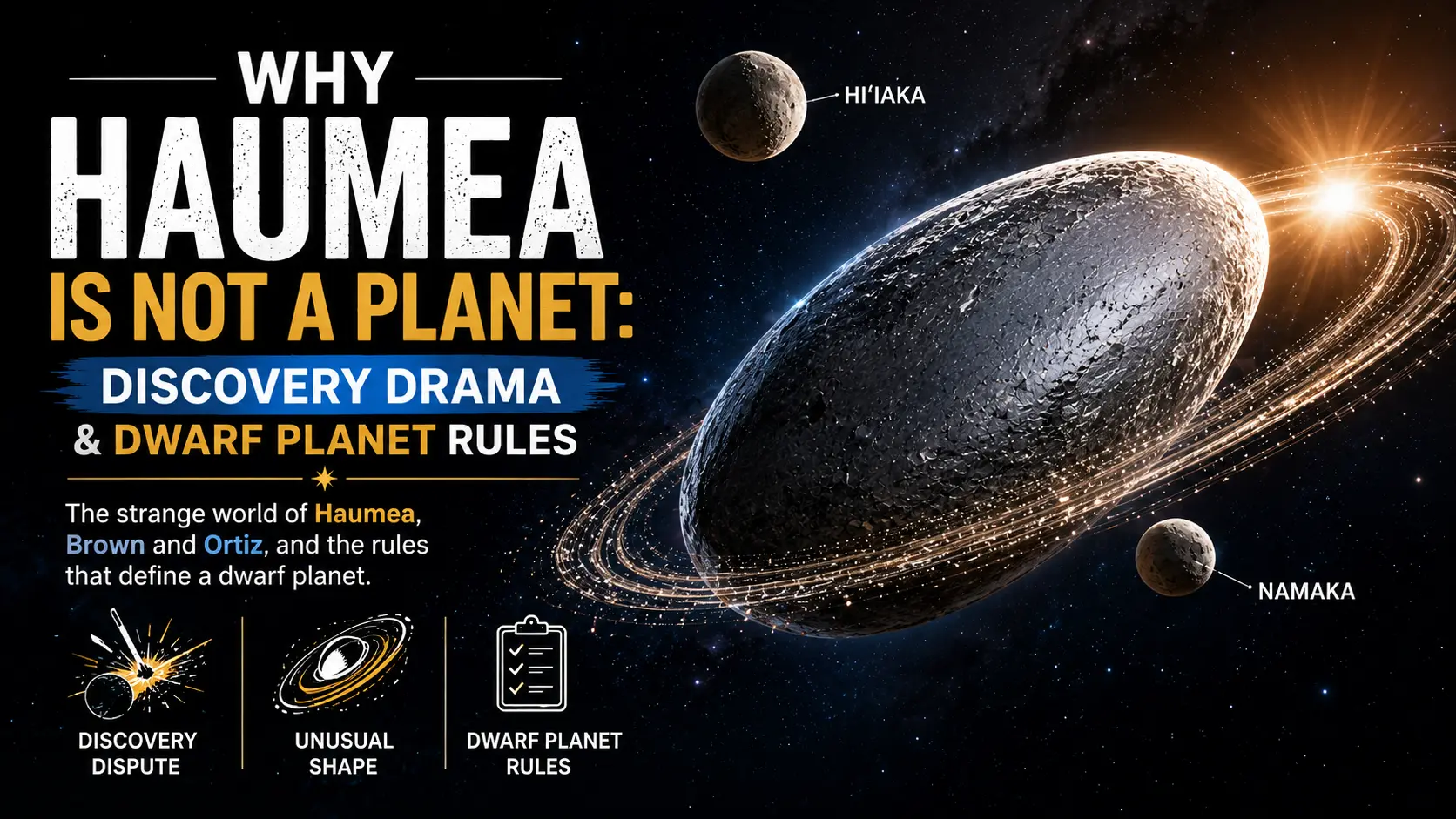
Over the course of this series, we have explored why Haumea is shaped like a rugby ball and how an ancient collision gave it a ring and two tiny moons. But despite being one of the most fascinating objects in the outer solar system, Haumea does not carry the title of "planet." Its classification as a dwarf planet is tied to strict astronomical rules and one of the most famous discovery disputes in modern space science.
Understanding why Haumea falls into this category requires looking at both the politics of discovery and the physics of planetary definitions. The story is just as compelling as the object itself.
The Great Discovery Dispute of 2005
Haumea’s journey to official recognition was anything but smooth. In late 2004, a team led by Mike Brown at Caltech discovered the object using images from the Palomar Observatory. However, before they could formally announce their find, a Spanish team led by José Luis Ortiz independently identified the same object in older archival images and submitted their discovery claim to the International Astronomical Union (IAU) first in July 2005.
What followed was a heated debate over who deserved credit. Brown accused the Spanish team of accessing his unpublished observation logs without permission, while Ortiz maintained his discovery was independent. As detailed in Wikipedia’s account of the Haumea controversy, the dispute delayed official naming for years. Ultimately, the IAU awarded discovery credit to Ortiz’s team for priority of submission, but accepted Brown’s proposed name "Haumea" over the Spanish proposal "Ataecina," because Haumea fit the IAU’s naming convention for classical Kuiper Belt objects after creation deities.
Three Rules That Define a Planet
The reason Haumea is not considered a full planet has nothing to do with the discovery dispute. It comes down to three criteria established by the IAU in 2006. To be a planet, an object must orbit the Sun, be massive enough for gravity to pull it into a round shape, and have cleared its orbital neighborhood of other debris.
Haumea easily meets the first two requirements. It orbits the Sun, and despite its elongated shape, it is still in hydrostatic equilibrium. The problem is the third rule. Haumea shares its region of the Kuiper Belt with thousands of other icy bodies and has not gravitationally dominated or swept them away. According to the Library of Congress explanation of Pluto’s reclassification, this same "clearing the neighborhood" criterion is exactly what demoted Pluto and defines the dwarf planet category. Think of it like this: a planet is a bowling ball rolling down a lane that knocks everything aside, while a dwarf planet is a marble sitting among many other marbles.
The Shape Exception That Makes Haumea Special
You might wonder how Haumea qualifies as a dwarf planet when it is clearly not spherical like Ceres or Eris. This is where Haumea breaks the mold in the best possible way. Scientists accept that Haumea is in hydrostatic equilibrium despite its rugby-ball shape because its extreme rotation creates a stable triaxial ellipsoid. In simpler terms, if you stopped Haumea from spinning, gravity would eventually pull it back into a sphere. Its current shape is a valid equilibrium state under rapid rotation, which satisfies the spirit of the IAU’s roundness requirement even if it violates the letter.
This exception makes Haumea unique among all recognized dwarf planets. As we discussed in our article about Haumea’s rugby ball shape, its spin is so fast that centrifugal force permanently distorts its form. And as we explored in the second part of this series on Haumea’s ring and moons, that same violent history that created its shape also produced its entire satellite system. Both features are interconnected pieces of the same cosmic puzzle.
A World That Defies Simple Categories
Haumea teaches us that the universe does not always fit neatly into human-defined boxes. It is a dwarf planet that is not round, a discoverer’s dilemma that reshaped scientific protocol, and a frozen relic that preserves evidence of the solar system’s chaotic youth. While it may never wear the crown of "planet," Haumea holds a far more interesting title: the most dynamically complex dwarf planet we know.
This concludes our three-part series on Haumea. From its impossible shape to its collision-born family and its controversial path to recognition, this distant world proves that the smallest categories often contain the biggest stories. Keep exploring, because the Kuiper Belt has many more secrets waiting to be simplified.