The Exosphere: Where Earth’s Atmosphere Meets Outer Space
Discover the exosphere, Earth's outermost atmospheric layer. Learn how this thin boundary fades into space and why satellites orbit within it.
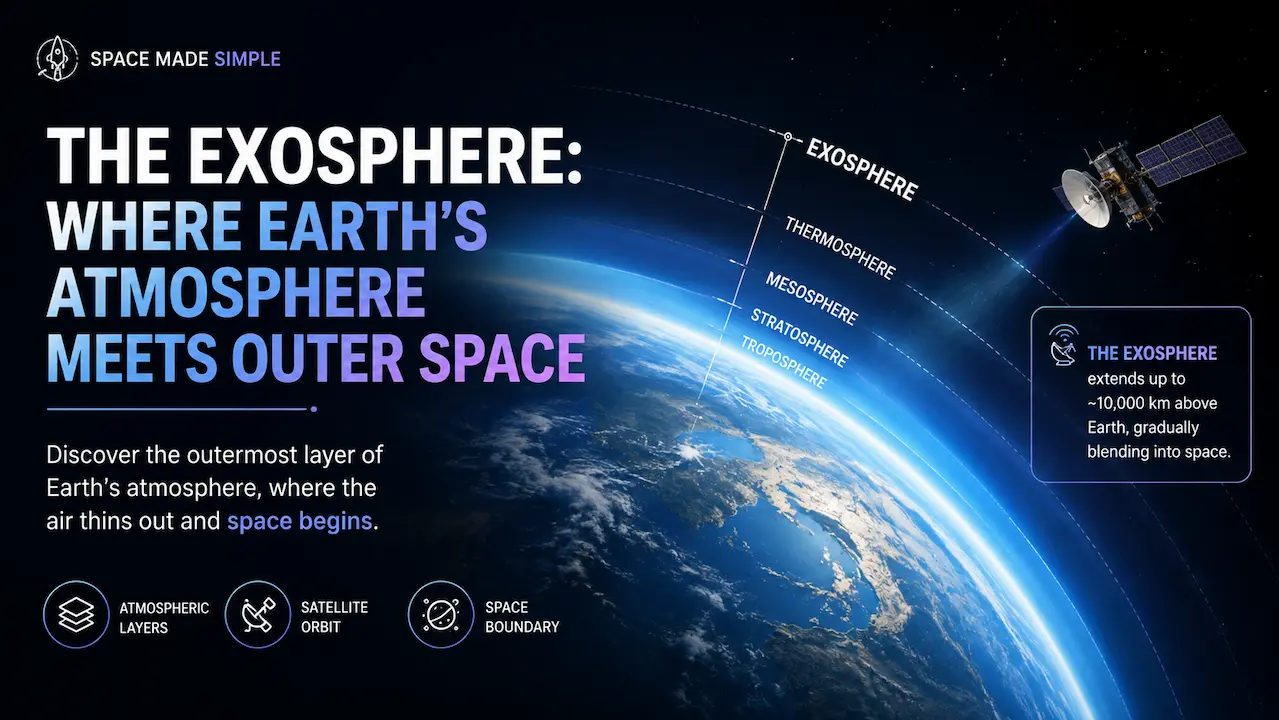
When we think about the edge of our planet, we often imagine a sharp line where the blue sky ends and the black void of space begins. However, Earth does not have a solid ceiling. Instead, our atmosphere gradually thins out over hundreds of kilometers. The final chapter of this atmospheric story is called the exosphere.
As the outermost layer of Earth's atmosphere, the exosphere serves as the ultimate transition zone between our planet and the vacuum of outer space. Understanding this layer helps explain how satellites stay in orbit and how our planet slowly interacts with the solar environment.
What Exactly Is the Exosphere?
The exosphere sits directly above the thermosphere. While lower atmospheric layers like the troposphere (where we live) are dense with nitrogen and oxygen, the exosphere is incredibly thin. In fact, the air here is so sparse that gas particles rarely collide with one another.
In most parts of the atmosphere, gas molecules bounce off each other constantly, creating weather and wind. In the exosphere, particles follow ballistic trajectories. They move in curved paths influenced by gravity, much like tiny satellites. Some particles fall back toward Earth, while others achieve escape velocity and drift permanently into interplanetary space.
Because the density is so low, traditional concepts of temperature do not apply in the same way. A thermometer placed here would read extremely cold due to lack of particle contact, even though individual atoms may possess high kinetic energy from solar radiation.
There Is No Hard Boundary
One of the most fascinating aspects of the exosphere is that it has no definitive upper limit. Scientists refer to the bottom of this layer as the exobase, which typically fluctuates between 500 and 1,000 kilometers above sea level depending on solar activity. During periods of intense solar storms, the exobase can expand significantly higher.
The upper boundary is equally fuzzy. According to NASA Heliophysics, the exosphere gradually merges with the solar wind and interplanetary medium. For practical purposes, many scientists consider the exosphere to extend up to 10,000 kilometers, but traces of Earth's geocorona (a cloud of hydrogen atoms) have been detected as far as 630,000 kilometers away—well beyond the Moon's orbit.
Why Satellites Orbit in This Region
If you have ever wondered where the International Space Station or GPS satellites reside, the answer involves the exosphere and the upper thermosphere. This region offers a unique balance for orbital mechanics.
At these altitudes, atmospheric drag is minimal but not entirely absent. Low Earth Orbit satellites still experience trace resistance, which is why they occasionally need booster burns to maintain altitude. Higher up in the exosphere, drag becomes negligible, allowing geostationary communication satellites to remain fixed relative to the ground for decades without constant fuel expenditure.
This delicate equilibrium makes the exosphere a critical real estate for modern technology. As noted by the European Space Agency, understanding the density variations in this layer is essential for predicting satellite decay and avoiding orbital collisions.
Atmospheric Escape: Losing Air to Space
Earth is not a perfectly sealed container. Over geological timescales, our planet loses light gases through the exosphere. Hydrogen and helium atoms, being the lightest elements, can reach speeds exceeding Earth's escape velocity when energized by ultraviolet sunlight.
This process, known as Jeans escape, means Earth is constantly leaking a small amount of its atmosphere into space. While the loss rate is insignificant on human timescales, it plays a role in planetary evolution. Studying this escape mechanism also helps astronomers understand how other planets, including Mars, may have lost their atmospheres billions of years ago.
For a deeper look at how atmospheric composition changes with altitude, the NASA Solar System Exploration guide provides excellent context on Earth's vertical structure.
Final Thoughts
The exosphere reminds us that planetary boundaries are rarely clean lines. It is a vast, ghostly frontier where Earth whispers its last breath before yielding to the cosmos. From enabling global communications to slowly shedding atoms into the void, this tenuous layer remains an active and vital part of our home planet.