The Difference Between Asteroids, Comets, and Meteors Explained Simply
Confused about asteroids, comets, and meteors? Learn the simple differences between these space objects, including what they're made of, where they come from, and why they look different.
If you've ever looked up at the night sky and wondered about those twinkling lights or sudden streaks of light, you're not alone. Many people use the words "asteroid," "comet," and "meteor" interchangeably—but they're actually very different things.
Let's clear up the confusion once and for all with a simple explanation.
The Quick Answer
Here's the simplest way to remember:
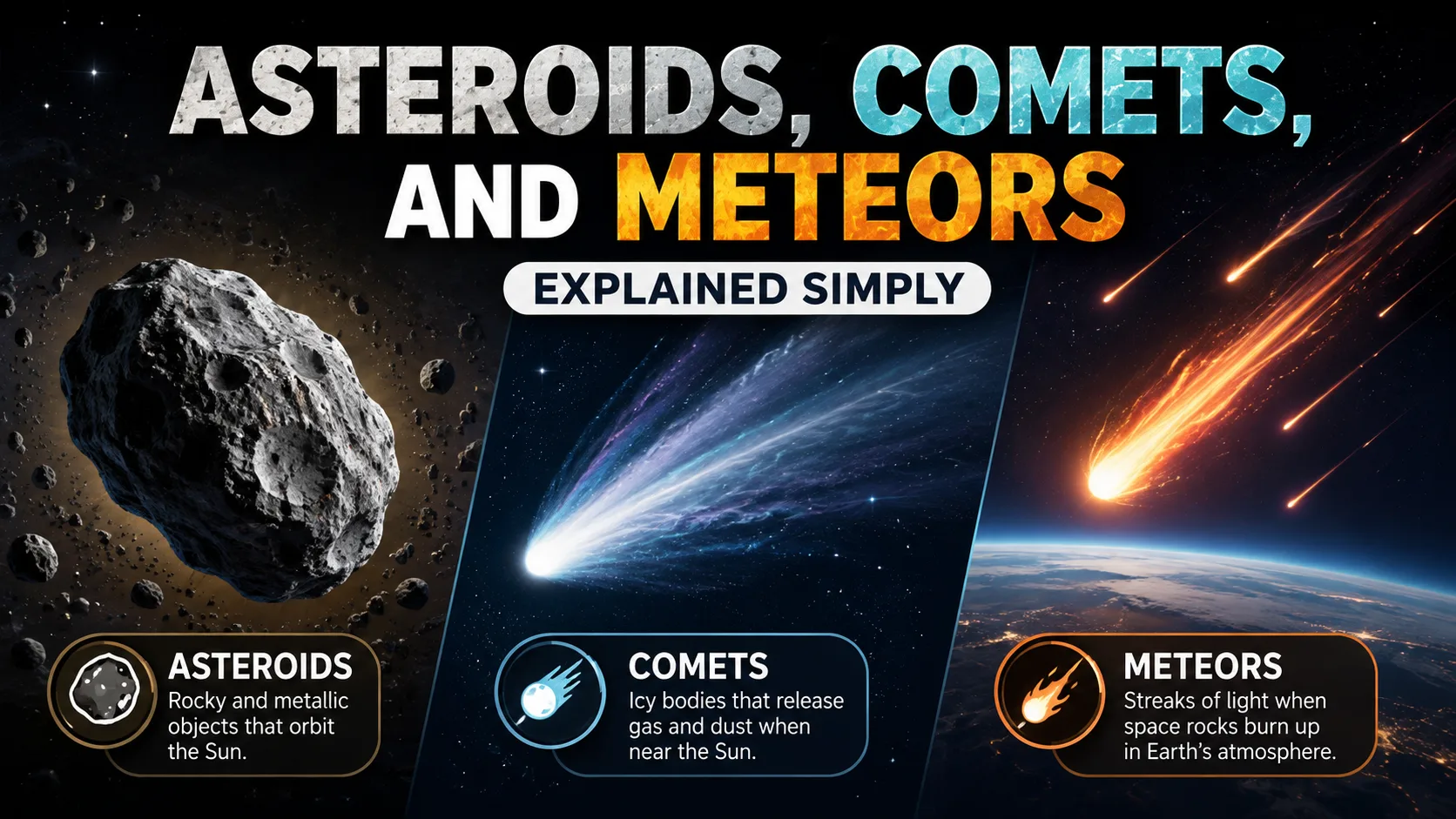
- Asteroids are rocky leftovers from planet formation
- Comets are icy cosmic snowballs that develop tails near the Sun
- Meteors are the streaks of light we see when space debris burns up in Earth's atmosphere
But there's more to the story. Let's dive deeper into each one.
What Are Asteroids?
Asteroids are rocky, airless objects that orbit the Sun. Think of them as the leftover building blocks from when our solar system formed about 4.6 billion years ago.
Key Characteristics:
Composition: Asteroids are made primarily of rock and metal. They contain minerals, iron, nickel, and sometimes organic compounds.
Size: They range from tiny pebbles to objects hundreds of kilometers across. Most asteroids are larger than 1 meter (3.28 feet) in diameter.
Location: The majority of asteroids live in the asteroid belt between Mars and Jupiter. However, some wander closer to Earth—these are called Near-Earth Asteroids.
Appearance: Asteroids are typically irregularly shaped, like lumpy potatoes. They don't have atmospheres or tails.
Behavior: When asteroids approach the Sun, they don't change much. They remain dark, rocky, and relatively unchanged.
Fun fact: If all the asteroids in the main belt were combined, they would still be smaller than Earth's Moon!
What Are Comets?
Comets are often called "cosmic snowballs" because they're made of frozen gases, ice, dust, and rock. They formed in the cold outer regions of the solar system, far from the Sun.
Key Characteristics:
Composition: Comets contain large amounts of water ice, frozen carbon dioxide, methane, ammonia, and dust particles. This icy composition is what makes them so different from asteroids.
Size: Comet nuclei (the solid core) are typically a few kilometers across—much smaller than most asteroids.
Location: Comets originate from two distant regions:
- The Kuiper Belt beyond Neptune (short-period comets)
- The Oort Cloud, a spherical shell surrounding our solar system (long-period comets)
Appearance: This is where comets get spectacular. When a comet approaches the Sun, its ices heat up and turn directly into gas (a process called sublimation). This creates:
- A glowing coma (atmosphere) around the nucleus
- Two distinct tails: a dust tail and an ion (gas) tail that always point away from the Sun
Behavior: Comets are like cosmic time capsules. Each time they pass close to the Sun, they lose some material. After many orbits, they may break apart completely or run out of volatile materials.
The famous Halley's Comet, for example, returns every 76 years. Each visit, it leaves behind a trail of debris that creates meteor showers when Earth passes through it.
What Are Meteors?
Now here's where it gets interesting. Meteors aren't actually objects floating in space—they're events that happen in our atmosphere.
The Meteor Family Tree:
To understand meteors, we need to know three related terms:
1. Meteoroid: This is the actual object in space. Meteoroids are small rocky or metallic bodies, smaller than asteroids (usually less than 1 meter across). They can come from asteroids, comets, or even other planets.
2. Meteor: When a meteoroid enters Earth's atmosphere at high speed (up to 72 kilometers per second!), friction with air molecules causes it to heat up and glow. This streak of light is what we call a meteor—or more commonly, a "shooting star".
3. Meteorite: If a meteoroid survives its fiery journey through the atmosphere and lands on Earth's surface, it's called a meteorite.
Key Characteristics of Meteors:
Duration: Most meteors last only a fraction of a second to a few seconds.
Altitude: They typically burn up 80-120 kilometers above Earth's surface.
Frequency: On any given night, you might see 5-10 meteors per hour if you're in a dark location. During meteor showers, this can increase to dozens or even hundreds per hour.
Origin: Most meteoroids come from comets. As comets travel through the solar system, they leave behind trails of dust and small particles. When Earth passes through these trails, we experience meteor showers.
Side-by-Side Comparison
| Feature | Asteroids | Comets | Meteors |
|---|---|---|---|
| What they are | Rocky objects in space | Icy objects in space | Light phenomenon in atmosphere |
| Main composition | Rock and metal | Ice, dust, and rock | N/A (it's light, not an object) |
| Typical size | 1 meter to hundreds of km | Few km (nucleus) | N/A (meteoroids are <1 meter) |
| Where found | Mostly asteroid belt | Kuiper Belt & Oort Cloud | Earth's atmosphere |
| Visible tails? | No | Yes, when near Sun | The meteor itself is the "tail" |
| Orbit stability | Relatively stable | Can change over time | N/A (one-time event) |
Common Misconceptions
Let's bust some myths:
Myth 1: "Shooting stars are actually stars."
Reality: They're not stars at all! They're tiny bits of space debris burning up in our atmosphere. Real stars are massive balls of gas millions of kilometers away.
Myth 2: "Asteroids and comets are basically the same thing."
Reality: While both are small solar system bodies, their composition is fundamentally different. Asteroids are rocky; comets are icy. This difference affects how they behave near the Sun.
Myth 3: "Meteorites are extremely rare."
Reality: Thousands of meteorites fall to Earth every year. Most land in oceans or uninhabited areas, but scientists recover hundreds annually.
Myth 4: "All meteors come from asteroids."
Reality: Most meteors actually come from comets! The debris trails left by comets create most meteor showers we observe.
Why Does This Matter?
Understanding the difference between these objects isn't just academic—it has real-world implications:
Planetary Defense: Knowing whether an approaching object is an asteroid or comet helps scientists predict its behavior and plan potential deflection missions. Our recent article on how scientists track dangerous asteroids explains this in detail.
Scientific Research: Each type of object tells us different stories about solar system formation. Asteroids reveal information about the inner solar system, while comets preserve clues about the outer solar system's early conditions.
Resource Potential: Some companies are exploring asteroid mining for valuable metals. Understanding composition is crucial for these future endeavors.
Cultural Significance: Meteor showers have inspired human culture for millennia, featuring in mythology, art, and scientific discovery.
How to Spot Them Yourself
Want to see these objects with your own eyes?
Asteroids: You'll need a telescope and specific coordinates. Most asteroids are too faint to see with the naked eye. Apps and websites can help you locate bright ones.
Comets: Bright comets are visible to the naked eye and often make news headlines. Check astronomy websites for current comet visibility. Our guide to comet C/2025 A7 ATLAS shows how to observe these icy visitors.
Meteors: These are the easiest! Just find a dark location away from city lights, lie back, and look up. Meteor showers occur at predictable times each year—the Perseids in August and Geminids in December are particularly impressive.
The Bottom Line
While asteroids, comets, and meteors are all related to small objects in our solar system, they're distinctly different:
- Asteroids = Rocky leftovers orbiting the Sun
- Comets = Icy snowballs that grow tails near the Sun
- Meteors = The light show when space debris burns in our atmosphere
Next time someone mentions these terms, you'll know exactly what they mean—and you can explain it simply to others too!
Curious about other dwarf planets and small bodies in our solar system? Check out our articles on Eris and Haumea to learn more about these fascinating worlds.