Maffei 1 Galaxy: The Hidden Giant Behind the Milky Way
Explore the Maffei 1 galaxy, a giant elliptical galaxy hidden behind the Milky Way's dust. Learn how infrared astronomy revealed this cosmic giant!
Imagine a galaxy so massive that it rivals our own Milky Way, yet it remained completely unknown to humanity until 1967. This isn't science fiction—this is the story of Maffei 1, one of the most intriguing examples of how interstellar dust can hide cosmic giants right in our galactic backyard.
What Is Maffei 1?
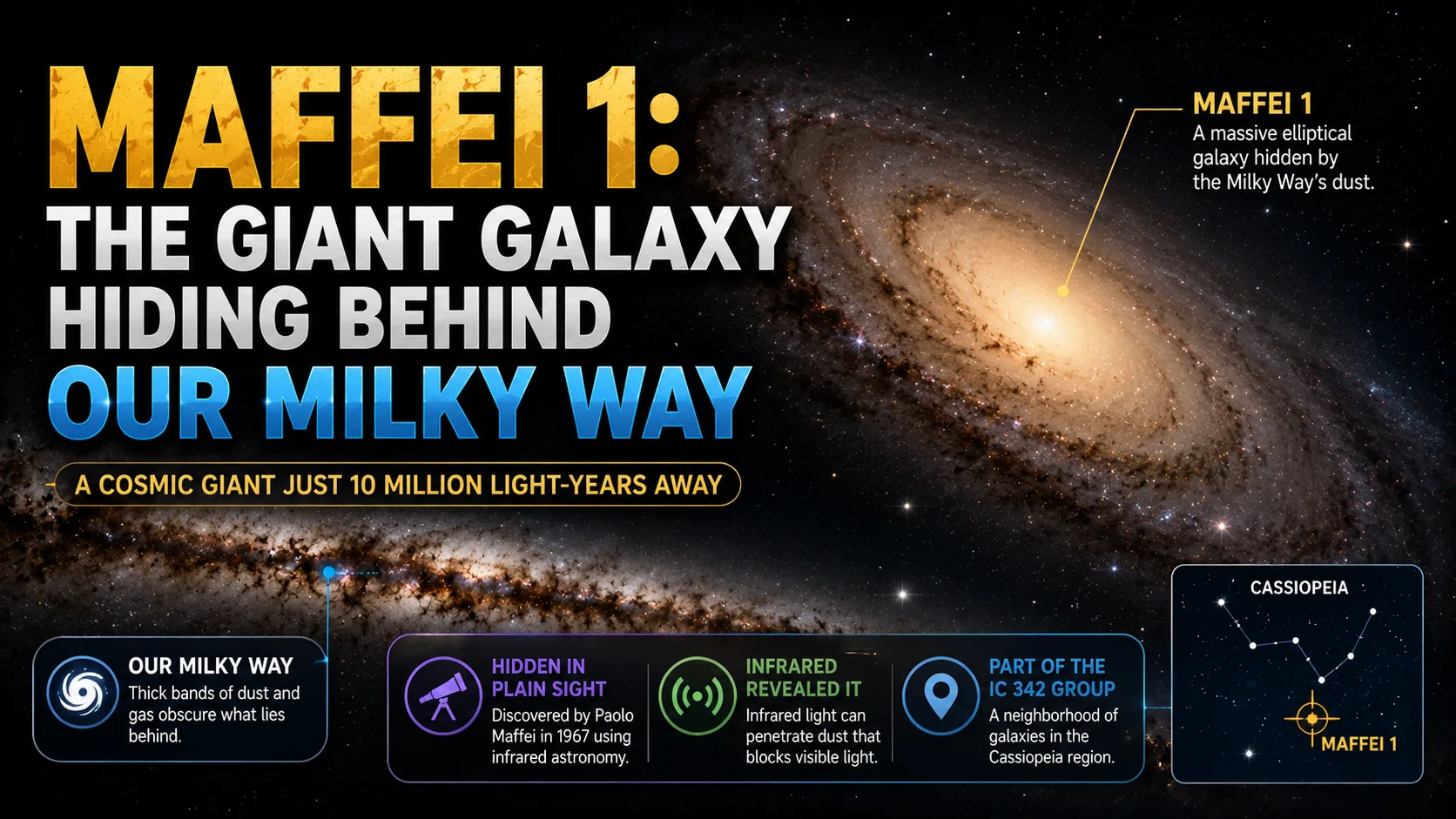
Maffei 1 is a giant elliptical galaxy located approximately 9.8 to 11 million light-years from Earth in the constellation Cassiopeia. Despite its enormous size and relative proximity, this cosmic behemoth was invisible to optical telescopes for centuries because it lies directly behind the dense plane of our own Milky Way galaxy.
The galaxy belongs to the IC 342/Maffei Group, which is one of the nearest galaxy groups to our Local Group. What makes Maffei 1 particularly fascinating is that it may be the closest giant elliptical galaxy to the Milky Way, yet we couldn't see it until modern infrared astronomy techniques were developed.
The Discovery That Changed Astronomy
In late 1967, Italian astronomer Paolo Maffei was studying photographic plates of the Heart Nebula (IC 1805) when he noticed something unusual. Using infrared-sensitive film, he detected two faint smudges that didn't correspond to any known objects. These turned out to be not just any galaxies, but two massive systems hidden behind thick curtains of interstellar dust.
This discovery was revolutionary because it demonstrated that more than 95% of Maffei 1's light was being absorbed by dust clouds in our own galaxy. In visible light, the galaxy is essentially invisible. It was only through infrared wavelengths—which can penetrate dust more effectively—that Maffei could reveal these hidden neighbors.
You can learn more about this groundbreaking discovery at Astronomy Magazine.
Physical Characteristics of Maffei 1
Size and Structure
Maffei 1 spans approximately 75,000 light-years across, making it slightly smaller than the Milky Way's diameter of over 100,000 light-years. However, what it lacks in size, it makes up for in mass and stellar density.
As an E3-type elliptical galaxy, Maffei 1 has a smooth, featureless appearance without the spiral arms or prominent dust lanes seen in galaxies like our own. Its stars are predominantly old, with ages around 10 billion years, suggesting that most of its star formation occurred early in the universe's history.
Distance and Location
The exact distance to Maffei 1 has been refined over the years through various measurement techniques. Current estimates place it at 2.9 to 3.4 megaparsecs (approximately 9.5 to 11 million light-years) from Earth. This places it well beyond our Local Group of galaxies but still relatively close in cosmic terms.
For perspective on cosmic distances and how astronomers measure them, check out our article on the Triangulum Galaxy (M33), another nearby galaxy that helps us understand our place in the local universe.
Stellar Population
Unlike spiral galaxies that continue forming new stars, Maffei 1's stellar population tells a different story. The galaxy contains mostly ancient red stars, with very little ongoing star formation. This is typical of massive elliptical galaxies, which tend to exhaust their gas reserves early and then evolve passively.
Recent observations have revealed that Maffei 1 contains a distinct red nucleus, which may indicate low-level nuclear activity or a unique central stellar population. The galaxy also hosts numerous globular clusters—dense spheres of ancient stars orbiting the galactic center.
Why Maffei 1 Remains Hidden
The Zone of Avoidance
Maffei 1 lies in what astronomers call the "Zone of Avoidance"—the region of the sky along the Milky Way's galactic plane where our view of the external universe is severely obscured. This area is filled with:
- Dense clouds of interstellar gas
- Thick layers of cosmic dust
- Billions of foreground stars from our own galaxy
These obstacles absorb and scatter visible light, making it nearly impossible to observe distant objects in this direction using traditional optical telescopes. The extinction (dimming) caused by this dust is estimated to be around 4.7 magnitudes in the visual band, meaning Maffei 1 appears roughly 100 times dimmer than it would without the intervening dust.
Infrared Astronomy to the Rescue
The key to discovering Maffei 1 was infrared astronomy. Infrared light has longer wavelengths than visible light, allowing it to pass through dust clouds with less absorption. Modern infrared telescopes and space observatories have since revealed many other hidden objects in the Zone of Avoidance.
To understand how different types of electromagnetic radiation help us explore the universe, you might find our article on black hole myths and facts interesting, as it discusses how we observe invisible cosmic phenomena.
Maffei 1 vs. Other Nearby Galaxies
Comparison with IC 342
Maffei 1 is often discussed alongside its companion, IC 342, which Paolo Maffei also discovered. However, these two galaxies are quite different:
- IC 342 is a large spiral galaxy similar to the Milky Way, with active star formation and visible spiral structure
- Maffei 1 is an elliptical galaxy dominated by old stars with minimal current star formation
Despite their differences, both galaxies are part of the same group and lie at similar distances from Earth.
Relationship to the Local Group
While the IC 342/Maffei Group is one of the nearest galaxy groups to us, it is not gravitationally bound to our Local Group. The Local Group includes the Milky Way, Andromeda (M31), Triangulum (M33), and dozens of smaller galaxies. The Maffei Group represents a separate collection of galaxies that happens to be nearby but is moving independently through space.
For readers interested in understanding how galaxies cluster together, our exploration of the Cosmic Trio of black holes in young galaxies provides insights into galactic interactions and evolution.
Observing Maffei 1 Today
Can You See It With a Telescope?
Unfortunately, even with powerful amateur telescopes, Maffei 1 remains extremely challenging to observe visually due to the heavy dust obscuration. However, advanced amateur astrophotographers using specialized infrared filters and long exposure times have successfully captured images of this elusive galaxy.
Professional observatories equipped with infrared detectors regularly study Maffei 1 to understand:
- The properties of heavily obscured galaxies
- The distribution of matter in the Zone of Avoidance
- The evolution of elliptical galaxies in the local universe
Future Studies
With the launch of next-generation space telescopes like the Nancy Grace Roman Space Telescope (scheduled for August 2026), astronomers will have even more powerful tools to study obscured regions of the sky. These instruments will likely discover many more hidden galaxies like Maffei 1, potentially revolutionizing our understanding of the local universe.
Why Maffei 1 Matters
The story of Maffei 1 teaches us several important lessons about astronomy and the universe:
What we can see is limited by our technology - For centuries, this massive galaxy was completely unknown simply because we lacked the right tools to detect it.
The universe is full of hidden structures - If one giant galaxy could remain hidden until 1967, how many other objects are still waiting to be discovered?
Multi-wavelength astronomy is essential - Different wavelengths of light reveal different aspects of the cosmos. Relying solely on visible light gives us an incomplete picture.
Proximity doesn't guarantee visibility - Even objects relatively close to us can remain hidden if they're positioned behind obstacles.
Conclusion
Maffei 1 stands as a testament to both the limitations and the triumphs of human observation. This giant elliptical galaxy, lurking just 10 million light-years away, reminds us that the universe still holds many secrets—even in our cosmic neighborhood. Thanks to Paolo Maffei's pioneering work with infrared photography in 1967, we now know that sometimes the most massive objects are the hardest to see.
As our technology continues to improve, who knows what other hidden giants await discovery behind the dusty veil of the Milky Way? The story of Maffei 1 encourages us to keep looking, keep questioning, and remember that the universe is always more surprising than we imagine.
Want to explore more about hidden cosmic objects? Check out our article on JWST's discovery of the "impossible" early galaxy Z14, which shows how modern telescopes continue to challenge our understanding of galaxy formation.