Are Teegarden's Star Planets Habitable? Meet b, c, and d
Teegarden's Star harbors three confirmed exoplanets—designated b, c, and d—with masses comparable to Earth orbiting near or within the host star's habitable zone.
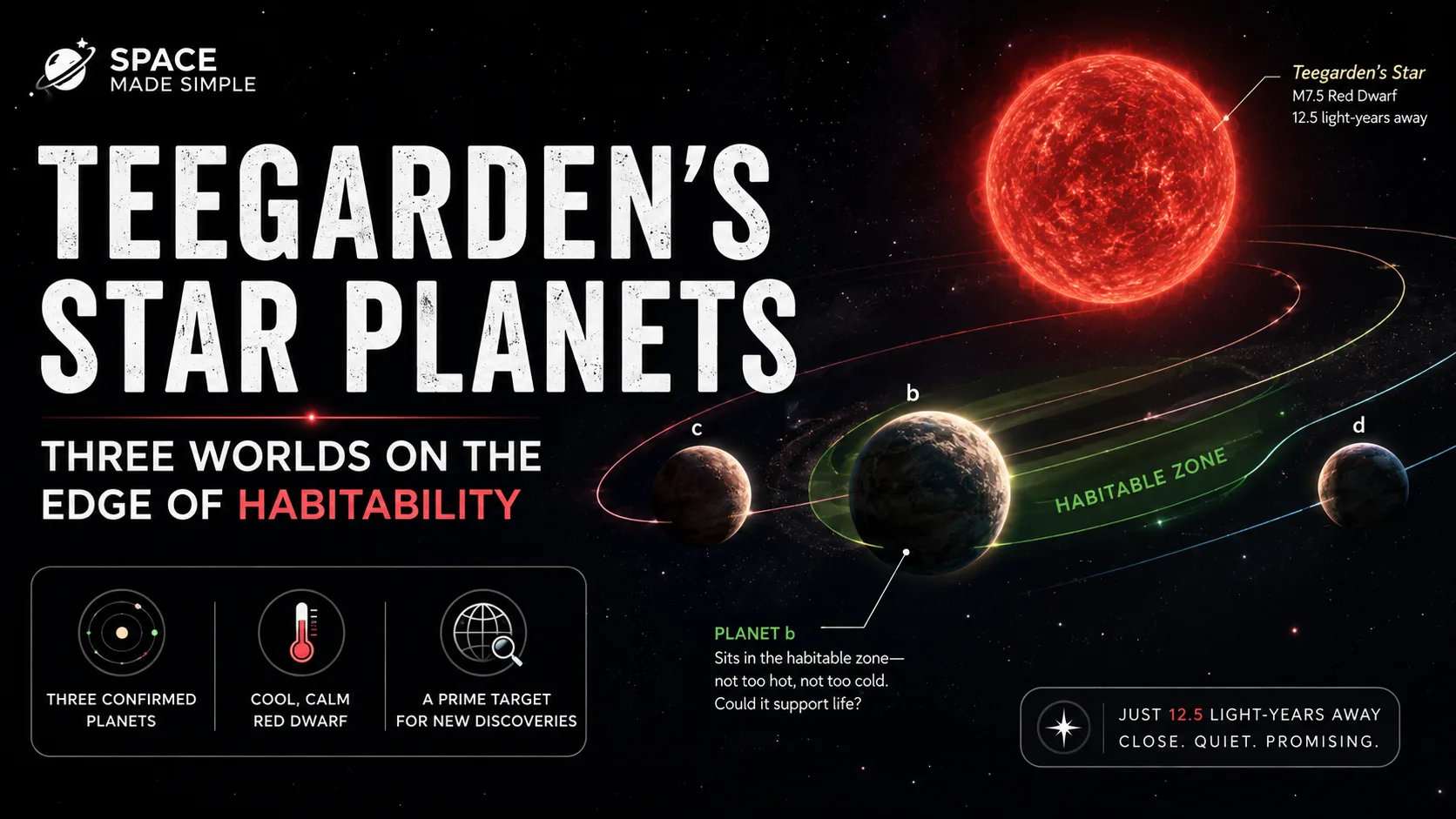
In our previous exploration of Teegarden’s Star as an ancient red dwarf, we established why this faint neighbor is such a compelling target. Now, it is time to meet its family. Unlike many red dwarf systems that host only one or two detectable worlds, Teegarden’s Star is now confirmed to harbor at least three planets. This compact system offers a rare glimpse into how Earth-mass bodies arrange themselves around the smallest and coolest stars.
The Trio: b, c, and d
For years, astronomers knew of two planets, b and c. However, a comprehensive 2024 study refined their orbits and revealed a third candidate, planet d, making this one of the most densely packed nearby planetary systems known. All three were detected using the radial velocity method, which measures the star's subtle wobble caused by planetary gravity rather than waiting for transits.
- Teegarden’s Star b: Orbits every 4.9 days with a minimum mass of ~1.16 Earth masses and a radius of ~1.02 Earth radii.
- Teegarden’s Star c: Orbits every 11.4 days, sitting comfortably in the outer habitable zone with similar Earth-like mass.
- Teegarden’s Star d: A newer addition with a longer orbital period, likely residing beyond the traditional habitable zone but crucial for understanding system dynamics.
Planet b: Walking the Thermal Tightrope
Teegarden’s Star b is the crown jewel of this system, but its habitability is nuanced. Recent climate simulations from 2025 show it receives about 1481 W/m² of stellar energy—just below the runaway greenhouse threshold of ~1565 W/m². This means liquid water could theoretically exist on its surface, but only if atmospheric conditions are just right.
Think of it as a planet perpetually on the verge of becoming too hot, much like Venus did early in its history. Its proximity to the inner edge of the habitable zone makes it an exceptional laboratory for testing climate models. If future observations confirm a stable atmosphere, it would be among the closest potentially habitable worlds to Earth. For deeper technical context on these thresholds, researchers have published detailed analyses on AAS Nova explaining the delicate balance.
Why Three Planets Matter
The presence of multiple Earth-mass planets in such tight orbits challenges formation theories. How did so much rocky material accumulate so close to a tiny star? Planet c and d provide gravitational stability that may help b maintain its orbit over billions of years. Their existence also suggests that small stars might be far more efficient at building terrestrial worlds than previously thought.
Unlike Proxima Centauri b, which faces intense stellar activity, the Teegarden system benefits from its host star's unusual calmness. This combination of multiple rocky planets and a quiet ancient star creates a unique opportunity. In the next installment, we will examine whether life could actually survive here and what upcoming telescopes hope to find in their atmospheres.
For real-time parameter updates, the Exoplanet.eu catalog remains an invaluable resource for tracking refinements to this fascinating system.