Teegarden's Star: Why This Calm Red Dwarf Could Host Life
Teegarden's Star is an 8-billion-year-old red dwarf located 12.5 light-years away with exceptionally low stellar flaring and high magnetic stability.
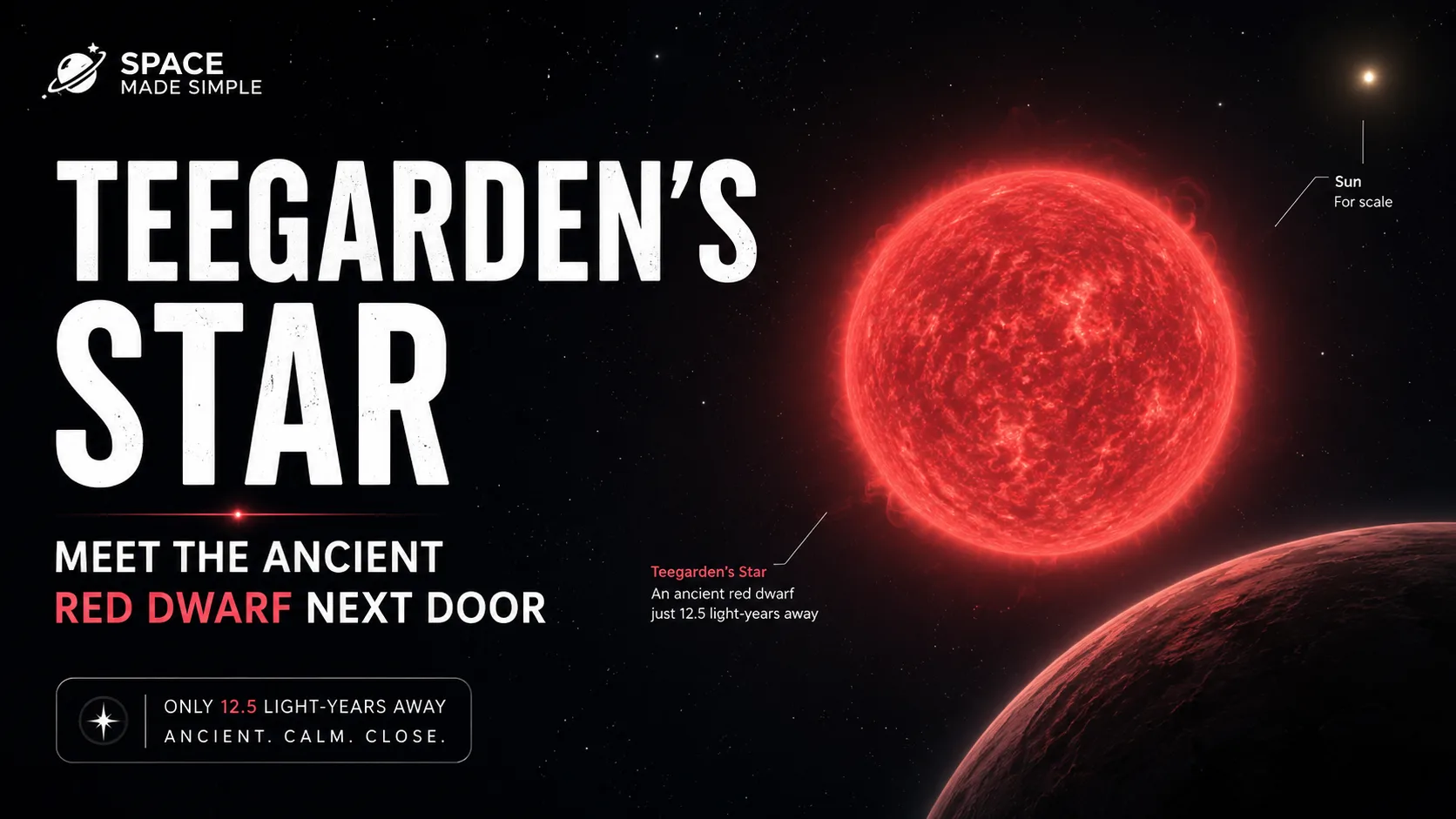
When we imagine nearby stars, bright beacons like Sirius or Alpha Centauri often come to mind. However, the universe is full of faint, hidden neighbors that are far more common and potentially more interesting for the search for life. One such neighbor is Teegarden’s Star, a tiny red dwarf located just 12.5 light-years from Earth. Despite its proximity, it was only discovered in 2003 because it is incredibly dim, shining with less than 0.1% of our Sun's luminosity.
Why This Tiny Star Matters
Teegarden’s Star is classified as an M-type red dwarf, the most abundant type of star in the Milky Way. What makes this particular star special is not just its closeness, but its age and temperament. While many red dwarfs are notoriously active, blasting their planets with violent flares, Teegarden’s Star is remarkably calm. Studies indicate it has relatively low magnetic activity compared to other late-M dwarfs, which significantly enhances its potential as a host for habitable worlds.
This stability is crucial because high-energy radiation can strip away planetary atmospheres over time. A quiet star means any orbiting planet has a much better chance of retaining the conditions necessary for liquid water.
An Ancient Cosmic Relic
Unlike our middle-aged Sun, Teegarden’s Star is a senior citizen of the galaxy. Estimates suggest it is at least 8 billion years old, making it nearly twice as ancient as our solar system. Its low metallicity further supports this advanced age, indicating it formed when the universe had fewer heavy elements.
This longevity provides a massive window of opportunity for biological evolution. If life exists there, it has had billions of years to emerge and adapt. For context, while Tau Ceti offers a sun-like comparison point, Teegarden represents the far more common "long-lived ember" archetype that dominates our galactic neighborhood.
Hidden in Plain Sight
You might wonder why such a close neighbor wasn't found sooner. The answer lies in its extreme faintness. With an apparent magnitude of 15.4, it is completely invisible to the naked eye and requires a decent telescope to spot even as a speck of light. It was identified through its high proper motion—moving about 5 arcseconds per year across the sky—which flagged it as a nearby object during data mining of older astronomical surveys.
Today, Teegarden’s Star stands as one of the most promising targets for next-generation observatories. Its combination of proximity, ancient stability, and confirmed planetary system makes it a cornerstone for understanding how common Earth-like environments truly are. In the next part of this series, we will dive deep into the planets themselves and explore what makes their orbits so intriguing.
For those interested in the technical details of how astronomers characterize these faint hosts, the NASA Exoplanet Archive provides comprehensive parameter tables. Additionally, recent climate modeling discussed on Astrobites highlights why this specific star remains at the forefront of habitability research.