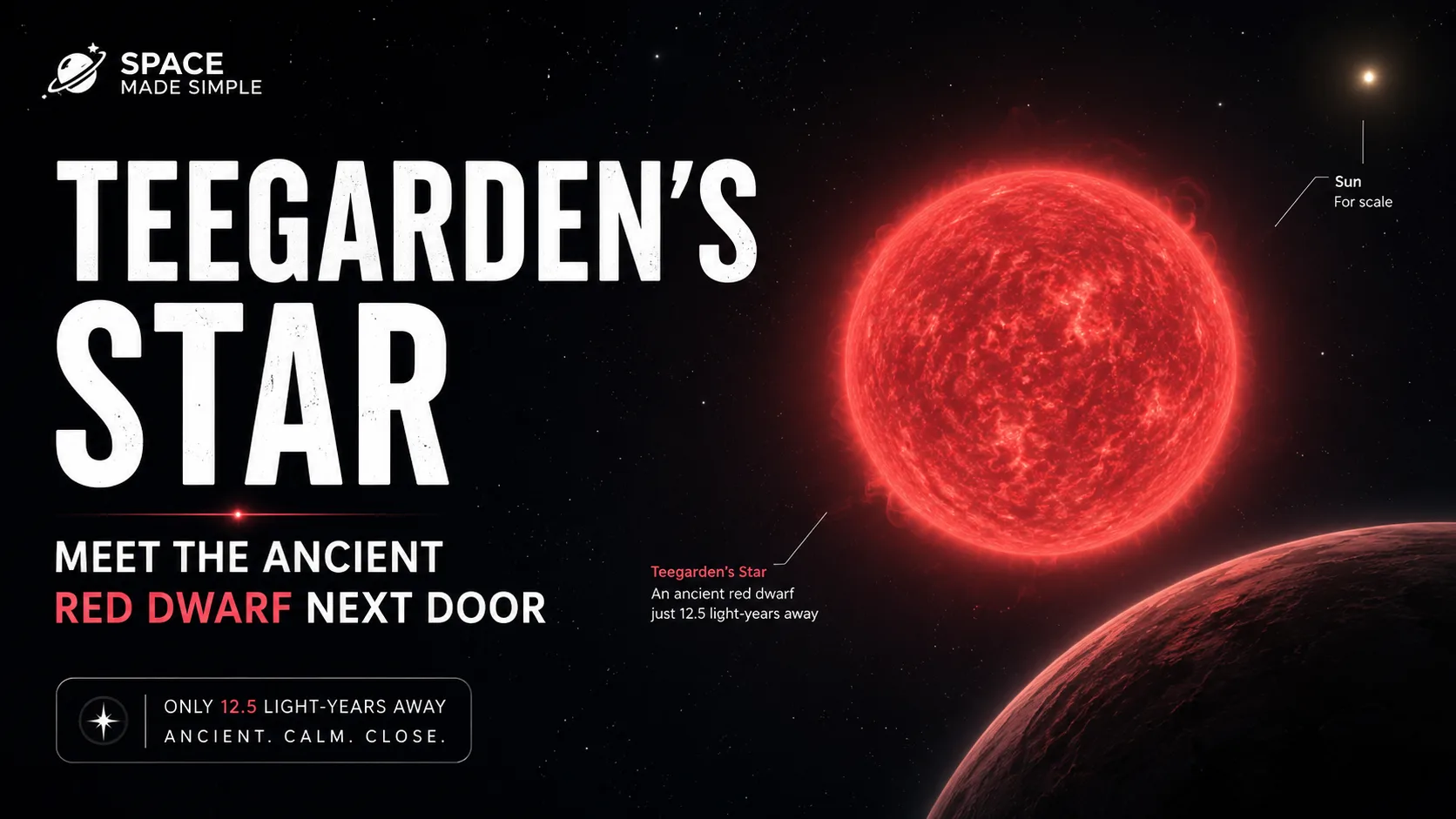
Can Teegarden's Star b Retain an Atmosphere for Life?
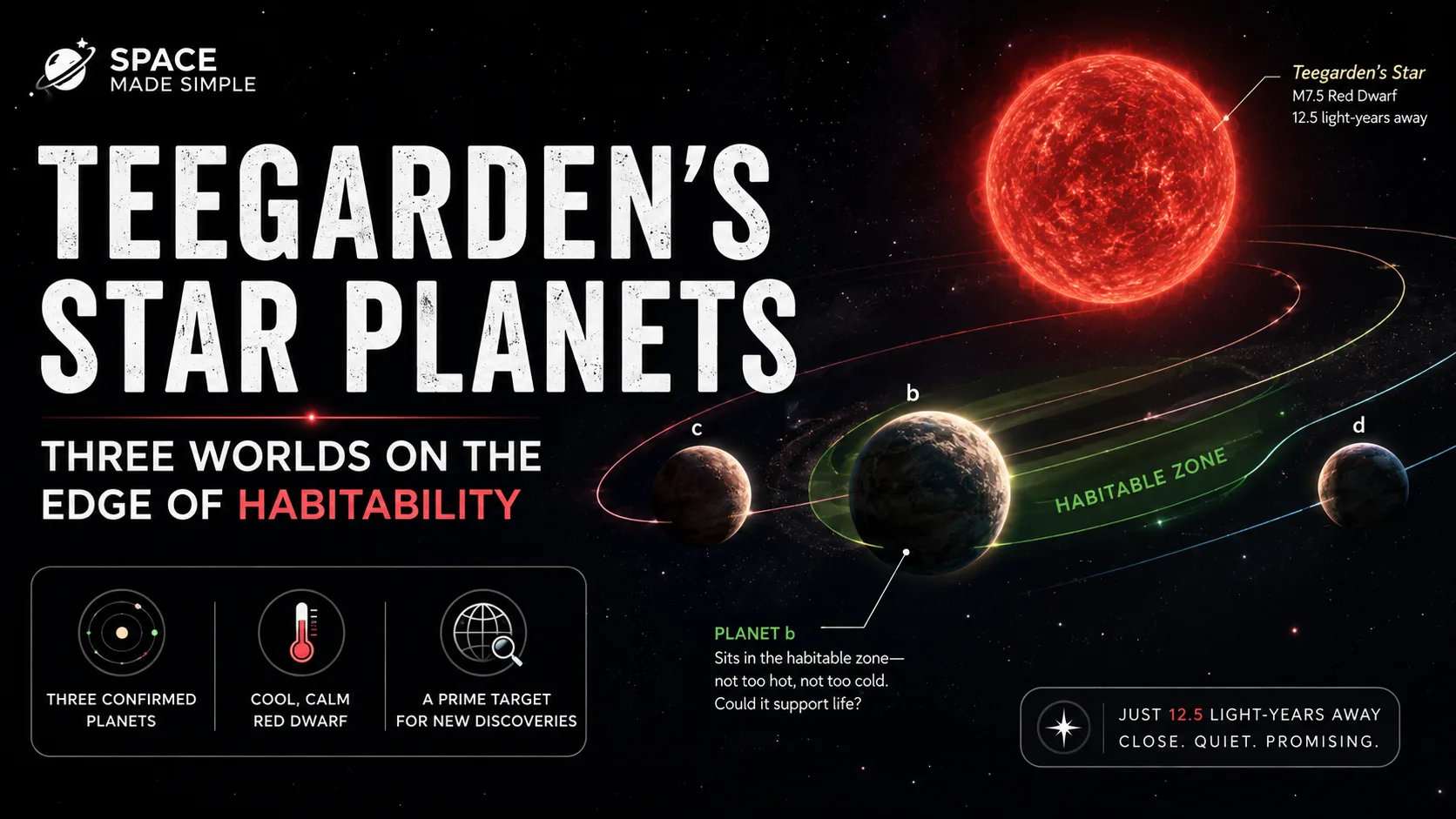
Teegarden's Star b is an Earth-mass exoplanet orbiting within the conservative habitable zone of its ultra-cool dwarf host star.
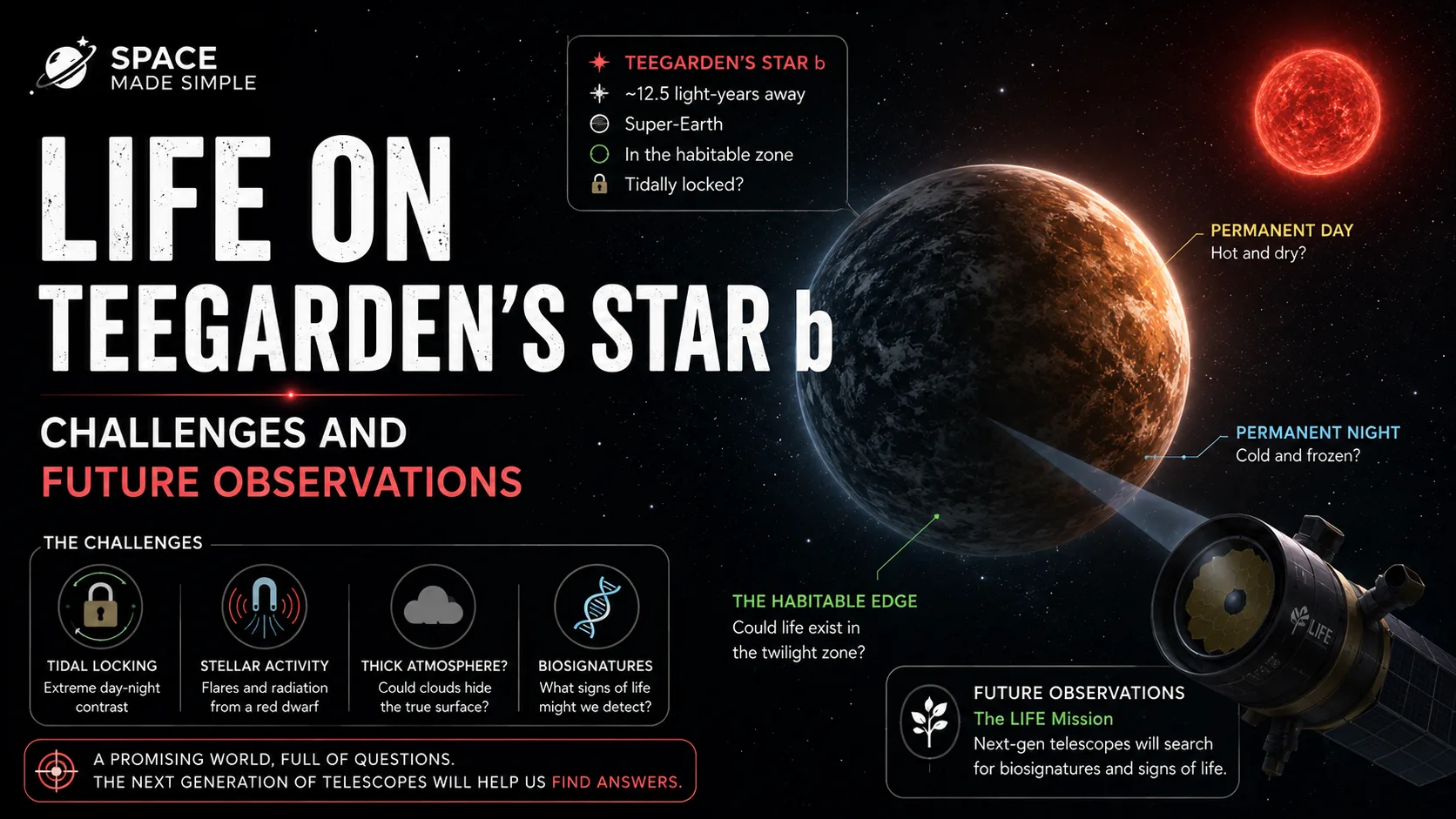
We have met the ancient host star and explored its trio of planets. Now comes the ultimate question: could anything actually live there? While Teegarden’s Star offers remarkable stability and its planets sit in the habitable zone, the reality of surface habitability is far more complex than orbital position alone. Teegarden’s Star b exists in a delicate balance between promise and peril.
The Tidal Locking Dilemma
With an orbital period of just 4.9 days, Teegarden’s Star b is almost certainly tidally locked. This means one hemisphere faces perpetual daylight while the other endures eternal night. Such extreme conditions create stark temperature gradients that could collapse atmospheres or freeze out volatiles on the dark side.
However, climate models suggest that if the planet retains a sufficiently dense atmosphere or global ocean, heat redistribution could prevent total atmospheric collapse. The dayside might remain temperate enough for liquid water, while the nightside acts as a cold trap. This "eyeball Earth" scenario is theoretically viable but demands precise atmospheric pressure and composition—conditions we cannot yet confirm.
Atmosphere Retention: The 3% Problem
Despite the host star's unusual calmness, studies estimate only a ~60% chance of surface liquid water and a mere ~3% probability that Teegarden’s Star b still possesses a substantial atmosphere. Billions of years of cumulative UV and X-ray exposure, even from a quiet M-dwarf, may have stripped away primordial gases and oceans. Without an atmosphere, the planet would be a barren rock regardless of its orbital position.
This uncertainty makes direct observation essential. Unlike transiting planets where starlight filters through atmospheres during eclipses, Teegarden’s planets do not transit from our viewpoint. Traditional transmission spectroscopy is impossible here, requiring entirely new observational strategies.
Next-Generation Eyes: LIFE and HWO
The future of characterizing non-transiting worlds lies in interferometry and advanced coronagraphy. The proposed LIFE (Large Interferometer For Exoplanets) mission has been shown in 2025-2026 simulations to realistically disentangle thermal emission from different hemispheres of Teegarden b, potentially mapping temperature contrasts and detecting molecular signatures like CO2 or O3 without needing a transit.
Simultaneously, NASA’s upcoming Habitable Worlds Observatory (HWO) aims to directly image and spectrally characterize Earth-like exoplanets using next-generation coronagraphs. As detailed by researchers on Astrobiology.com, these instruments represent our first realistic chance to test whether Teegarden b’s theoretical habitability translates to observable biosignatures.
Why This System Still Matters
Even if Teegarden’s Star b proves uninhabitable, it remains invaluable. It teaches us where the boundaries lie for life around red dwarfs—the most common stars in our galaxy. Every null result refines our search criteria; every detection transforms our understanding.
For now, Teegarden’s Star stands as both a cautionary tale and a beacon of hope. Its ancient calm invites optimism, while its planetary challenges demand rigor. As telescopes like LIFE and HWO come online in the coming decades, this nearby system will likely be among the first places humanity looks for answers to whether we are alone. For ongoing updates on mission development, the Habitable Worlds Observatory science page provides the latest roadmap for characterizing worlds like these.