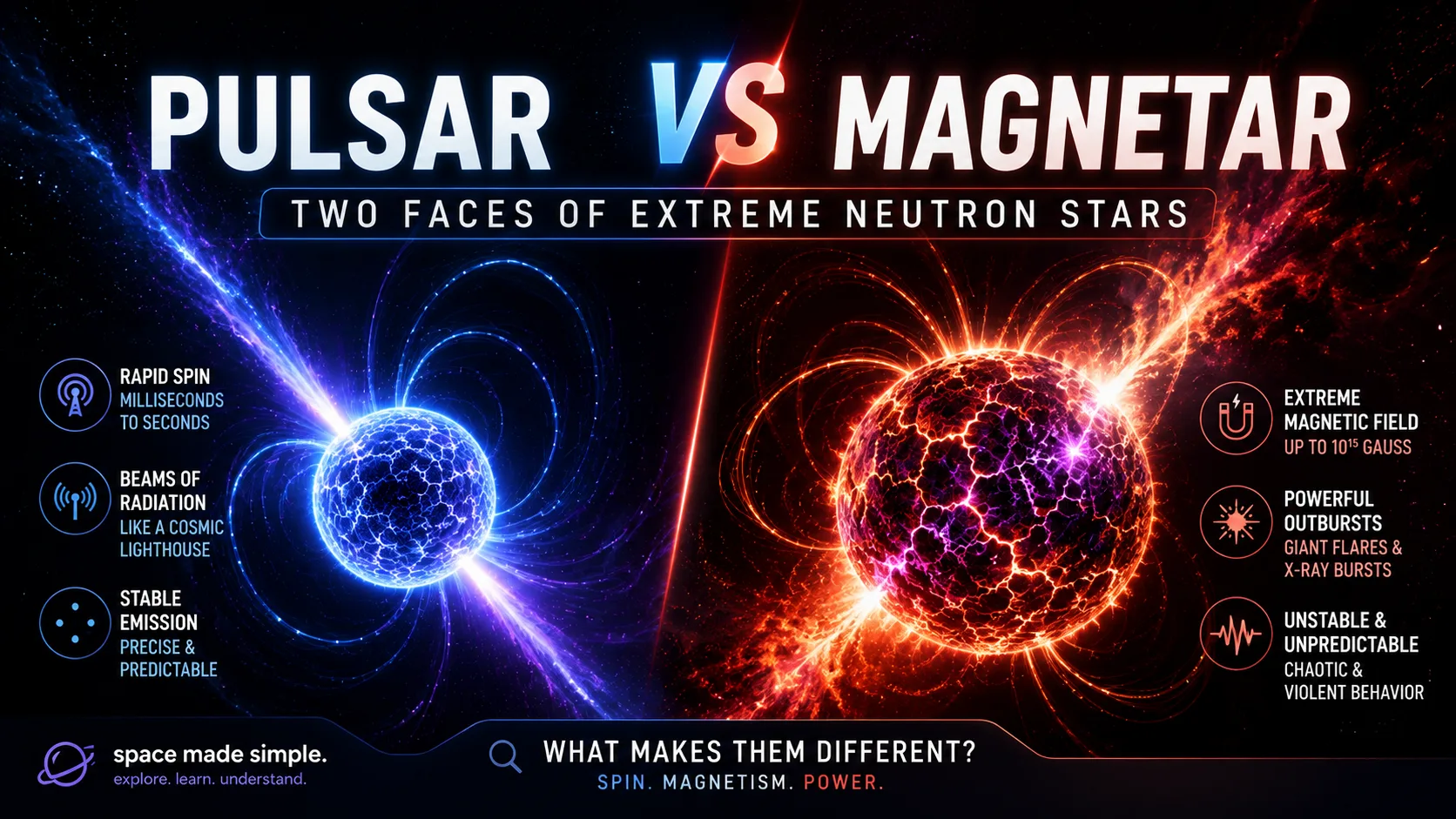
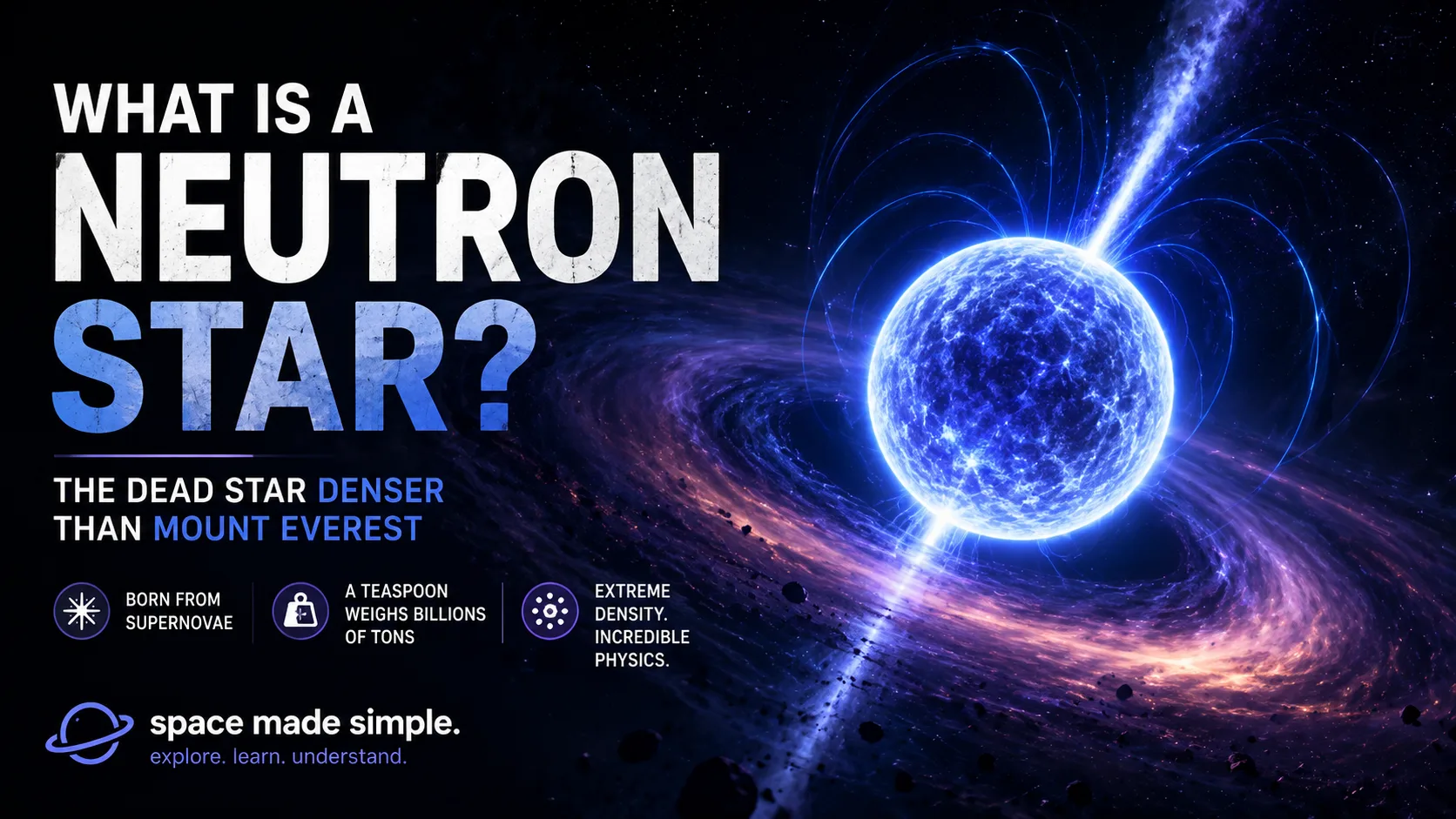
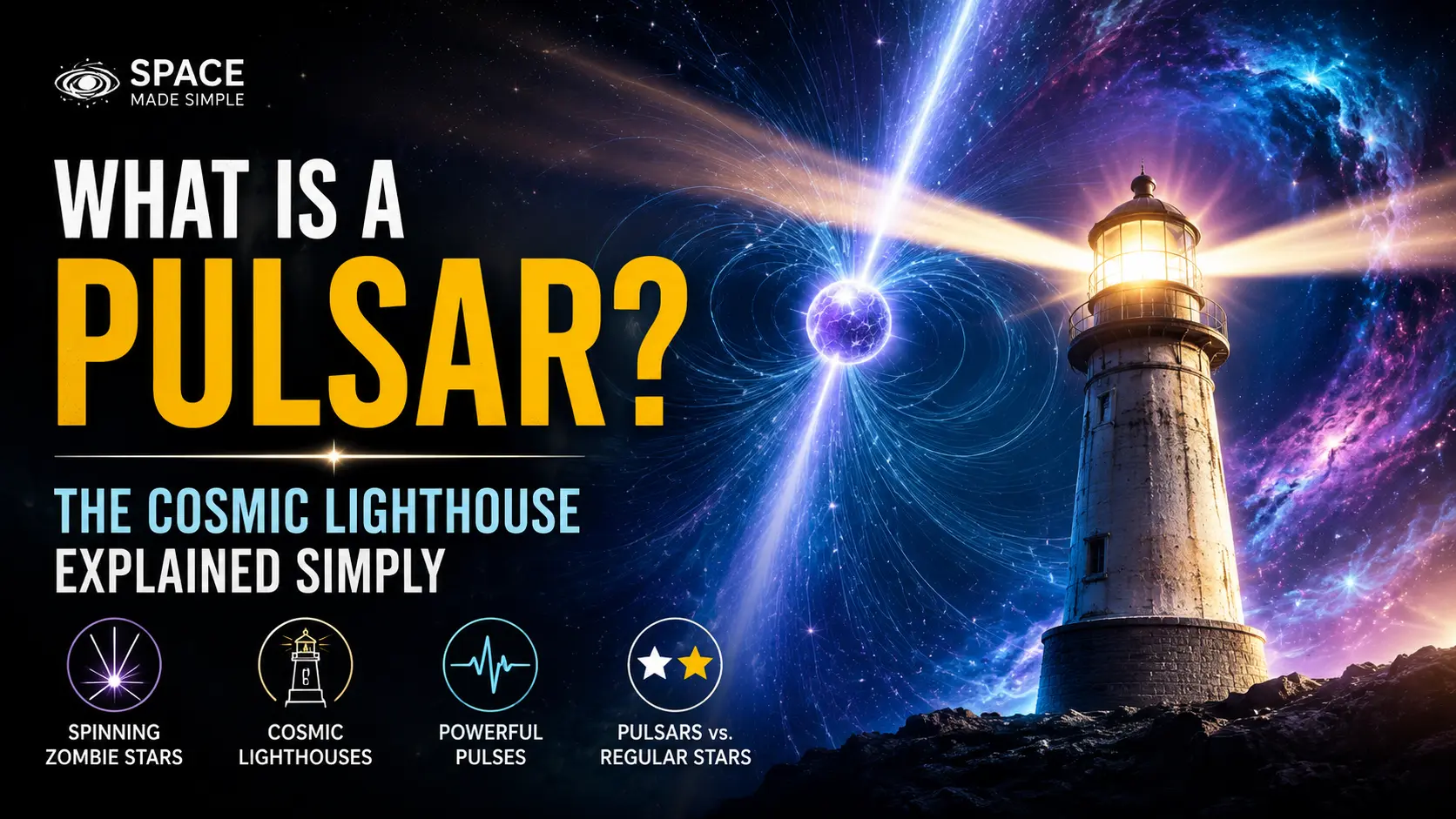
Kilonova Explained: How Neutron Star Collisions Forge Gold
A kilonova is an explosive event roughly 1,000 times brighter than a classical nova but far less energetic than a supernova.
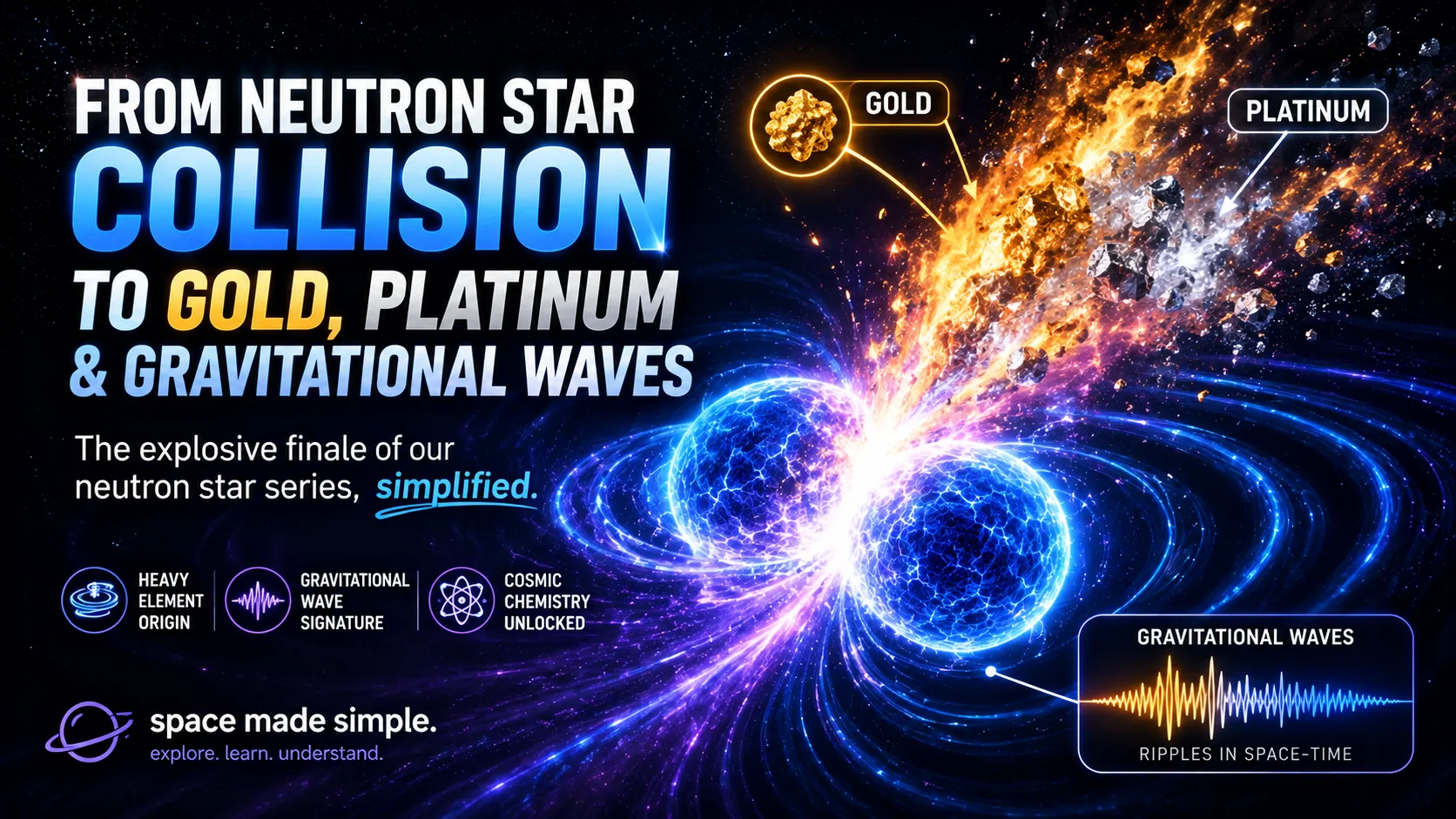
The gold in your jewelry was not forged on Earth. It was created in a cataclysmic collision between two dead stars billions of years ago. After exploring what neutron stars are and their extreme behaviors as pulsars and magnetars, we arrive at the most spectacular chapter of their story: what happens when two of them collide. This is not just an explosion; it is the universe’s own alchemy factory.
What Is a Kilonova?
A kilonova is an explosive event roughly 1,000 times brighter than a classical nova but far less energetic than a supernova. It occurs when two neutron stars spiral inward and merge, ejecting a cloud of neutron-rich material into space. Within this expanding debris, rapid neutron capture—known as the r-process—builds heavy atomic nuclei in seconds. Gold, platinum, uranium, and other elements heavier than iron are synthesized in quantities that dwarf all other known cosmic sources.
In a landmark achievement, astronomers recently witnessed atoms being formed in real time within a kilonova for the first time. The aftermath of the collision resembled conditions in the early universe, providing direct observational proof that these events are indeed the primary source of heavy elements witnessing atom formation in kilonova. This transforms kilonovae from theoretical models into observed cosmic foundries.
The Unexpected Collision Site
Until recently, scientists assumed neutron star mergers occurred primarily in typical galaxies with active star formation. That assumption was shattered in July 2026 when NASA’s Chandra X-ray Observatory identified a kilonova in a tiny, obscure galaxy embedded within a vast stream of intergalactic gas neutron star crash in unexpected site. This location was completely unanticipated by existing models.
The discovery implies that kilonovae can occur in environments far more diverse than previously thought. Neutron star binaries may be ejected from their birth galaxies or form in low-density regions, meaning future surveys must look beyond conventional targets to capture the full population of these element-forging events.
Gravitational Waves: Hearing the Universe
When two neutron stars merge, they do not just emit light; they ripple spacetime itself. These gravitational waves carry unique information about the masses, spins, and internal structure of the colliding stars. The historic GW170817 event in 2017 marked the first time astronomers detected both gravitational waves and electromagnetic radiation from the same source, launching the era of multi-messenger astronomy.
Looking ahead, predicting where and how often these signals occur is critical. A December 2025 study from Carnegie Mellon University estimated the detection odds for black hole–neutron star mergers, helping optimize search strategies for next-generation observatories kilonova prediction study. Each detection refines our understanding of stellar evolution and confirms that the extreme physics discussed throughout this series has tangible, observable consequences.
Why This Series Matters
Over three articles, we have journeyed from the violent birth of neutron stars through their bizarre lives as pulsars and magnetars, culminating in their explosive deaths as kilonovae. These objects are not merely curiosities; they are essential to our existence. Without neutron star collisions, the universe would lack gold, platinum, iodine, and many other elements necessary for planets and life as we know it.
If this series sparked your curiosity about stellar extremes, continue exploring with our guide on how stars die or debunk common misconceptions in black hole myths. The cosmos is stranger and more interconnected than it appears, and neutron stars are among its most eloquent storytellers.