Pulsar vs Magnetar: Two Faces of Extreme Neutron Stars Explained
What is the difference between a pulsar and a magnetar? Learn how these extreme neutron stars spin, shine, and wield universe-breaking magnetic fields.
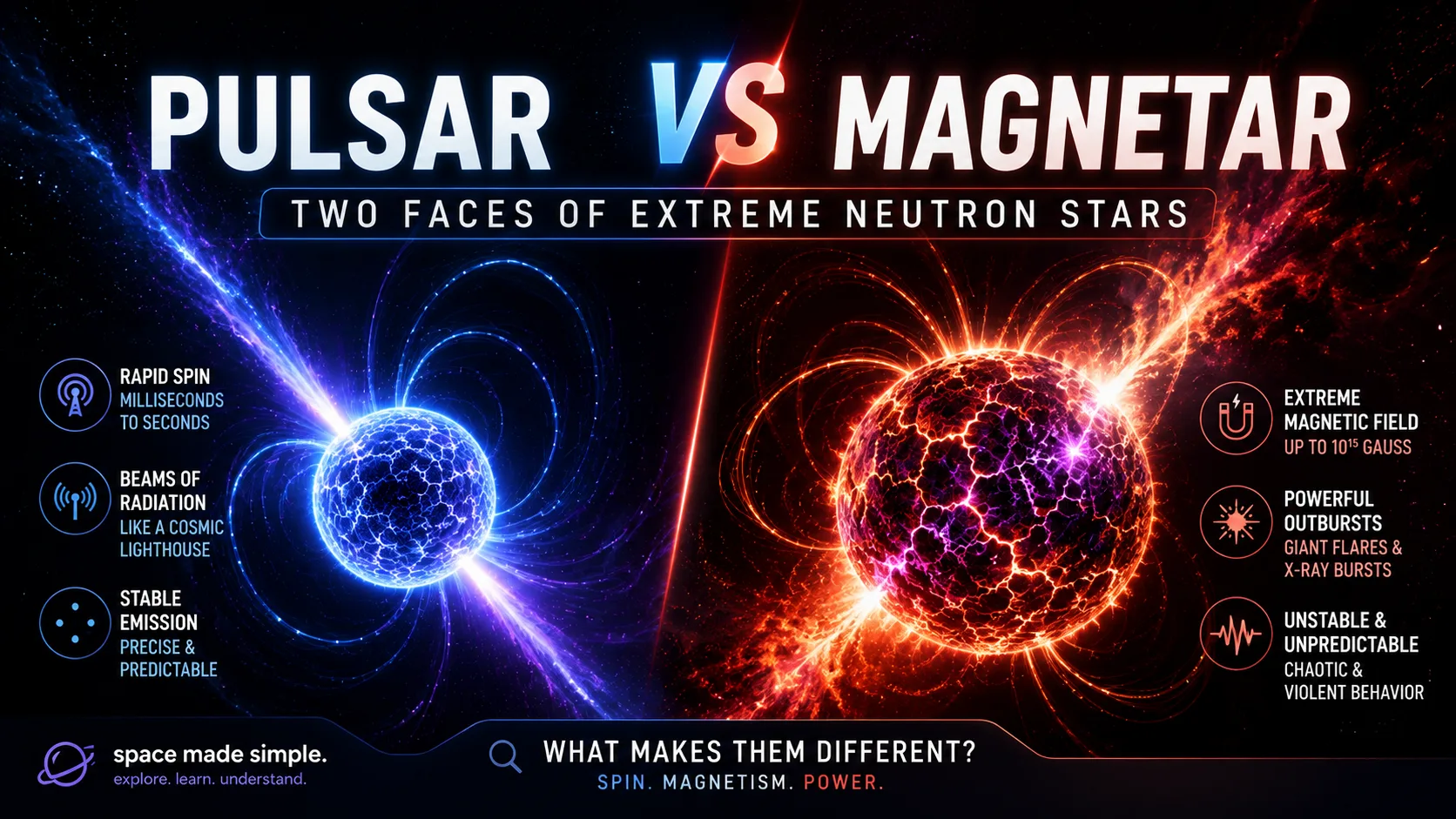
All pulsars and magnetars are neutron stars, but not all neutron stars are pulsars or magnetars. Think of them as two siblings with wildly different personalities: one is a precise cosmic clockkeeper, while the other is a chaotic magnetic storm. After understanding what a neutron star is in our previous article, it is time to explore why these stellar remnants behave so differently despite sharing the same origin.
Pulsars: Cosmic Lighthouses with Perfect Timing
Pulsars are rotating neutron stars that emit beams of electromagnetic radiation from their magnetic poles. As the star spins, these beams sweep across space like a lighthouse. When Earth lies in the path of this beam, we detect regular pulses of radio waves, X-rays, or gamma rays. The timing of these pulses is astonishingly stable; some millisecond pulsars rival atomic clocks in precision. For a deeper dive into this mechanism, our guide on what is a pulsar covers the fundamentals.
Recent observations have added new layers to our understanding. Astronomers using NASA data captured an unprecedented view of a neutron star’s environment, revealing a dual-peaked iron emission line near a pulsar for the first time. This feature provides direct clues about the extreme physics occurring just above the star’s surface Wayne State neutron star observation. Meanwhile, millisecond pulsars represent another fascinating subset, having been spun up to incredible speeds by stealing matter from companion stars.
Magnetars: Monsters of Magnetic Fury
If pulsars are defined by rotation, magnetars are ruled by magnetism. Their magnetic fields are roughly 1,000 times stronger than those of typical pulsars and trillions of times stronger than Earth’s. At this intensity, the magnetic field alone can distort atoms into thin needles and trigger violent "starquakes" on the crust, releasing bursts of soft gamma rays and X-rays.
A groundbreaking discovery in 2025 challenged long-held assumptions about magnetar formation. Astronomers identified a young magnetar moving significantly slower than expected, suggesting it belongs to a previously unrecognized breed with a distinct birth mechanism slow-moving magnetar discovery. This finding implies that not all magnetars are born from the same type of supernova, adding complexity to our models of stellar death. Unlike pulsars whose energy comes from rotational slowdown, magnetars are powered primarily by the decay of their immense magnetic fields.
Key Differences at a Glance
| Feature | Pulsar | Magnetar |
|---|---|---|
| Primary Energy Source | Rotational kinetic energy | Magnetic field decay |
| Magnetic Field Strength | 10⁸ – 10¹² Gauss | 10¹⁴ – 10¹⁵ Gauss |
| Pulse Regularity | Extremely stable | Irregular, burst-dominated |
| Active Lifetime | Millions of years | ~10,000 years |
| Notable Behavior | Precision timing, glitches | Starquakes, giant flares |
It is worth noting that pulsars are not always perfectly stable. Phenomena like pulsar glitches and nulling reveal sudden changes in rotation or temporary cessation of pulses, hinting at complex internal dynamics that sometimes blur the line between pulsar and magnetar behavior.
The Blurred Line and Future Discoveries
The boundary between pulsars and magnetars is not always sharp. Some objects exhibit transitional behavior, switching between rotation-powered pulsar states and magnetar-like bursting episodes. These hybrid sources suggest that magnetic field strength and rotational energy exist on a continuum rather than in separate categories.
Current research continues to uncover new populations at both extremes. A comprehensive review of extreme objects highlights how discoveries of slow magnetars, intermittent pulsars, and high-field rotators are reshaping classification schemes extreme objects roundup. Understanding these differences is crucial because they set the stage for the most energetic events in the universe. In the final part of this series, we will explore what happens when two neutron stars collide, forging gold and rewriting cosmic history through kilonovae.