How Diamond Rain Forms on Ice Giants Neptune and Uranus
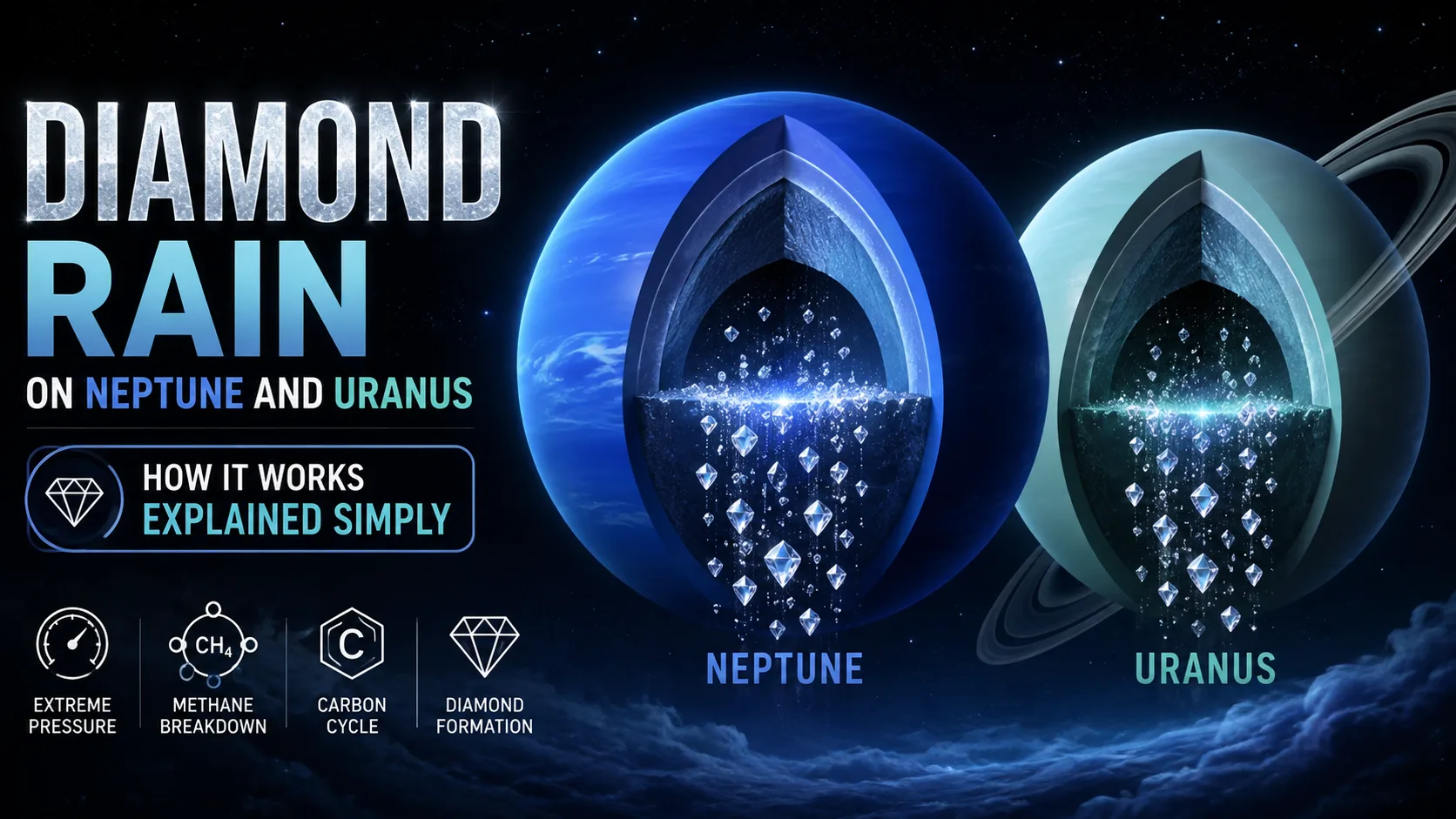
High temperatures and extreme pressures thousands of kilometers inside Neptune and Uranus break apart methane molecules, causing carbon atoms to compress into diamond crystals that sink toward the core.
When we think of rain, we imagine water droplets falling from clouds. But in the outer reaches of our solar system, weather takes on a much more extravagant form. On the ice giants Neptune and Uranus, scientists believe it literally rains diamonds. This is not science fiction; it is a fascinating consequence of extreme planetary physics that researchers are now able to recreate in laboratories on Earth.
Why Ice Giants Are Different
Neptune and Uranus are classified as "ice giants," distinct from gas giants like Jupiter and Saturn. While they do have thick atmospheres of hydrogen and helium, their interiors are dominated by heavier elements like water, ammonia, and methane. Methane (CH4) is particularly important here because it contains carbon, the essential building block of diamonds.
As you travel deeper into these planets, the temperature and pressure increase dramatically. Thousands of miles beneath the visible cloud tops, conditions become so intense that molecular bonds are ripped apart. This is where the magic happens.
The Diamond Formation Process
The process of diamond rain can be broken down into three simple stages:
- Methane Breakdown: Extreme heat and pressure break methane molecules apart, separating carbon atoms from hydrogen.
- Carbon Compression: The freed carbon atoms are squeezed together with tremendous force, arranging themselves into crystalline diamond structures.
- Diamond Precipitation: These solid diamonds are denser than the surrounding fluid mantle, causing them to sink slowly toward the planet's core like heavy raindrops.
Recent experiments at SLAC National Accelerator Laboratory have shown that this process might occur at shallower depths than previously thought. Researchers used high-powered lasers to simulate the interior conditions of ice giants and observed nanodiamonds forming in real time. They also discovered that oxygen, which is abundant in these planets, actually boosts diamond formation rather than hindering it.
A Cycle of Sinking and Rising
Diamond rain on ice giants is not a one-way trip. According to models published by Space.com, diamonds sink through the mantle until they reach regions where temperatures become too extreme. At that point, they vaporize back into carbon-rich gas, float upward, and eventually re-condense into diamonds again. This creates a continuous recycling loop that could last for millions of years.
Some estimates suggest that over time, these diamonds could grow to enormous sizes, potentially reaching millions of carats. However, before you start planning an interplanetary mining mission, remember that retrieving them is currently impossible. The pressures required to keep these diamonds stable would destroy any spacecraft long before it reached the diamond-forming zone.
Carbon Abundance in Perspective
It is worth noting that while diamonds seem precious to us, carbon is actually one of the most common elements in the universe. In fact, organic materials we consider rare on Earth are surprisingly abundant in space. As explained in our article on why wood is rarer than diamonds in the universe, true rarity in space depends on specific chemical conditions, not just elemental abundance. Diamond rain is simply what happens when abundant carbon meets extraordinary pressure.
What Diamond Rain Tells Us About Planets
Understanding diamond rain is not just about exotic weather. It helps scientists explain why Uranus and Neptune have such unusual magnetic fields. Unlike Earth, whose magnetic field is generated by molten iron in its core, ice giant magnetism may be driven by electrically conductive layers of diamond-rich slush in their mantles. Research highlighted by NASA's Gravity Assist podcast suggests that diamond precipitation plays a direct role in shaping these mysterious magnetic environments.
Diamond rain reminds us that the universe operates under rules far stranger than anything we experience on Earth. By studying these distant worlds, we gain a deeper appreciation for the incredible diversity of planetary systems across our galaxy.