Why Wood Is Rarer Than Diamonds in the Universe
Discover why a simple piece of wood is one of the rarest materials in the cosmos, far exceeding diamonds in scarcity due to its biological origins.
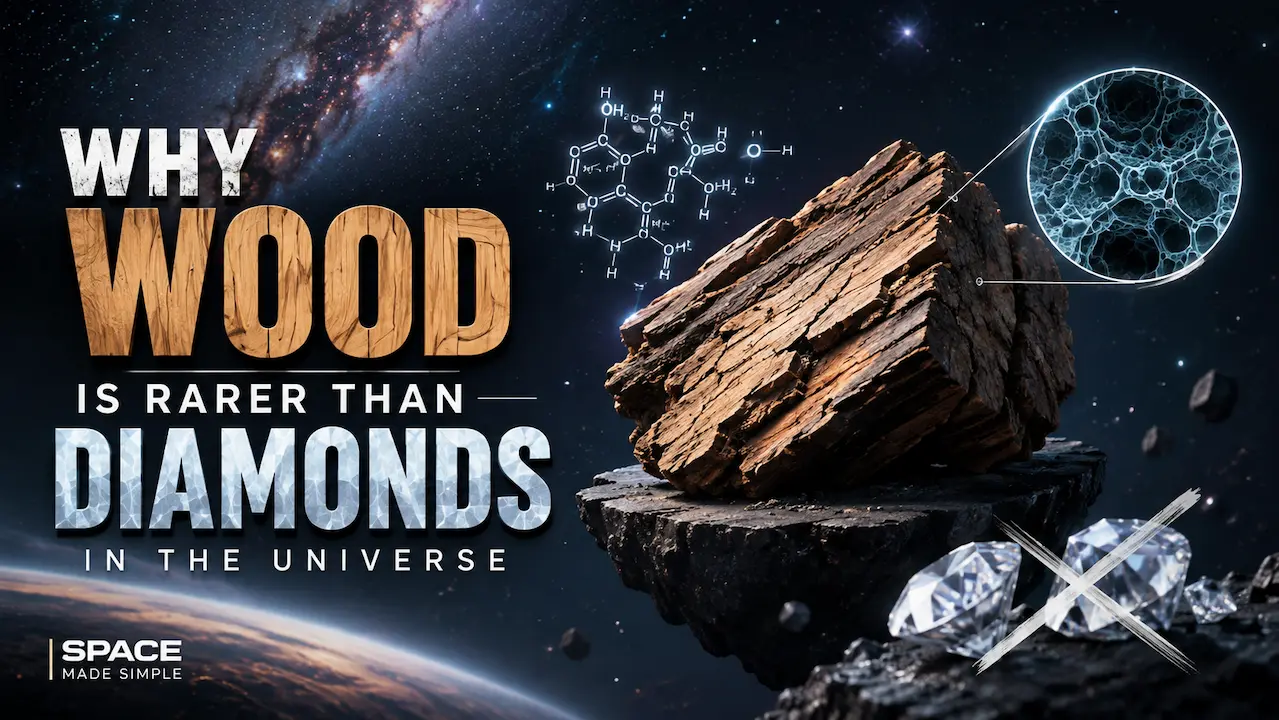
When we think of rare materials, our minds often jump to glittering diamonds, shiny gold, or exotic metals from distant asteroids. On Earth, these substances are valuable because they are hard to find. However, if you zoom out to the scale of the entire cosmos, the hierarchy of rarity flips completely. A simple wooden stick found in your backyard is likely one of the rarest objects in existence.
While diamonds are scattered across dead stars and giant planets, wood requires something far more precious and elusive: active, complex life. Here is why this everyday material is actually a cosmic miracle.
Carbon Is Common, But Wood Is Not
It is true that carbon is one of the most abundant elements in the universe. It forms inside aging stars and gets blasted into space when they die. Because carbon loves to bond with other elements, astronomers have found many complex organic molecules floating in interstellar clouds. According to research published in Quanta Magazine, the cosmos actually teems with prebiotic organic compounds that serve as building blocks for life.
However, finding raw carbon ingredients is very different from finding a finished wooden table. Wood is not just carbon; it is a highly organized structure made of cellulose and lignin. These complex biopolymers do not form through random chemical reactions in cold space. They require the precise biological machinery of living plants to assemble them. Without biology, carbon remains dust, gas, or diamond, but never wood.
The Impossible Recipe for Timber
To create even a single twig, the universe must align dozens of improbable factors. This concept ties closely to the Rare Earth hypothesis, which suggests that while simple chemistry is everywhere, complex biospheres are exceptionally uncommon. As explained by researchers studying planetary habitability at Astronomy.com, the emergence of complex life depends on a perfect storm of stable orbits, plate tectonics, liquid water, and moderate temperatures over billions of years.
Wood specifically demands even more than just basic microbes. It requires vascular plants that evolved structural support to grow upward against gravity. This evolutionary leap took hundreds of millions of years after life first appeared on Earth. In the vast majority of the universe, conditions never stabilize long enough for such complexity to arise. Therefore, wood represents a level of organization that may be unique to our tiny blue dot.
Diamonds Are Cheap, Biology Is Expensive
In space, diamonds are essentially industrial byproducts. They form naturally in the cooling atmospheres of carbon-rich stars, inside the crushing mantles of ice giants like Neptune, and in the debris of ancient supernovae. They are durable, simple crystals that survive extreme violence.
Wood, conversely, is fragile and temporary. It rots, burns, and decays. Its existence proves that a planet currently hosts a thriving ecosystem capable of sustaining itself. While we have detected diamond rain on exoplanets and found gemstones in meteorites, we have zero evidence of lignin or cellulose anywhere else. Until we discover a forest on another world, wood remains rarer than any jewel, serving as the ultimate signature of life in an otherwise sterile void. For deeper insights into how scientists distinguish biological signatures from abiotic chemistry, resources from NASA's Solar System Exploration provide excellent context on the search for organic matter beyond Earth.
Conclusion
Next time you hold a piece of wood, remember that you are touching a material more exclusive than platinum or diamond. Its rarity does not come from geological scarcity, but from the miraculous chain of events required to produce it. In the grand silence of space, wood is not just a building material; it is proof that somewhere, against all odds, the universe woke up and started growing.